


Document reveals approval to harvest remnant old-growth in B.C.’s northwest
By Canadian Press on December 7, 2025.
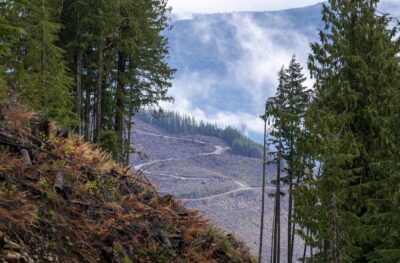
British Columbia’s logging agency has changed a policy that conserved remnant old-growth forest in the province’s northwest, with a government briefing note showing a plan to open those areas for harvesting has been approved.
The note, obtained by The Canadian Press and written by a BC Timber Sales manager in the Babine region, acknowledged the shift “may invoke scrutiny” from conservationist environmental groups.
It says First Nations in the Bulkley, Morice and Lakes timber supply areas do not support old-growth logging deferrals recommended by a provincially appointed panel in 2021, and continuing to conserve remnant stands “does not demonstrate respect of the First Nations’ responses” to that process.
Photographs of the document show the word “approved” marked with yellow highlighter, just below the recommendation to stop sparing the remnant old-growth.
The photos show the document was dated July 9 and signed by Jevan Hanchard, regional executive director for the Forests Ministry in the Skeena region, on Aug. 9. It was also reviewed by BC Timber Sales’ director of sustainability, among others.
In response to a request for comment on the briefing note, the Forests Ministry says the province is “committed to true and lasting reconciliation with First Nations.”
In the case of the Babine region, it says the ministry is following First Nations’ definitions of areas to be deferred from logging.
The pre-existing BC Timber Sales policy was to preserve remnant old-growth, regardless of First Nations’ positions on the recommended deferral areas.
Independent ecologist Rachel Holt served on the panel that identified 2.6 million hectares of old-growth at risk of irreversible biodiversity loss in 2021, and proposed it be set aside from logging to allow time for long-term planning with First Nations.
She says the remnant subcategory represents the last of the old-growth in a given area, providing habitat for wildlife that isn’t found in younger forests.
“Across the landscape of B.C., we are systematically losing that forest type … and many, many species are suffering as a result.”
Holt says the briefing note demonstrates a lack of understanding within BC Timber Sales about “the importance of … these irrecoverable ecological values.”
But the crisis in B.C.’s forests is not just ecological.
Holt says extremely poor management has led to mill closures and job losses across the province, with forestry companies citing market conditions and a lack of fibre among the driving factors.
B.C. is meanwhile trying to position itself as a leader in clean, green jobs, she says.
“Logging ancient forests is not a clean job from a carbon perspective or a biodiversity perspective or a global responsibility perspective.”
The Forests Ministry says in general, when First Nations have indicated they do not support deferrals — and in the absence of other government-to-government forestry agreements — BC Timber Sales will continue to defer remnant old-growth where “at-risk ecological criteria have been confirmed.”
“Our approach is focused on the full value of ecosystems — including the protection of watersheds, wildlife habitat and areas of cultural significance,” the ministry says.
Bulkley Valley resident Len Vanderstar, a professional forester by training and a former habitat biologist for the B.C. government, says the deferral mapping was meant to preserve ecologically important old-growth forests.
Instead, it “painted bull’s-eyes on the best, last wood that was left,” he says.
“They’re targeted with industry impunity, with government endorsement,” says Vanderstar, who left his job with the province in 2018.
He says the forests where he lives along the Highway 16 corridor have been hammered by clear-cut logging, leaving very little old-growth.
Vanderstar says logging the last old-growth depletes ecological capital, or the important services natural systems provide, and undermines community resiliency at a time when B.C. is trying to bolster against U.S. tariffs and economic threats.
“What we’re doing is we’re depleting our future generations, maybe even ourselves and our communities, and that’s why we’re seeing these mill closures.”
Holt notes a previous BC Timber Sales guidance document from 2023 outlined how big-treed and ancient old-growth, subcategories representing the oldest and biggest trees left standing across B.C., would be open for logging where First Nations didn’t support or stayed silent on the proposed deferral areas.
At the same time, Holt says B.C. has not provided sufficient conservation financing or any real alternatives for First Nations to offset foregone logging revenues.
The BC Timber Sales briefing note from July says the agency’s policies related to the proposed deferral areas were to be “stopgap” measures.
The approach to managing old-growth in northwestern B.C. has progressed over the last four years, “but the (BC Timber Sales) policy has remained static,” it says.
“First Nations and stakeholders have strongly voiced that old-growth should not be managed through static reserves, but rather a natural range of variability be represented on the landscape through active management,” it says.
The agency has harvested some portions of proposed deferral areas with “moderate to severely burned timber” in the Babine region using a specified field verification process, while avoiding remnant stands, the note says.
As a result, it says many timber sales licenses had required re-engineering, posing a “significant hindrance and economic impact” to the agency’s operations.
The pre-existing policy was to preserve remnant old-growth even when field verification found “it does not meet old-growth stand conditions,” the note says.
Holt says the deferral process has been marred by a lack of transparency.
She says she has asked BC Timber Sales to see the data behind the decision that a forest doesn’t meet the criteria, but it has never been provided.
“In all of these cases, a professional forester is going ahead and writing these prescriptions,” she says, noting logging rare and irreplaceable remnant old-growth works against the spirit and intent of the profession’s ethical guidelines.
Foresters are supposed to think generations ahead and make good stewardship decisions, she said.
“These are not good stewardship decisions,” she says.
A recent review of BC Timber Sales, convened by the province, says the agency “can and should play a critical role in shaping a new model for forest stewardship.”
Holt says the policy change for remnant stands flies in the face of that statement.
There is no sign of the change on a B.C. government web page with policy updates related to BC Timber Sales. There is no information currently listed under “important notices” for the Babine region, while the most recent document listed under “policy changes” for the whole province was posted in September 2022.
The BC Timber Sales briefing note outlining the policy change for remnant old-growth does not specify which First Nations it is referring to when it says those in the Bulkley, Morice and Lakes timber supply areas do not support the deferral process.
The Canadian Press sent requests for comment to several nations, including the Lake Babine Nation, Saik’uz First Nation, Wet’suwet’en First Nation and Cheslatta Carrier Nation, among others, but received no responses in time for publication.
This report by The Canadian Press was first published Dec. 7, 2025.
Brenna Owen, The Canadian Press
47-46