


City strikes deal with firefighters
By Lethbridge Herald on December 4, 2025.
 HERALD PHOTO BY JOE MANIO
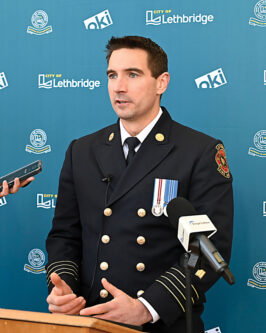
Communications and Strategy Deputy Fire Chief Kevin McKeown speaks about the new agreement between the City of Lethbridge and the International Association of Firefighters Union (IAFU) Local 237 at City Hall Wednesday.
HERALD PHOTO BY JOE MANIO
Communications and Strategy Deputy Fire Chief Kevin McKeown speaks about the new agreement between the City of Lethbridge and the International Association of Firefighters Union (IAFU) Local 237 at City Hall Wednesday.Joe Manio
Lethbridge Herald
Local Journalism Initiative Reporter
It took a while but the City of Lethbridge and the local firefighters’ union have reached an innovative new deal. The previous collective agreement between the City and the International Association of Firefighters Union (IAFU) Local 237 expired in 2020.
On Tuesday Lethbridge City Council ratified the new agreement between the two bodies which retroactively covers the period of 2021-2025.
One of the major innovations of the new agreement will allow Lethbridge Fire and Emergency Service (LFES) to implement a new operating model within the department. By introducing an EMS operational division, LFES will be able to maintain its integrated fire and EMS service but also allow staff to remain in the EMS division, if they choose.
“The EMS division is an ability for us to hire paramedics that are out there in the workforce,” says communications and strategy deputy fire chief Kevin McKeown.
“What we’ve seen over the last couple of years is that we’re operating in a very tight labour market, and we do see a difficulty in bringing in advanced care paramedics.”
McKeown says an EMS division allows LFES to recruit and attract paramedics to their service and gives them the ability to work as paramedics without having to perform and complete their firefighter training right off the bat.
“That avenue is still available for them. We are still an integrated service, where you join as a paramedic, you work your time on the ambulance and progress through the fire training that we provide you up into the firefighter roles,” he says.
Currently, employees joining LFES are trained as both paramedics and firefighters but will spend several years working in EMS before expanding to firefighting.
The new system will have recruits enter the system as dedicated EMS employees with training support to advance to firefighting closer to when they will start actively working in fire suppression.
This creates operational efficiencies and allows for more flexible recruitment and career opportunities within LFES.
“This is an industry leading approach,” says LFES Chief Greg Adair. “It is significant for our department because it creates a long-term strategy to map out a sustainable way forward.”
“It will help with recruitment, retention and financial viability while still supporting our integrated approach – a system we know provides an extremely high level of service to our community.”
In addition to operational changes, the new collective agreement settles wage increases to the end of 2025. Members will see a total wage increase of 16.25 per cent over five years: 2021 – 2.75 per cent, 2022 – 3.25 per cent, 2023 – 3.00 per cent, 2024 – 3.75 per cent and 2025 – 3.50 per cent.
The City of Lethbridge employs 253 IAFF members who fill roles in integrated paramedic/firefighting, fire prevention and dispatch. On November 27, 95 per cent of IAFF Local #237 members voted on the new agreement. Of those who voted, 99 per cent were in favour of ratifying the deal.
“Both bargaining teams have to be commended for the immense amount of work and innovation that was brought to the table,” says Lethbridge Mayor Blaine Hyggen.
“This is an important agreement because it creates a strong, sustainable future for the people and the systems that support critical emergency services to our community. I want to thank our staff for their patience through this process and for their ongoing dedication to public service.”
18-17