


How horses helped champion jockey Eurico Rosa da Silva heal and help others
By Canadian Press on December 23, 2025.
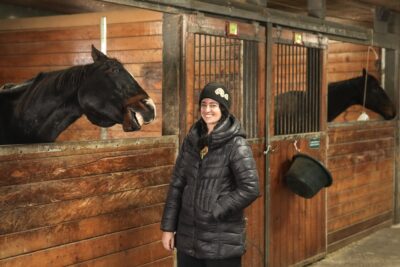
HILLSBURGH — Long before learning how to harness the raw power of a thoroughbred racehorse, champion jockey Eurico Rosa da Silva experienced the therapeutic powers of the animal’s inner strength.
Da Silva, 50, was verbally abused and tormented by his father growing up in Brazil, driven to the brink of suicide. As early as age four or five, da Silva fondly remembers experiencing a horse’s gentle nature.
Not only did da Silva decide then that he ultimately wanted to be a jockey, but finding solace in the animal gave him much-needed calm and inner peace.
“The horse has the ability to feel what you’re feeling inside yourself,” da Silva said. “They bring it into their body and release it.
“They’re like sponges, they have that ability to release everything.”
It’s that ability da Silva channels these days as he supports mental health healing with horses. Through the Equine Experiential Connection, da Silva connects clients with horses at LongRun Thoroughbred Retirement Society, a 100-acre facility in Hillsburgh, Ont., that specializes in matching retired thoroughbreds with new owners for a second career.
“Many times with my clients, you can see the horse yawning very strongly,” da Silva said. “That’s because they have a lot of stress in their body, and the horse is sucking in that energy and releasing it for them.
“Or they just stretch their body and go, ‘Ahhhh.’ And right away, I ask the client, ‘How did that feel for you?’ They say, ‘Oh my God, my chest has opened up,’ and I say, ‘Yeah, because the horse just released the energy for you.'”
Da Silva retired as a jockey in 2019 with 2,942 career wins — including two King’s Plates. He was named Canada’s top rider seven times.
After leaving the track, da Silva worked as a mental coach with professional athletes, but about two years ago felt something was missing.
“It’s then when I realized, ‘Oh my God, of course it’s missing something, the horses,'” he said. “I started looking for places and thought I’d found a farm, but it didn’t work out.”
That changed when da Silva met Vicki Pappas, LongRun’s chairperson and founding member.
“I met Vicki on a walk one day, and she asked what I was doing,” da Silva said. “I told her I was looking for a farm because I wanted to do a horse therapy program, and she said they were looking for somebody to do this.
“When I came here and saw the horses, I said, ‘My goodness, this is the dream place.'”
Pappas said da Silva’s program fills a clear need, both for LongRun and for those seeking mental health support.
“It gives horses that can’t be adopted a real purpose, and they enjoy interacting with humans,” she said. “Those horses then get to help people who’re experiencing any form of trouble in their lives.
“And there’s no need (for people) to fear horses because they’re a lot more afraid of you than you are of them, if you can believe that. I’d say horses love children. I’ve never seen a horse be menacing or mean towards a child.”
When da Silva adds a client, the first order of business is establishing contact with a horse in its stall. Da Silva allows the animals to determine if they’re best suited to helping that person.
Currently, da Silva has 15 horses in his program. Nine participate in exercises in the barn/arena, with the remainder involved in outdoor fields.
“My job is to teach people to connect with the horse,” he said. “But it’s not the client that chooses the horse; the horse is going to choose the client.”
Once a connection is established, the program shifts to an indoor arena for one-on-one exercises between the horse and client. Depending on how those go, there could be additional sessions in the open field, which da Silva affectionately dubs, ‘The Field of Compassion.’
“It’s very simple,” he said. “You come, you tell me what your goal is, and I’ll tailor the exercise you need to work with or on, then we make progress from there.”
Da Silva said the program varies widely, with some participants finishing after a few sessions while others continue for several months, depending on individual needs.
Lauren Millet, LongRun’s farm manager, said clients often begin to show noticeable change within a few visits, growing more comfortable around staff and horses as their confidence builds.
“I truly feel it’s because they’re more comfortable with themselves,” she said.
Da Silva hopes to extend his program to abuse victims and the homeless. Ultimately, he’d also like to provide horse therapy to individuals in jail as well as first responders.
“My dream is to bring these horses to jails,” he said. “Because it’s (those) people we need to welcome back into the community again.
“We all need love, we all need connection, and horses illuminate our mind, they illuminate us inside to do that.”
This report by The Canadian Press was first published Dec. 23, 2025.
Dan Ralph, The Canadian Press
-32