


Carney meets with Coastal First Nations to talk about major projects, oceans
By Canadian Press on January 13, 2026.
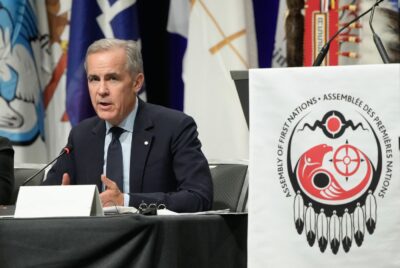
PRINCE RUPERT — Prime Minister Mark Carney said Tuesday his meeting with Coastal First Nations in Prince Rupert, B.C. is about “dialogue” and exploring how First Nations can partner with the federal government to build the economy.
Speaking just before entering the meeting with the advocacy group that works to protect the B.C. coastline and the Great Bear Rainforest, Carney said there’s a “huge responsibility” to protect the environment.
“So how do we work together to preserve that, to enhance it while we’re looking for opportunities for development?” he said.
“Today is not a day for big announcements. It is a day, as I said, for dialogue, for listening and working.”
Carney is being joined at Tuesday’s meeting by a handful of ministers, including Natural Resources Minister Tim Hodgson and Housing and Infrastructure Minister Gregor Robertson. Crown-Indigenous Relations Minister Rebecca Alty is not in attendance.
Tensions between the federal government and Coastal First Nations heated up in the fall when federal officials failed to meet with the group before signing an agreement with Alberta opening the door to a pipeline to B.C.’s coast.
Hodgson was forced to apologize after quipping in a television interview that he could have met with alliance members through Zoom.
Coastal First Nations president Marilyn Slett has said there is no support among the group’s members for a pipeline to the Pacific or the suspension of the legislated ban that keeps large oil tankers off the northern B.C. coast.
Asked about those tensions, Carney said the meeting was arranged to work through those issues and find ways Ottawa and Coastal First Nations can move forward together.
Slett is expected to speak with media after the meeting, along with Gaagwiis (Jason Alsop), vice president of Coastal First Nations and president of Haida Nation, and Maureen Nyce, chief councillor of Haisla Nation.
The agreement signed by Alberta Premier Danielle Smith and the federal government sets a path forward for a proposed bitumen pipeline. Smith has said her government will submit a pipeline proposal to Ottawa’s major projects office this summer.
That office has promised to review projects within two years. Citing recent promises by the U.S. to ramp up oil production in Venezuela following the capture of that country’s President Nicolas Maduro, Smith recently called on Carney to approve the project no later than the fall.
Smith, who also met with Carney recently, said the developments in Venezuela and global energy markets have underscored the need for a new pipeline to supply Asian markets.
While the agreement with Alberta does not spell out the route for a pipeline, the proposal has faced opposition from First Nations along B.C.’s northern coast because it would require lifting the federal tanker ban.
The agreement signed by Smith and Carney in late November includes language that opens the door to changing the ban, “if necessary.”
The opposition from First Nations along the coast comes despite promises of Indigenous co-ownership and other unspecified economic benefits.
Opposition to the project has also come from the province. B.C. Premier David Eby has said repeatedly the project lacks the necessary private proponent.
Eby also has said the proposed pipeline would threaten the “fragile” consensus on other “real” energy and mining projects in northern B.C.
This report by The Canadian Press was first published Jan. 13, 2026.
— With files from Alessia Passafiume in Ottawa
Wolfgang Depner, The Canadian Press
24-23