


Carney: Canada entering ‘new era’ in relationship with Beijing
By Canadian Press on January 15, 2026.
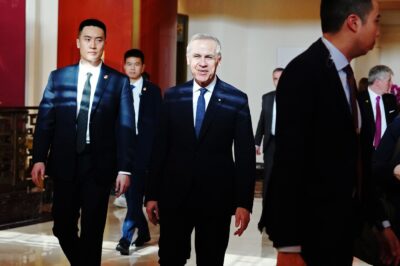
BEIJING — Canada is entering a “new era of relations” with China and the stage is set for talks on ways the two countries can be “strategic partners,” Prime Minister Mark Carney said Thursday.
The prime minister made the comments as he was welcomed in Beijing by the second and third most powerful figures in China’s political system: Premier Li Qiang and Zhao Leji, chairman of the standing committee of the National People’s Congress.
While most of the talks took place in secret, media were allowed into the room to hear opening remarks at some of the meetings and to observe a signing ceremony for a number of memorandums of understanding.
“From energy to agriculture to people-to-people ties to multilateralism to issues on security, we believe that the spirit and the substance of these discussions, and these agreements, will provide great benefit to each of our peoples,” Carney said at the start of one of his meetings.
Carney added Ottawa hopes this renewal will become an “example to the world of co-operation amidst a time globally of division and disorder.”
Premier Li hailed what he called a “turnaround” in bilateral ties with Canada, calling it a “new starting point” for the two countries.
Li also said Carney’s meeting with President Xi Jinping on Friday will pave the way for “upward growth” in the relationship, according to the live translation provided by the Chinese government.
Before the trip, Canadian officials told reporters to expect possible movement on — but not an end to — the tariff dispute. China imposed steep tariffs on Canadian agriculture products, including canola and peas, after Canada imposed a 100 per cent tariff on Chinese electric vehicles.
Industry Minister Mélanie Joly said Thursday Carney will have more to say about the state of those tariff negotiations after he meets with Xi.
“There’s still negotiation happening and of course the prime minister will be able to answer your question tomorrow,” Joly said during a media scrum in Beijing when asked if she thinks a tariff breakthrough is possible.
Carney said Thursday he is “heartened by the leadership of President Xi” and the “speed with which our relationship has progressed in recent months.”
Saskatchewan Premier Scott Moe, whose province is smarting from the canola tariffs, sat at Carney’s right during that meeting, alongside several Liberal ministers and senior federal bureaucrats.
In an earlier meeting with Carney, Zhao said China looks forward to “new strategic guidance” from Ottawa to put the relationship on a trajectory of “healthy, steady and sustainable development.”
It’s a marked change in tone from nearly a year ago, when — during the spring election campaign — Carney described China as the biggest threat to Canada on the world stage.
But the Carney government is seeking to double non-U.S. exports in the next decade in response to the unstable geopolitical and trading environment ushered in by the re-election of U.S. President Donald Trump.
Carney was also in and out of a marathon of closed-door meetings with businesses throughout Thursday.
He met with top officials from such firms as Alibaba, China National Petroleum, the EV battery company Contemporary Amperex Technology, Primavera Capital Group and ICBC, China’s state-owned commercial bank.
It all signals that economic doors are starting to open between the two countries after nearly a decade of friction on trade, security and diplomacy.
The MOUs signed Thursday included provisions for sanitary oversight of pet food and animal health — areas where Canada has long complained about trade irritants.
Since February 2022, exports of heat-treated dry pet food with poultry have been halted due to China’s avian flu trade restrictions. One case of atypical BSE also led to a suspension of beef exports to China in 2021.
Ottawa has been frustrated by Chinese officials’ limited willingness to engage on those files, which stymied some agricultural exports.
Canadian officials were not made available Thursday to explain what they hope to accomplish through the animal-related MOUs.
Energy Minister Tim Hodgson said one MOU he signed is expected to lead to more Canadian wood being used in Chinese construction. He said this is just the beginning of Ottawa’s efforts to foster deeper economic integration.
“This is not a one-and-done,” he said. “We will be back here more, looking for more ways to get Canadian products into this country so more Canadians have good paying jobs.”
He also said he heard in his meetings with Chinese officials there’s an appetite for more Canadian energy products as China seeks “reliable” trading partners that “don’t use energy partners for coercion.”
The biggest trade sticking points have not yet been sorted: Canada’s electric vehicle tariffs and China’s duties on Canadian canola and other agricultural products.
The Liberals are under pressure to convince Beijing to repeal or lower agricultural tariffs that are hurting Atlantic and western provinces.
But that would involve some sort of trade-off with Canada’s levies on Chinese electric vehicles.
Ontario Premier Doug Ford maintains those tariffs are essential to protecting domestic jobs.
Foreign Affairs Minister Anita Anand met early Thursday with her Chinese counterpart, Wang Yi.
Wang said the renewed diplomatic engagement between the two countries will create new prospects in a world facing unprecedented and complex changes.
Anand had said a day earlier that Canada’s relationship with China is being “recalibrated.”
But she stopped short of calling it a reset and did not directly answer a pointed question about whether Canada still sees China as a disruptive power.
Anand said her Chinese counterpart will visit Canada this year, a decade after Wang Yi berated a Canadian reporter.
Anand said she will work with Wang to “create opportunities for both our peoples” and she is looking forward “to welcoming him to Canada this year.”
When Wang visited Ottawa in 2016, he berated a press gallery journalist who asked about human rights and the jailing of Canadian citizens.
Wang responded angrily, saying the question was “full of prejudice against China and arrogance” and that it was “totally unacceptable.”
This report by The Canadian Press was first published Jan. 15, 2026.
-With files from Dylan Robertson in Ottawa
Kyle Duggan, The Canadian Press
-42