


Canadian veterans outraged by Trump’s NATO comments: “A great deal of disrespect”
By Canadian Press on January 25, 2026.
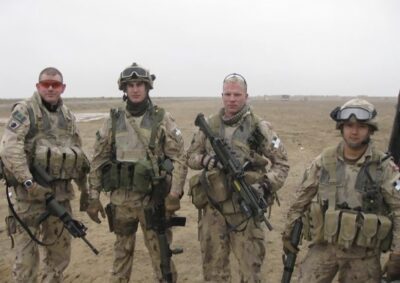
A Canadian veteran said U.S. President Donald Trump’s recent remarks about the contribution of NATO soldiers in Afghanistan show “a great deal of disrespect” toward those killed while fighting.
In an interview with Fox News on Thursday, Trump described NATO partners’ role in Afghanistan as small, saying that “we never needed them, we have never really asked anything of them,” adding that “they stayed a little back, a little off the front lines.”
Matthew Luloff was livid after hearing Trump’s comments. The former soldier was stationed in a combat outpost that was “on the front line of the war against the Taliban” in Kandahar province, one of the most dangerous regions in the Afghan conflict.
“I was diagnosed with post traumatic stress injury and hearing loss in 2009, and so that’s when I left the army. But I do not regret serving, and I do not regret standing up for what was right in 2008,” Luloff said.
“And to hear President Trump describe the role that we played as being ‘a little bit’ behind the front lines is incredibly discouraging, and really shows a great deal of disrespect towards my friends that were injured and my friends that were killed” said veteran Luloff, who spent eight months in 2008 serving in Afghanistan.
Canada and other NATO allies joined the U.S. in Afghanistan after the country invoked Article 5 of the alliance following the Sept. 11 terror attacks. Article 5 states that an attack on one member nation is an attack on all.
Defence Minister David McGuinty said that Canadians will never forget the sacrifices their troops have made for Americans and the NATO alliance in Afghanistan.
“We joined the Americans and other NATO allies on the day operations were launched in Afghanistan,” McGuinty told the media Saturday, reading out a statement on Parliament Hill.
Luloff, who is now an Ottawa city councillor, said he and other Canadian soldiers “fought face to face with the Taliban nearly every single day” for eight months during the Afghan war.
“For eight months, we would wake up in the morning and get attacked. They would shoot rocket-propelled grenades and mortars at us. These bombs would go off inside our base,” Luloff said.
But he said these attacks didn’t intimidate them at all.
“We were the front line and oftentimes fighting shoulder to shoulder with our NATO partners,” Luloff said.
From 2001 to 2014, more than 40,000 Canadian Armed Forces members served in Afghanistan as part of the NATO International Security Assistance Force, making it the largest Canadian military deployment since the Second World War. During the war, 158 Canadian soldiers were killed while supporting the United States, while thousands more were injured.
Canadian veteran Keenan Geiger from Calgary served in Afghanistan between October 2009 and May 2010. Geiger said he has been “pretty desensitized” to Trump’s remarks. He said Trump would say “whatever he thinks is most useful in that moment,” whether it’s an “outrageous lie” or the truth.
“So I don’t have an emotional reaction to it anymore. But the outrageousness, the outlandishness. It’s not lost on me,” Geiger said.
He said several American veteran friends sent him apologetic messages following Trump’s public remarks, such as “I am sorry, this is really embarrassing.”
On Saturday, Trump posted about the sacrifices made by U.K. soldiers, but didn’t mention other NATO allies who supported the U.S. in Afghanistan.
Geiger was 22 when he went to Afghanistan, and he said there were many “emotionally charged and tragic things” that happened during that period.
Geiger said the most unforgettable moments during his service in Afghanistan was when four Canadian soldiers and Michelle Lang, a reporter from the Calgary Herald, were killed on Dec. 30, 2009, after the group’s vehicle was struck by a roadside bomb in the city of Kandahar.
Geiger said the tragedy hit home for him since he knew these soldiers personally. In the military, friends of fallen soldiers would be pallbearers for a ramp ceremony to take the coffin onto the plane.
“That’s how our 2010 started, was placing bodies on a plane,” said Geiger, adding that the mercy of time helps him heal from those losses.
Looking back to those days in Afghanistan, Geiger said he felt it was “a very rare and very exclusive experience that you can’t pay money to replicate.”
“It’s a very limited time where you have an opportunity to serve your country, go somewhere overseas, to do something that you believe in, and that was just like a very special moment for me,” Geiger said.
Although it has been 18 years since Luloff set foot in Afghanistan, he said the memory was still fresh, as if it just happened yesterday.
Luloff recalls one day where it was so hot — about 40 C outside — and he and several soldiers decided to sleep under a tent outside of the bunker to get some air.
And then a rocket-propelled grenade hit their walls, cut through the tent that they were sleeping in, and landed about a foot over the head of another soldier.
“The Taliban, I guess, did not pull the pin on the charge at the front. Otherwise, Chris (the soldier) would have been dead. I probably would have lost my legs. Maybe worse,” Luloff said.
Luloff said Taliban fighters would ambush soldiers on three sides, and oftentimes the only way out was a route that had been planted with explosives.
“Like, instead of retreating, we’d have to fight through them, and so we were ambushed over and over and over again throughout the time that we were there. Honestly, I feel incredibly lucky to have survived it. Some of my friends were not as lucky as me.”
Luloff said once a rocket-propelled grenade landed in the middle of their base and two soldiers were chatting on the phone with their family members at the time.
“The RPG landed right in between them and blew off, you know, portions of each of their bodies, one guy’s head was blown open, and we covered their bodies and kept them for a couple of days while we waited for an Afghan helicopter to come out and take them,” Luloff said.
Luloff said tragic memories from the war stuck with them.
“With proper treatment and a lot of hard work, the nightmares are very few and far between now, but I’ll tell you that I was very much tortured by it for about a decade afterwards,” Luloff said.
But Luloff said he isn’t alone, thousands of Canadian soldiers who shared a similar experience to his.
“Mine is no more special than the rest of them. I am just a very small piece of this story. There are so many of us.”
This report by The Canadian Press was first published Jan. 25, 2026.
Nono Shen, The Canadian Press
-39