

Poll
Do longer days actually improve your mood?
- Yes (70%, 332 Votes)
- No (30%, 141 Votes)
Total Voters: 473
 Loading ...
Sponsored
1984’s warnings still resembling with readers
By Lethbridge Herald on February 5, 2026.
 HERALD PHOTO BY JOE MANIO
ORWELL'S DYSTOPIAN FUTURE: 1984 STILL RESONATES
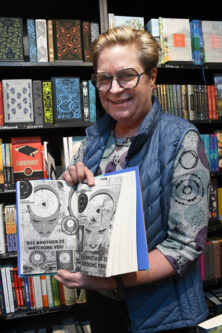
Analog Books owner Penny Warris holds a newly arrived hard-bound illustrated edition of George Orwell's 1984, which opens to a graphic saying "Big Brother is watching you." More than seven decades after its 1949 publication, the novel's warnings about surveillance, control and the power of language continue to resonate with readers.
HERALD PHOTO BY JOE MANIO
ORWELL'S DYSTOPIAN FUTURE: 1984 STILL RESONATES
Analog Books owner Penny Warris holds a newly arrived hard-bound illustrated edition of George Orwell's 1984, which opens to a graphic saying "Big Brother is watching you." More than seven decades after its 1949 publication, the novel's warnings about surveillance, control and the power of language continue to resonate with readers.By Joe Manio
Local Journalism Initiative Reporter- Lethbridge Herald
Once a chilling warning from George Orwell’s 1949 novel 1984, his vision of a totalitarian society has become cultural shorthand—used in reality-TV promos, smartphone jokes and casual conversation about life online.
More than 75 years later, Orwell’s dystopia continues to feel uncomfortably current, a fact reflected not just in classrooms and reading lists, but in local book sales. Orwell was the pen name of Eric Arthur Blair, an English novelist and journalist whose works remain influential for their sharp critique of authoritarianism and the misuse of language and power.
In Orwell’s dystopia, everyone is tracked, eavesdropped on and surveilled, both overtly and covertly. There is no such thing as privacy, freedom of thought, expression or movement. “Telescreens” are installed in every home and public space, constantly transmitting government propaganda while monitoring citizens’ behaviour.
They are literally mandatory, leaving no corner of life untouched. Many readers and scholars see modern technology as a precursor: smartphones, smart speakers and devices like Amazon Echoes can collect data, track activity and respond to voice commands, evoking the same sense of ubiquitous observation Orwell imagined decades ago.
Orwell also imagined Newspeak, a language designed to limit thought by reducing vocabulary and controlling meaning. The goal was to make dissent nearly impossible.
Some commentators drew parallels when U.S. presidential adviser Kellyanne Conway described inaccurate statements about the 2017 inauguration as “alternative facts,” noting how language can be manipulated to reshape perception—a modern portent of Orwell’s warnings.
Surveillance today extends beyond personal devices. Cameras monitor streets, public spaces and workplaces, while biometric identification—such as facial recognition and fingerprint scanning—is becoming more common under the rationale of security.
These technologies raise questions about privacy and oversight, echoing Orwell’s vision of a society under constant observation.
It’s that enduring relevance—Orwell’s imagined surveillance and linguistic control echoing in today’s technology and political rhetoric—that keeps readers returning to 1984, a trend local booksellers say shows no sign of slowing.
Independent booksellers in Lethbridge say 1984 rarely sits on shelves for long. With debates over digital surveillance, misinformation and the power of language dominating public life, Orwell’s vision of a tightly controlled society has found renewed relevance.
While the novel is often revisited during election cycles or political uncertainty, booksellers say interest has become steady rather than cyclical.
At Big John’s Used Books, demand for the novel is strong enough that the store regularly brings in new copies. The proprietor notes the book’s relevance is underscored by its repeated appearance on banned or challenged book lists in parts of the United States.
“It’s been in demand for a very long time,” says owner John Pyska, adding that students, longtime readers and new readers are all buying copies. “Most customers are picking up 1984 to compare it to current times.”
Analog Books reports a similar pattern. Owner Penny Warris said the novel has been a reliable seller since the store opened, appealing to readers across generations.
“It’s always been a steady seller, and in the past couple of years demand has increased,” Warris said. “Last year it ranked as our fifth-best-selling book, which is considerable.”
At Echo Books, staff say copies of 1984 come in, but rarely linger.
Booksellers say part of the novel’s staying power lies in its language. Terms like “Big Brother,” “doublethink” and “thought police” are routinely used to describe modern political or technological concerns, often without direct reference to the book itself.
1984 has also long appeared alongside other politically charged novels on banned or challenged book lists. Fellow Orwell work Animal Farm, Aldous Huxley’s Brave New World and, more recently, Margaret Atwood’s The Handmaid’s Tale have all faced repeated challenges over their depictions of power, ideology and social control.
Local reading groups, including the Best of All Possible Words Book Club, have recently scheduled discussions of 1984, citing its relevance to contemporary issues. The club meets monthly, but organizers could not be reached for comment before publication.
Orwell imagined a future shaped by surveillance and control. More than seven decades later, 1984 continues to sell steadily, its warnings still finding an audience.
23-22





Evidence of George Orwell’s foresight was visible and happening at UofL. Tuesday historian Frances’s Widdowson was dragged off university grounds by none other than the L.P.S. Yes ,the police from Lethbridge. Free speech? Widdowson speaks about history that many, too many don’t want to hear. The pathetic Turdo government repeated “ residential school genocide” 3 times out of, got the mainstream media too pick up on it, and now it is taught as historical fact. The fact is though , millions of tax payer $$$$$ wasted on ground probing radar proved something else. A lie , a myth being perpatrated. Don’t try to speak reason to a woke student body though. Free speech? Voice of reason? Proof of alogations? Seemingly selectively applied. Nobody can prove ms. Widdowson wrong . Banish her from speaking. Hide the truth. Live the lie. Scary what thousands of students can be made to believe.