


History that’s still happening at the Galt
By Lethbridge Herald on February 19, 2026.
 Herald photo by JOE MANIO
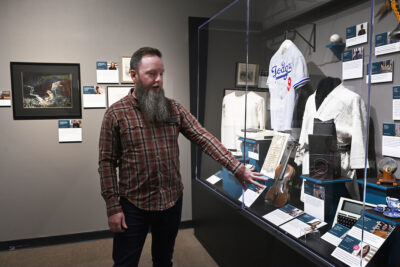
Galt Museum & Archives curator Tyler Stewart talks about a display case featuring a Los Angeles Dodgers jersey, a vintage baseball, a violin and an early Commodore computer among other artifacts, during a tour of the Treasures & Curiosities exhibition. The exhibition runs through March 1, 2026
Herald photo by JOE MANIO
Galt Museum & Archives curator Tyler Stewart talks about a display case featuring a Los Angeles Dodgers jersey, a vintage baseball, a violin and an early Commodore computer among other artifacts, during a tour of the Treasures & Curiosities exhibition. The exhibition runs through March 1, 2026By Joe Manio
Lethbridge Herald
A Curator’s Tour at the Galt Museum & Archives shows why artifacts don’t have to be old to matter and how exhibits connect Alberta’s past to the present
The exhibits currently on display at the Galt Museum & Archives tell powerful stories of southwestern Alberta — but they represent only a fraction of the more than 17,000 artifacts in the museum’s collection. On occasion, visitors are allowed a behind-the-scenes glimpse, but those tours are rare for obvious reasons, according to curator Tyler Stewart.
Stewart guided a small group through Treasures & Curiosities on Feb. 13, pausing not just at display cases but at the threads connecting past and present. Treasures & Curiosities runs through March 1, 2026, giving visitors a limited window to experience it. The museum’s entire collection is fully searchable online 24/7 — a point of pride for Stewart and the staff.
The tour explores items tied to the Nitsitapii (Blackfoot), early settlers, and the many newcomers who shaped the region. Stewart emphasized that his role goes beyond preserving artifacts.
“My role isn’t just to collect and conserve artifacts,” he said. “It’s to collect the stories that come with them — the context, the voices, the lived experiences. Without that, we’re just storing things. With it, we’re preserving community memory.”
He challenged a common assumption: something doesn’t have to be “old” to belong in a museum — it has to be meaningful. Recent milestones, cultural shifts, or even a T-shirt supporting students during Alberta’s 2020 gay-straight alliance controversy can be as significant as a century-old artifact.
“History isn’t just 50 years ago. History is right now, or five minutes ago, or five days ago,” Stewart said. “Being able to connect with people today and collect their stories is really important.”
Artifacts come alive when paired with context. Stewart pointed to a chessboard, a ship-in-a-bottle, and a POW-carved lunch pail, noting that many items reflect surprising stories from Lethbridge’s past — from Camp 133, a World War II prisoner-of-war camp, to the local brewing industry adapting during Prohibition.
The collection also includes personal items, technology, and artwork: a laptop used by author Joy Kogawa to write Obasan, and paintings by Conrad Chiefbody and Gerald Tailfeathers. Stewart highlighted the museum’s commitment to accessibility:
“Our collections are very accessible compared to most other museums. Everything is searchable online — baseball, fishing, wedding dresses, military items. But more importantly, we include the stories behind the objects, not just the objects themselves.”
Treasures & Curiosities underscores the scale of that work. Each item represents a life, a moment, a community, tracing layered histories from the Nitsitapii to successive waves of settlers and immigrants. Large portions of archival material are also available online, opening local history to researchers, students, and the curious.
Stewart also pointed to the permanent exhibition Taking Care, which honors the legacy of the former Galt Hospital. Operating from 1910 to 1955, the hospital shaped generations of families and trained local nurses.
“The hospital was more than a building,” Stewart said. “It was a place where generations of families experienced some of their most important moments — births, recoveries, losses. Preserving that history helps us understand how care shaped this community.”
The storytelling continues March 21 with A Smile in Every Bottle — Sicks’ Lethbridge Breweries Ltd., running until Sept. 6, 2026. The exhibition traces how Fritz Sick built Sick’s Breweries into a powerhouse across western Canada and the northwestern United States, connecting familiar products to deeper community roots.
If the Curator’s Tour makes anything clear, it’s that museums are not static repositories. They are living spaces of dialogue and discovery. Stewart’s commentary turns display cases into conversations, reinforcing that history is defined not by age alone, but by meaning.
As Treasures & Curiosities nears its close and a new exhibition prepares to open, one message stands out: at the Galt, history isn’t finished. It’s still being collected, still being cared for — and still being told.
19-18