


Ahead of PM’s visit, India’s envoy says Canada could sign trade deal ‘within a year’
By Canadian Press on February 20, 2026.
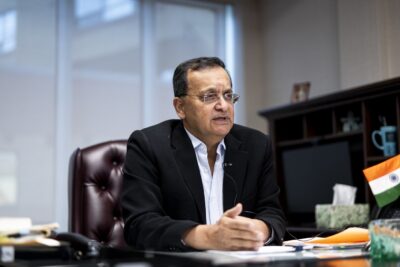
OTTAWA — India’s envoy to Ottawa says Canada could sign a comprehensive trade deal with New Delhi within a year — despite the fact that trade talks between the two nations have stalled multiple times since they started in 2010.
Ahead of Prime Minister Mark Carney’s anticipated visit to India, High Commissioner Dinesh Patnaik said Thursday a 12-month timeline isn’t overly ambitious because both countries face a shifting geopolitical climate requiring collaboration in multiple sectors.
“We expect it to be much faster, given that we both have had enough experience of doing these kind of free trade agreements in the last one or two years,” Patnaik told The Canadian Press.
Patnaik said Carney’s visit likely will involve meetings with a wide range of government and business officials in New Delhi and Mumbai.
In November, Carney and Indian Prime Minister Narendra Modi agreed to formally launch negotiations on a Comprehensive Economic Partnership Agreement — a trade deal that would cover almost all services and goods, including investments, agriculture and digital trade.
Canada and India launched talks 16 years ago on a comprehensive deal before downgrading those negotiations to focus instead on a sectoral deal that would touch only on specific industries.
New Delhi has historically been protective of multiple industries and has sought to shield its small businesses from foreign competition. Ottawa, meanwhile, has blocked foreign market access to sectors involving important political constituencies, such as dairy farmers.
Canadian exporters have accused India of engaging in unpredictable trade practices — such as changing fumigation protocols for imported lentils after shipments already had been prepared for export.
Trade talks collapsed again in fall 2023 after Ottawa accused unnamed Indian government officials of involvement in the murder of a Sikh activist near Vancouver, and of supporting a campaign of gang-related extortion and violent crime targeting those advocating for an independent Sikh nation carved out of Indian territory.
New Delhi has rejected those allegations and claims Canada has not presented proof to back its claims. Both countries have since shifted to what they call structured talks on security while they pursue economic and technological collaboration.
Patnaik pointed out that India and Canada have signed agreements over the past year on issues ranging from energy and climate change to high-tech research and climate-resilient agriculture.
“Both the prime ministers are very keen, so the intent is there on both sides,” he said.
Patnaik noted that India has signed trade deals with multiple countries since 2010, as has Canada.
“The way we look at the world has changed,” he said. “We have moved on our positions, both of us. And so a lot of the issues which are there in the past, which could have held us back, are probably more resolvable now.”
Patnaik argued there are no major policy conflicts between the two countries and their industries tend not to compete with each other — with Canada being a major commodity exporter and India having a massive consumer market.
He said the issues that tend to clog up trade negotiations — phytosanitary measures, government procurement rules and customs documentation — are not causing major disputes between Canada and India.
“We really don’t compete on many issues,” Patnaik said.
Carney’s visit to India comes just weeks after India signed a trade agreement with the European Union — one of the largest trade deals in history, covering roughly two billion people.
Carney has been leading efforts to shore up rules-based trade by facilitating talks between the Comprehensive and Progressive Agreement for Trans-Pacific Partnership — a large trading bloc of Pacific Rim countries — and the EU.
Canada is a CPTPP member and has a trade deal with the EU. Both trading blocs are seeking predictable rules that can help them evade both the erratic tariff policies of U.S. President Donald Trump and coercion from Beijing.
Patnaik said Canada is aligned with India in seeking predictable trade, and in hoping Washington returns to that mindset.
“What you want to do with the CPTPP, we’re doing it on the Atlantic side rather than the Pacific side,” he said. “So we will have India, the EU, Canada and hopefully the U.S. all together into one sphere, where we work together on a free-trade agreement and trade agreements which bring together people, trade, industry, innovation — everything.”
Foreign Affairs Minister Anita Anand said last year that both countries expect to be able to double two-way trade to US$50 billion by 2030, through a comprehensive trade deal.
This report by The Canadian Press was first published Feb. 20, 2026.
Dylan Robertson, The Canadian Press
28-27