


Water , wonder and warning at Trianon Gallery
By Lethbridge Herald on February 25, 2026.
 Herald Photo by Joe Manio PHOTO CUTLINE:
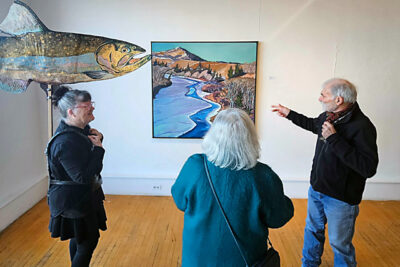
Artist Mike Judd discusses his painting Open Winter on the Castle with a gallery visitor (centre) as activist Kathleen Moors (wearing a mounted bull trout) listens during the opening of Water: Beauty and the Beast at the Trianon Gallery on Saturday.
Herald Photo by Joe Manio PHOTO CUTLINE:
Artist Mike Judd discusses his painting Open Winter on the Castle with a gallery visitor (centre) as activist Kathleen Moors (wearing a mounted bull trout) listens during the opening of Water: Beauty and the Beast at the Trianon Gallery on Saturday.By Joe Manio
Lethbridge Herald
Beneath that pristine surface, there was a story of risk, contamination, and human impact — a story that the group exhibition “Water: Beauty and the Beast” at the Trianon Gallery confronted head-on.
The exhibition opened Saturday, bringing together a dozen artists to explore Alberta’s headwaters and the environmental pressures threatening them. The idea for the show came from an unexpected source: a painting.
“I saw Donna Bilyk’s large painting of Window Mountain Lake,” says curator John Savill. “It’s breathtaking…but then I learned that the lake itself was contaminated, dust from coal mines seeping into the water. That contrast — beauty hiding a harsh reality — sparked the exhibition.”
The title, Beauty and the Beast, encapsulated the tension Savill hoped to convey.
“We wanted to show that the landscape can be both awe-inspiring and vulnerable. The gallery became a space to reflect on what’s at stake environmentally, economically, and ethically,” Savill said.
One of the exhibition’s highlights was Mike Judd’s painting Open Winter on the Castle, which captured a stretch of the Castle River just north of Beaver Mines.
“I wanted to show the beauty of the headwaters. It wasn’t about environmental damage — it was about appreciating the landscape,” Judd explained. “That river and those mountains are part of my life. I grew up there, I’ve spent my life fly-fishing, and I feel intimately connected to it.”
Even in work that celebrated beauty, the exhibition carried a cautionary undertone.
“All the headwaters are beautiful, but they’re at a critical point. Logging, potential open-pit coal mines — these activities could destroy the rivers, dry them up, or contaminate them. No water means we all suffer,” Judd said.
The opening also drew attention from activists highlighting water’s broader significance.
Kathleen Moors, a supporting artist from Calgary’s Studio Creative Resistance, attended wearing a large mounted bull trout strapped to her back.
“The trout symbolizes the health of Alberta’s waterways: a crucial species whose wellbeing reflects the entire ecosystem,” Moors said. “By presenting the trout, I can spark conversations about river health, selenium contamination, and the impacts of mining. As long as the bull trout is healthy and beautiful, the world is going to be healthy and beautiful.”
Savill emphasized that Alberta’s headwaters weren’t just a local concern; their reach extended far downstream.
“Contaminating these waters affected not just Alberta, but downstream all the way to the Libby Dam in the U.S., and even potentially Hudson’s Bay. Heavy metals like selenium linger for hundreds of years, and there’s no large-scale solution yet,” he said.
The exhibition also highlighted the diversity of voices invested in protecting these waters, from environmental activists to fly-fishermen and artists whose work had traveled to the United Nations.
“Some of the pieces were even designed for children, to help them understand the importance of water,” Savill said.
The show arrived at a time when local watersheds faced increasing pressures.
In places like Fernie and near the Crow’s Nest Lakes, contamination from coal dust was already a reality.
Even newly built water treatment facilities have struggled to provide safe drinking water.
“Mining on this side of the Rockies was damaging our environment, our economy, and our way of life,” Savill said.
With work from Troy Nickle, Donna Bilyk, Mike Judd, Karen Tamminga-Paton, John Savill, Narda Ray, Sanna Darby, Jane Evelyn, Mary McQuitty, Tony Partridge, Luann Sunohara, and Myrl Eddy, the exhibition offered both aesthetic beauty and ethical provocation.
“Ultimately, I hoped visitors left with heightened awareness. To see the beauty, but also to understand the impact of human activity on these fragile waters, and to think about our responsibility for what flows downstream,” Savill concluded.
25-24