


UNC has 40 years of history in its Smith Center home. Deciding what’s next is proving complicated
By Canadian Press on March 4, 2026.
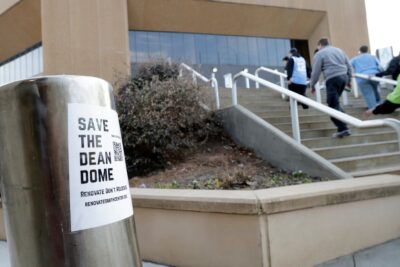
CHAPEL HILL, N.C. (AP) — North Carolina had just completed its first-ever 18-0 season at its longtime home, and Seth Trimble wrapped up his on-court senior night speech by pointing to a simmering debate that will linger into the offseason.
“I really, really hope to see the Dean Smith Center here for a long, long time,” he said after Tuesday’s win against Clemson, drawing a loud roar.
The 17th-ranked Tar Heels’ storied program has jammed four decades of unforgettable wins, big names and loyal passion into the arena named for its late Hall of Fame coaching patriarch. That’s why talking about what’s next — Renovate? Relocate, maybe off campus? — is unsurprisingly complicated for one of the sport’s blueblood programs.
At its core, UNC is trying to balance the emotional connection to history and Smith’s legacy with the realities in today’s revenue-driven world of major college athletics, where schools are clear to pay athletes directly.
Off-campus relocation has met significant pushback from many fans and even retired Hall of Fame coach Roy Williams. That has school officials slowing the process while talking more publicly about options after athletic director Bubba Cunningham said they had “dropped the ball” on that front, down to running a series of episodes on the arena topic through UNC’s official “Carolina Insider” podcast.
One thing is clear: it will be pricey. A Smith Center overhaul is estimated to cost around $591 million when including training facilities for the men’s and women’s programs, and related project costs. An off-campus arena could exceed $786.4 million, according to UNC data released Wednesday.
“As a department, we’ve been working on and off for the past 12 years, and now we’re getting a lot closer to the end,” Cunningham said in a recent interview. “And everybody does want to rush to the end.
“The basketball program is key to where we’re headed. Student participation is key to where we’re headed. Our donor base is key, our fan base. So we’re now exploring with them: how do we fulfill this charge of ensuring the future success of Carolina Basketball? We’re going to ask all of them to be patient as we work through, with them, on their priorities.”
Current status
The 21,750-seat Smith Center at the campus’ southern end turned 40 in January. It opened as a sparkling venue funded by donors who own rights to choice seats in perpetuity rather than packing rowdy students around the court for a better homecourt edge.
Now it’s an aging venue needing costly upkeep. For example, chancellor Lee Roberts has previously cited a “Band-Aid approach” to replace the roof, improve restrooms and concessions areas, and ensure compliance with the Americans with Disabilities Act. That cost is estimated to exceed $150 million.
Meanwhile, the arena lacks modern amenities like revenue-generating suites. It also has just one concourse that can create shoulder-to-shoulder bottlenecks of fans on gamedays.
Yet the history there resonates.
The images of Smith and later Williams roaming the sideline. The honored jerseys and banners filling the rafters, including four hanging for national titles won in the Smith Center era. And as recently as last month, there was Trimble’s last-second 3-pointer to stun now-No. 1 Duke and earn a permanent place in rivalry lore.
“There are magical moments in the Smith Center, and a lot of people have experienced them,” said former UNC trustee Rusty Carter, who is part of the Committee for a South Campus arena group backing a “Renovate Don’t Relocate” message.
“That history is on the floor, in the Smith Center, for the last 40 years. And it’s really hard for Tar Heels to dismiss this.”
Pushback
As of late 2025, it appeared the school had settled on building a new arena as a centerpiece in the long-discussed “Carolina North” off-campus expansion. That would feature academic, research, residential and mixed-use retail projects about 2 miles north of campus.
That triggered significant pushback, notably with Williams and former program great Tyler Hansbrough recording video messages backing renovation efforts at the Smith Center through Carter’s group.
Notably, Williams recalled his time as Smith’s assistant and his mentor wanting the arena to remain on campus.
“That was his wish, there’s no question,” Williams said, adding later: “And I hope that’s where we stay forever.”
Carter said the committee’s priority is to keep the arena on campus, with a preference for renovation. That group has also collected roughly 38,000 names to a petition. And he points to fellow marquee programs like Duke, Kansas and UCLA as examples of how updating venerable campus arenas can work.
Carter also appreciates that school officials have slowed the process and are talking more with stakeholders, including committees of former players and students.
“I continue to have anxiety that legacy, passion, students are not really as focal point of the discussion and the comparison that they need to be,” Carter said. “Because they’re strictly intangibles that need to be acknowledged as real. And the dollar sign cannot overrun all this.”
Arena options
UNC officials have been clear that any project will continue to bear Smith’s name on the building and Williams’ name on the court. They have also pointed to priorities of building a basketball-first arena with top-flight training facilities, improved student seating and revenue-generating amenities, which would cut capacity to the 16,000-18,000 range.
The school is starting to focus on three options:
— A Smith Center renovation in its current footprint with an estimated annual revenue generation of $4 million, mostly from basketball but also with a potential limited number of other events. Yet any renovation would also likely displace the Tar Heels to play elsewhere for an extended period;
— The Carolina North project with the most expensive price tag would generate an estimated $26 million in basketball revenue, separate from any potential gains from surrounding mixed-use projects such as restaurants or hotels;
— There’s also what amounts to a compromise option of building a new arena on South Campus at nearby Odum Village, the shuttered former hub for graduate-student and family housing. A project there would cost an estimated $703.1 million and generate an average of $25.1 million annually, while offering the potential for at least some mixed-use projects.
The school doesn’t have a firm timeline for making a decision.
“We all have to get on the same page,” Cunningham said. “If we’re going to do a ($600) to $800-million-dollar project, the university community has to be behind it. And that community is the basketball program, the students, the alumni, the season-ticket holders — it’s the whole community.”
___
Get poll alerts and updates on the AP Top 25 throughout the season. Sign up here. AP college basketball: https://apnews.com/hub/ap-top-25-college-basketball-poll and https://apnews.com/hub/college-basketball
Aaron Beard, The Associated Press
-38