


Sticks, hoops, Tricksters and simple truths
By Lethbridge Herald on March 5, 2026.
 Herald Photo by Joe Manio
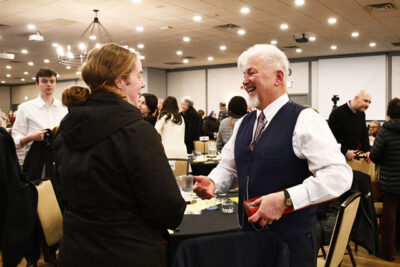
After exploring how traditional Indigenous stories were tools for teaching balance, responsibility and leadership during his presentation: Indigenous Childhood Stories Transform Worlds - Want Some? Dr. Don G. McIntyre greets audience members afterward.
Herald Photo by Joe Manio
After exploring how traditional Indigenous stories were tools for teaching balance, responsibility and leadership during his presentation: Indigenous Childhood Stories Transform Worlds - Want Some? Dr. Don G. McIntyre greets audience members afterward.By Joe Manio
Lethbridge Herald
What if the key to navigating today’s tangled political debates, cultural tensions and information overload isn’t found in another policy paper, but in a childhood story about dogs smelling each other’s butts?
At the University of Lethbridge’s February PUBlic Professor Series lecture, Dr. Don G. McIntyre made exactly that case.
Speaking Feb. 26 at the Sandman Signature Lethbridge Lodge McIntyre, an Anishinaabe scholar from Timiskaming First Nation and faculty member in the Dhillon School of Business, invited the audience to reconsider the power of Indigenous storytelling.
“This isn’t innovative,” he said. “What I’m doing is housekeeping. I’m trying to take the dust off ways of thinking…ways of being.”
His talk, Indigenous Childhood Stories Transform Worlds – Want Some?, explored how traditional Trickster stories featuring figures such as Raven, Coyote, Nanabush and Napi were never just bedtime entertainment. They were tools for teaching balance, responsibility and leadership long before those ideas were formalized in textbooks.
To illustrate, McIntyre returned to a childhood game he played on his grandfather’s farm: hoops and sticks. As children, they rolled metal hoops with sticks, adding more complex rules as they grew older.
It was simple. Intuitive. Clear.
Then McIntyre went to school.
There, the hoop became the letter “O.” Two sticks crossed became an “X.” The same shapes suddenly carried abstract meanings governed by rules that, when he asked why, were explained with a single answer: “Just because.”
That moment, he suggested, reflects how Western systems often layer complexity over simple truths, and expect acceptance.
“We feel like we have to accept that it’s complicated, but we don’t. We can push back and say: ‘Tell it to me simply,’” McIntyre told the audience.
In Indigenous storytelling traditions simplicity comes first. Trickster figures enter when systems are out of balance. Their role is to disrupt and ultimately restore harmony.
Although a five-minute Coyote story explaining why dogs sniff each other drew laughter; beneath the humour was a lesson about ego, humility and consequences. In other contexts, McIntyre noted, the same story could take days, each layer revealing deeper teachings.
“These stories are always true…not necessarily as literal history but as guides for human behaviour,” he said.
His presentation also touched on treaty relationships. Holding up a treaty coin design, McIntyre invited the audience to “read” the imagery: two figures shaking hands, a buried hatchet symbolizing peace, the rising sun of the British Empire. The visual promised equality and friendship.
But when the coin is flipped, he explained, the legal title rests with the Crown…a reminder of how simple agreements were absorbed into complex legal systems.
For McIntyre, the lesson isn’t to abandon modern life. He’s not advocating a return to pre-electricity living. Rather, he argues for clarity. If a six-year-old fresh off the farm can’t understand the explanation, perhaps it needs rethinking.
In a world of political spin, dense policy language and algorithm-driven information streams, McIntyre sees Trickster energy as something everyone can embody; the courage to ask basic questions and refuse to be overwhelmed.
“We all have Trickster in us. We have the power to say, ‘Dumb it down for me,’” he says.
In doing so, storytelling becomes more than cultural preservation. It becomes leadership. It becomes accountability. It becomes a way of restoring balance.
And perhaps, as McIntyre suggested with a smile, it begins by remembering a simpler world; one made of hoops and sticks.
The PUBlic Professor season concludes Thursday, with a presentation by Dr. Rob Williams: Legalized Gambling in Canada: Winners and Losers.
The final lecture will examine who benefits (and who pays) as gambling expands across the country, closing the series with a look at risk, revenue and responsibility.
26-25