

A Lagos rave rewrites the rules of nightlife, drawing young Nigerians priced out of club culture
By Canadian Press on March 5, 2026.
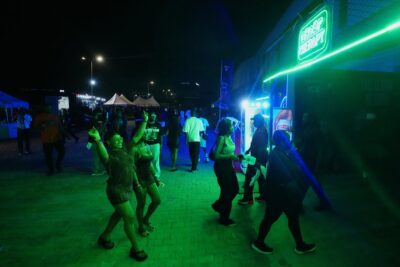
LAGOS, Nigeria (AP) — On a recent Friday night, thousands of mostly young people trooped into a large auditorium in Lekki, an upscale part of Lagos.
Inside, it was hard to discern the faces of people just meters away. The whole hall was dark, lit only by flashing green strobe lights from the stage. Those gathered had come together for therapy.
But this was Group Therapy, a popular rave in Lagos, where revelers come seeking a different party scene they wouldn’t find anywhere in Nigeria’s commercial heart of Lagos.
Lagos’ nightlife scene had, for decades, been dominated by table culture, a club experience that prioritizes how much people spend on drinks and prime seating. The party environment encourages a competitive atmosphere that young people who live in Nigeria, Africa’s most populous country, say has shut them out amid skyrocketing inflation.
At Group Therapy, there are no tables. Revelers in Lekki danced shoulder to shoulder. There was only one small bar, selling drinks for much less than the typical Lagos nightclub.
“At raves, the dance floor is present. You go to a usual Lagos party, and there is no dance floor,” DJ Aniko, the founder of Group Therapy, told The Associated Press. “We barely have spaces to just dance, spaces you can just go to literally have a nice time. Most places you have to make a reservation, or book a table, it is a lot more complicated.”
A Lagos party without tables
Yetunde Onikoyi, 28, started going to raves last year.
“Ever since then, I have been hooked by the neck; it is like a chokehold. I always want to be here,” Onikoyi said.
The nightclub culture has been determined by a table culture where partying is often a rat race of who buys the most drinks at the most expensive prices, and seats are reserved in a multitier system, including VVIP, VIP and the regulars.
A bottle of a drink can cost anywhere between 100,000 naria ($72.34) to nearly a million naira, thereby pricing out most of the young residents navigating a tough economic terrain. A parade of bartenders hoisting drinks with an LED board naming the table for some of the highest spenders of the night. A ticket for Group Therapy only costs 21,000 naira ($15.19), without the pressure to purchase drinks.
Experts say raves have grown in response to the table culture at clubs.
“Raves are more democratic,” said Oluwamayowa Idowu, founder of Culture Custodian, a leading culture publication in Lagos. “What this says is that people don’t have the purchasing power to sustain a club lifestyle. Clubs are still open and busy, but just generally in today’s climate, there is more of a focus on you enjoying yourself as opposed to you performing enjoying yourself.”
Aniko told the AP that several patrons have reached out to create separate seats, requests which they have declined on several occasions.
“Finding a place that still focuses on the human aspects of things, as against the materialism or need to amass as much as possible, is always a blessing,” said Dayo Williams, a consultant who had come to the party.
‘House music evokes feelings’
Each DJ worked their decks from the late night to early morning, blaring out an endless loop of high-tempo beats that electrically charged the hall, rising to a pulsating crescendo before dovetailing into another loop. The sea of heads bopped rhythmically and bodies swayed wildly.
Since around 2022 after the post-pandemic crossover of South African music genres, DJs have infused African sonic elements into house music, a subgenre of electronic dance music that has been a choice for raves in Lagos. The raves, deemed more inclusive than clubs, have become prominent among the younger generation, who have railed against Nigeria’s conservative society.
House music “evokes feelings,” said Zia Yusuf, a content writer and creator who attended. “You just connect to the music, and you connect to the music with other people who connect to the music with you.”
Culture experts regard it as one of the crossovers of South African musical influence, similar to amapiano.
Nigeria has, in recent years, taken the spotlight at global stages with an explosive rise of its artists, exporting its music across the world, but it has also, in turn, imported several genres in recent years. The choice of house music is deliberate, according to Aniko. Aniko doesn’t want musicians to control Group Therapy like they often do in big clubs, sometimes previewing unreleased songs or dictating the audience’s choice for the night.
“Once you are reliant on the mainstream industry for the music, the mainstream creeps into the space,” Aniko said.
Ope Adetayo, The Associated Press
-25