


City CFO presents budget impacts during council meeting
By Lethbridge Herald on March 11, 2026.
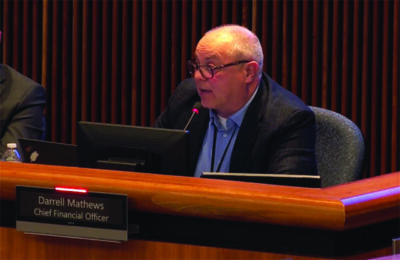 Herald photo by ALEJANDRA PULIDO-GUZMAN
Chief Financial Officer and Treasurer with the City of Lethbridge, Darrell Mathews
provides a presentation on the Provincial Budget Impacts to the City of Lethbridge
during Tuesday’s City Council meeting at City Hall.
Herald photo by ALEJANDRA PULIDO-GUZMAN
Chief Financial Officer and Treasurer with the City of Lethbridge, Darrell Mathews
provides a presentation on the Provincial Budget Impacts to the City of Lethbridge
during Tuesday’s City Council meeting at City Hall.By Alejandra Pulido-Guzman
Lethbridge Herald
Chief Financial Officer and Treasurer Darrell Mathews provided a presentation on Provincial Budget Impacts during Tuesday’s City Council meeting, for information only.
During the meeting, before Mathews gave his presentation, Mayor Blaine Hyggen explained that the budget is not passed until March 31 and things can change.
“For clarity, for members of Council and for the community, the fiscal year for the provincial government runs from April 1st of each year to March 31st of each year. So, the budget that came out just recently is now for 2026 to 2027,” explained Mathews.
He said the province has described the Budget 2026 as a budget that is holding the line on spending with targeted investments in such areas as education, healthcare, and workforce development.
“While the promise has avoided increases to personal and corporate taxes, the budget does include increases to provincial educational property taxes and maintain several policy directions that place financial pressures on the municipality and local taxpayers,” said Mathews.
He said a notable component of Budget 2026 is the increase in provincial educational property taxes.
“The province is implementing a 15 per cent increase in 2026, following a 14.3 per cent increase in 2025, as part of a strategy to fund roughly one third of kindergarten to Grade 12 education operating costs through the Education Property tax,” said Mathews. “In 2026, that share reaches approximately 33.4 per cent.”
He said for residential and farmland properties, the provincial tax rate will increase from $2.72 to $2.84 per 1000 of equalized assessment, while the non-residential rate will increase from $4.00 to $4.17.
“Because the education property tax is calculated using a provincial funding model, the amount collected varies by community. For the City of Lethbridge, the total combined education tax requisition is expected to increase by approximately 12.9 per cent in 2026,” said Mathews.
He said that although they have not completed the tax roll for 2026, they are currently estimating that for the average single family residential property in Lethbridge assessed at approximately $389,000, this change represents about $117 increase in 2026.
“Once again, I need to note that the city does not retain these funds. The city simply collects the education property tax on behalf of the province and remits it back to the Government of Alberta,” said Mathews.
He said in addition to the provincial budget, the city is also experiencing operating pressures resulting from recent legislative and policy changes, including changes in the Traffic Safety Act enforcement revenues which have resulted in an estimated $2.2 million budget pressure.
“As well as the implementation of body worn cameras for policing services creating approximately $800,000 in annual cost. And changes to election legislation requiring hand counting of ballots, which has significantly increased election administrative costs,” said Mathews.
To provide some broader context, Mathews shared that information provided by Alberta Municipalities highlighted that in 2009, municipalities received approximately $623 per person in provincial funding for infrastructure and local services. By 2024, that amount had fallen to approximately $318.
“In practical terms, this means that municipalities are now receiving roughly half the per person provincial funding we did 15 years ago to help support local services and infrastructure,” said Mathews.
He said for Lethbridge this dynamic is important because municipal governments are required to balance their budgets each year. Any increase in costs or reduction in provincial support must ultimately be offset by increased in local revenues such as property taxes, utility rates, per user fees or through adjustments to service levels.
“Council will need to consider these pressures as part of the upcoming discussions on the 2027 operating budget update and the 2027 to 2036 capital improvement program, which will be brought forward later this year,” said Mathews.
He said there are several key areas of the provincial budget that affect the City of Lethbridge’s capital and operating budgets and a significant increase to provincial education taxes which the city simply collects on behalf of the province.
“The first key area that affects the city’s capital budget is the Local Government Fiscal Framework (LGFF). The province has budgeted $800 million in 2026 to 2027 for this program, which remains the primary provincial grant supporting municipal infrastructure and some operating needs,” said Mathews.
He said that while the program provides predictable and formula-based allocations, their overall capital funding pool has not increased.
“Which means municipalities are experiencing limited growth and funding despite rising construction costs and infrastructure needs,” said Mathews.
For Lethbridge, Mathews said the preliminary 2026 LGFF allocation is approximately $15.6 million. These figures remain preliminary, and administration expects formal confirmation from the province in April of this year.
“However, when viewed over a longer time horizon, combined MSI and LGF funding between 2022 and 2031 is expect to average approximately 13.3 million annually for the city, which is about 37 per cent lower than the average provincial infrastructure funding we received in the previous decade,” said Mathews.
As a result, said Mathews, LGF funding alone will not be sufficient to offset the existing infrastructure pressures.
“For context, administration is currently reviewing more than $244 million in transportation and community infrastructure projects alone within the 2027 to 2030 period of the capital improvement program,” said Mathews.
He said across the full 2027 to 2036 CIB horizons, those transportation and community projects alone represent over $736 million in infrastructure needs.
“These estimates do not include the future expansion to the city’s water and wastewater treatment facilities or capital requirements related to the waste service and electric utilities,” said Mathews.
He also highlighted the Family and Community Support Service Budget 2026 allocations, which is $105 million provincially for FCSS programming.
“While this funding supports important preventive social services, it is important to note that FCSS funding has only increased by about five per cent since 2015, despite significant population growth and inflation during that time,” said Mathews.
For Lethbridge, said Mathews, FCSS allocation will remain stable at approximately $2.6 million annually for the period of 2026 through 2028.
When talking about the Policing Support Grant, Mathews said the allocation from Budget 2026 has not been confirmed.
“For reference, the city received approximately $2 million in 2025. However, the per capita and per officer funding levels used to calculate grants remain based on 2008 to 2009 values, meaning the funding has not kept pace with inflation and increasing cost of policing services,” said Mathews.
35-34





it is interesting with the increase in the education portion of the tax bills the CFO made it abundantly clear that the city collects on behalf’s of the provincial government. Well, Daryl, it’s all the same pocket. We won’t blame you, you don’t blame the province. Who to blame, the ATA, AFL, those that supported strike action, those whining incessantly about teacher shortages, not enough EA’S, and classroom complexities, and the NDP. You got your wish. Time to shut up and pay for it.