


Canada must rethink U.S. Ties as global order fractures
By Lethbridge Herald on March 13, 2026.
 Herald photo by Joe Manio
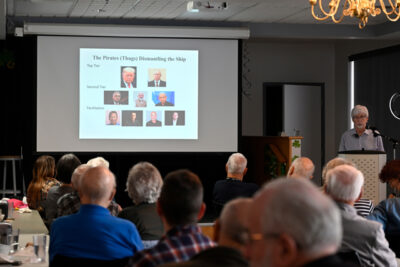
Dr. Trevor Harrison speaks to the the SACPA audience Thursday, using a slide of ÒpiratesÓ (thugs) with U.S. President Donald Trump at the top tier, to illustrate his warning about a fractured global order and CanadaÕs need to rethink its U.S. ties.
Herald photo by Joe Manio
Dr. Trevor Harrison speaks to the the SACPA audience Thursday, using a slide of ÒpiratesÓ (thugs) with U.S. President Donald Trump at the top tier, to illustrate his warning about a fractured global order and CanadaÕs need to rethink its U.S. ties.By Joe Manio
Lethbridge Herald
The global political order that helped shape Canada’s prosperity after the Second World War is breaking down — and the result increasingly resembles a world run by “thugs,” according to retired University of Lethbridge sociologist Dr. Trevor Harrison.
Speaking at this week’s Southern Alberta Council on Public Affairs (SACPA) meeting, Harrison said the instability reflects deeper changes in global capitalism that have weakened the American empire and destabilized the system it once led.
“Donald Trump is really the symptom of something that has gone on for decades — probably a couple of centuries,” Harrison told the audience.
“Right now we have what looks like pirates taking over the ship of state. They’re stealing the nails out of the ship even if it means the whole thing sinks.”
Harrison framed his talk around remarks earlier this year by Prime Minister Mark Carney at the World Economic Forum in Davos, where Carney warned of a “rupture” in the international order.
For much of the post-war period, Harrison said, the U.S.-led system helped stabilize global capitalism and allowed Western middle classes to grow through what he described as a “grand bargain” between labour and capital.
“We got a middle class. We got houses. We got healthcare,” he said. “We got a whole bunch of things that looked really quite good.”
Beginning in the late 1970s and accelerating through the 1980s, governments dismantled restrictions on capital and embraced globalization, allowing money to move freely across borders.
The result, Harrison said, was growing instability and an unprecedented concentration of wealth.
“Unregulated capital inevitably leads to social and political chaos,” he said.
“The number of billionaires has increased exponentially, and money is not just money — it’s political power.”
Harrison argued the financial crisis of 2008 marked a turning point, eroding public faith in political institutions and fuelling anger that later helped propel figures like Trump to power.
“A lot of people lost faith in the American dream,” he said. “They saw that the people responsible were never punished.”
In response to an audience question about whether Trump is truly driving global turmoil, Harrison said the former president’s behaviour reflects deeper systemic forces — even if his personality adds volatility.
“If he actually had a plan, you’d see a plan,” Harrison said.
“But there’s no plan. He’s chaotic, and that chaos reflects the deeper problems within the system.”
In Harrison’s view, the United States must be understood differently than the idealized democratic image often presented in popular culture.
“The United States has never really been a democracy in a genuine sense,” he said. “It is effectively a vehicle for capital accumulation.”
As American dominance weakens, Harrison warned its response may become more aggressive abroad and at home — a pattern common in declining empires.
“Empires don’t just police the outside,” he said. “Eventually they start policing their own populations as well.”
For Canada, the shift raises questions about how closely it should align itself with its powerful neighbour.
Harrison criticized what he described as lingering illusions about the Canada–U.S. relationship.
“The United States is not our friend. It never has been,” he said. “States have interests, and their interests are not necessarily the same as ours.”
Instead, he suggested Canada focus on strengthening local communities, protecting public services and defending democratic institutions.
“Defending things like healthcare is part of defending Canada,” Harrison said. “Once you privatize something, it ends up owned by billionaires who are not working in the interests of Lethbridge or anywhere else.”
Despite the bleak diagnosis, Harrison closed with a cautious note of hope.
“Stay close with friends, colleagues and loved ones,” he told the audience.
“As dark as it is, the only way you get to the light is to fight through it.”
He likened the moment to the uncertainty of 1939, before the world emerged from the Second World War.
“It may feel like September 1939,” Harrison said. “But eventually May 1945 came. A new world began — and we can build a better one this time.”
33-32