


Workers’ Agenda takes aim at Alberta’s widening economic divide
By Lethbridge Herald on March 20, 2026.
 Herald photo by JOE MANIO
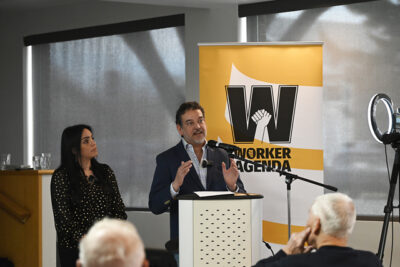
Alberta Federation of Labour president Gil McGowan and secretary treasurer Cori Longo presented the WorkerÕs Agenda during the weekly Southern Alberta Council on Public Affairs meeting Thursday; calling for an economy that works for everyone.
Herald photo by JOE MANIO
Alberta Federation of Labour president Gil McGowan and secretary treasurer Cori Longo presented the WorkerÕs Agenda during the weekly Southern Alberta Council on Public Affairs meeting Thursday; calling for an economy that works for everyone.By Joe Manio
Lethbridge Herald
If Alberta’s economy is working as designed, then the question raised Thursday at the weekly Southern Alberta Council of Public Affairs (SACPA) meeting was a simple one. Who exactly is it working for?
At a one-hour Noon session at the Lethbridge Senior Citizens Organization (LSCO), Alberta Federation of Labour (AFL) president Gil McGowan laid out what he calls the “Workers’ Agenda,” a policy roadmap aimed at shifting the balance back toward working people in a province where, he argues, prosperity has become increasingly uneven.
Developed by labour groups and community partners, the Workers’ Agenda focuses on issues many Albertans are already feeling in their daily lives. Rising housing costs, wage stagnation, strained public services and concerns about workplace safety all feature prominently.
McGowan’s message was clear. These are not isolated problems. They are the result of policy choices.
“This didn’t just happen,” McGowan told the audience. “We have one of the richest economies in the world and yet a growing number of people are struggling just to get by. That’s not an accident.”
AFL secretary-treasurer and co-presenter Cori Longo reinforced that the issues outlined in the agenda are not theoretical.
“These aren’t abstract issues,” Longo said. “These are things people are dealing with every day in their workplaces and in their lives.”
McBowan argued that Alberta’s economic story is often told through growth statistics and resource revenues, but that those numbers obscure a more complicated reality for many families.
“People are working full-time and still can’t afford housing or basic necessities. This came out of conversations with workers and community members about what they’re actually facing,” McGowan said.
Longo added that the platform itself was built from those lived experiences.
At the heart of the issue is a long-term shift in who holds power in the economy, according to McGowan.
“Over time, the rules of the economy have been rewritten, and not in favour of working people,” he said.
The Workers’ Agenda, he explained, is intended as both a policy framework and a rallying point. Its priorities include stronger labour standards, better wages, affordable housing strategies and renewed investment in public services.
“We’re saying it’s possible to build an economy that works for everyone, not just those at the top. But it requires different choices,” McGowan said.
Not everyone agrees with that approach, he acknowledged, but framed the debate in broader terms.
“The question is what kind of economy we want,” he said.
McGowan also tied economic concerns to what he described as a broader erosion of democratic norms, pointing to growing willingness by governments to consider tools such as the notwithstanding clause.
“You can’t separate economic rights from democratic rights,” he said. “When one erodes, the other follows.”
Without diving into specific legislation, he was direct in his criticism of the province’s current direction on labour relations.
“Policies that weaken unions or make it harder for workers to organize don’t create prosperity,” he said. “They shift power.”
At the same time, he pushed back on the idea that stronger labour protections come at an economic cost.
“When workers have a voice, wages are higher, workplaces are safer, and communities are stronger,” he said. “That’s not ideology, that’s evidence.”
The message resonated with many in attendance, particularly during the question and answer portion, where community voices added urgency to the discussion.
Barb Phillips of the Raging Grannies did not mince words.
“If we don’t push back, we’re going to keep losing ground, not just economically but democratically,” she said.
Her comment drew nods from across the room, underscoring a shared concern that the challenges facing workers extend beyond paycheques and into the broader health of democratic institutions.
McGowan agreed, emphasizing that the Workers’ Agenda is as much about engagement as it is about policy.
“Change only happens when people get involved. It doesn’t happen on its own,” he said.
As the session wrapped up the tone remained cautious but not without optimism. The challenges facing Alberta workers are significant but not fixed in stone.
“The future isn’t predetermined. It’s shaped by the choices we make,” McGowan said.
A rally connected to the Workers’ Agenda are planned around Alberta, offering other opportunities for supporters to bring those conversations beyond meeting rooms and into the public square.
For those in attendance, the message was clear. The Workers’ Agenda may begin as a policy platform, but its impact will depend on whether Albertans decide to take part in shaping what comes next.
35-34