


Five things on the Bill 21 Supreme Court hearings this week in numbers
By Canadian Press on March 22, 2026.
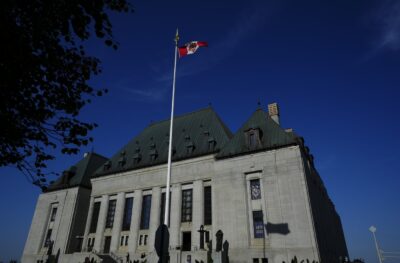
MONTREAL — The Supreme Court of Canada will begin hearing arguments Monday over Quebec’s secularism law, known as Bill 21.
The law has faced legal challenges since its adoption in June 2019 and the Supreme Court of Canada will now listen to arguments on the legislation and its pre-emptive use of the Charter of Rights and Freedoms Section 33, the notwithstanding clause, to shield it from rights violation challenges.
Here are a few numbers behind the case, which will be heard by the high court over four days this week in Ottawa.
142 — the number of lawyers taking part in the case before the country’s highest court, although not all will be allotted time to argue before it.
61 — the number of parties expected to be heard over the four-day hearing.
51 — the number of parties that have intervener status, including a half-dozen governments, including the federal government, Ontario, Manitoba, Saskatchewan, Alberta and British Columbia, who will each have 15 minutes to argue. Meanwhile, the 45 other parties who have intervener status will have five minutes each to make their arguments.
6 — The case involves six appellants, primarily the English Montreal School Board, which prevailed at the Quebec Superior Court level before being overruled on appeal; the Fédération autonome de l’enseignement, a teachers’ union; the World Sikh Organization of Canada; and Ichrak Nourel Hak, a Muslim woman of Moroccan origin who wears the hijab and is joined by the National Council of Canadian Muslims and the Canadian Civil Liberties Association.
4 — On the respondents’ side are four parties, including the attorney general of Quebec representing the Quebec government, the Mouvement laïque québécois, a pro-secularism group; and the organization Pour les droits des femmes du Québec, a feminist organization.
This report by The Canadian Press was first published March 22, 2026.
— with files from Pierre Saint-Arnaud in Montreal.
The Canadian Press
14-13