


Budget watchdog nominee promises ‘pointy analysis’ as MPs question independence
By Canadian Press on March 23, 2026.
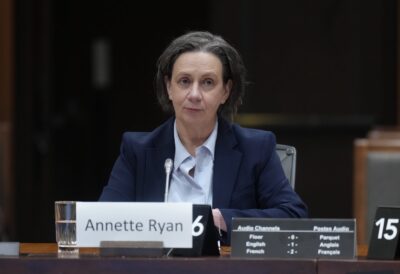
OTTAWA — Ottawa’s choice for the next federal fiscal watchdog promised not to go lightly on the federal government if she is confirmed for the post.
Annette Ryan, a longtime public servant and the current deputy director at Canada’s financial intelligence agency, Fintrac, was named as cabinet’s pick to lead the Office of the Parliamentary Budget Officer earlier this month.
Ryan’s nomination has to be approved by the House of Commons and the Senate and she faced questions from MPs on the finance committee Monday afternoon.
“I intend to provide you with high-quality, independent and relevant analysis so that you can hold the prime minister, his ministers and senior officials to account,” Ryan told MPs in her opening statement.
Ryan’s testimony was clouded at times by MPs’ focus on Jason Jacques, the former interim PBO whose term expired earlier this month.
Conservative MPs said Monday they would vote against Ryan’s nomination because they want Jacques to take on the permanent role.
Conservative MP Sandra Cobena told reporters that not renewing Jacques’ six-month term was akin to firing the former budget watchdog, who was critical of Liberal finances early in his tenure.
Numerous MPs prefaced their questions to Ryan on Monday by stating their satisfaction with Jacques in the PBO role. Ryan repeated multiple times throughout the committee her “deep respect” for Jacques and his predecessors in the role.
Bloc Québécois MP Jean-Denis Garon said after the committee hearing Monday that he went into the meeting with an “open mind” and said his party has not decided whether to support Ryan’s nomination.
Garon took issue with the closed process for selecting a new PBO and said he would have liked to compare Ryan with other candidates for the permanent position.
“It’s never the skills that are questioned. It’s the independence,” he said. “And I think she defended her point well.”
Conservative MP Jasraj Singh Hallan asked whether Ryan would be comfortable speaking out if she felt she was being pressured to tailor her analysis. She responded by committing to serving parliamentarians — not the party in power.
“I would see you collectively as my boss. I think that the key of that role is to provide you with exactly that pointy analysis,” she said.
Ryan took the step of promising to seek only one term as PBO to avoid any suggestion that she could compromise her analysis in exchange for partisan favours.
While Ryan said she would “hold the government’s feet to the fire” on spending decisions, she said “fiscal sustainability is not a partisan issue.”
“Nobody’s agenda gets carried if you hit the fiscal wall,” she said.
Jacques made a splash on Parliament Hill early in his tenure by describing the Liberals’ debt track as “stupefying” and not sustainable — language he later expressed regret over using.
Ryan said she would present the office’s fiscal analysis in a way that makes clear the implications of spending decisions, but added she would leave the “stark language” to parliamentarians.
Numerous MPs asked for Ryan’s opinion on the state of federal finances. She largely deferred to existing analyses from sources like the International Monetary Fund which say that Ottawa’s debt levels are sustainable.
Jacques also said after the Liberals tabled the fall budget in November that the debt track was sustainable over the long term, though he argued the feds had used up some of their fiscal buffer to absorb future shocks.
In response to questions from Singh Hallan, Ryan acknowledged it’s a risk for the Liberal government to abandon previous fiscal anchors related to the debt-to-GDP ratio.
Brought up in Newfoundland and Labrador and later in Prince Edward Island, Ryan is a Rhodes Scholar with degrees from Acadia University and Oxford University. She has served in a variety of roles across Canada’s public service during her career.
In her opening statement, Ryan ran through a cross-partisan list of ministers she has supported over the course of her career in Ottawa — among them Conservative Leader Pierre Poilievre.
Ryan was asked about her relationship with Prime Minister Mark Carney, whose time studying at Oxford overlapped with her own in the early 1990s.
Ryan said that while she and Carney knew each other “as Canadians” abroad, they ran in different social circles.
The two later crossed paths back in Ottawa, she added, when she was the chief economist at Industry Canada and Carney was the governor of the Bank of Canada. She said most of their interactions at this time were through his office, not directly, and they did not have any contact after Carney went back across the pond to head up the Bank of England.
This report by The Canadian Press was first published March 23, 2026.
Craig Lord, The Canadian Press
31-30