


Lethbridge firefighters pack council chambers to hear update on ambulance service
By Lethbridge Herald on March 25, 2026.
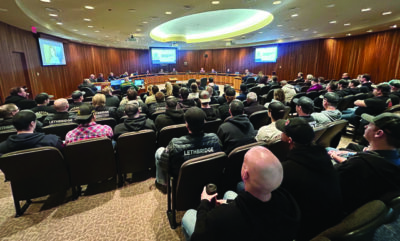 Photo by Alejandra Pulido-Guzman
Dozens of Lethbridge Fire and Emergency Services members listen to a presentation on ground ambulance service agreement during TuesdayÕs city council meeting at city hall.
Photo by Alejandra Pulido-Guzman
Dozens of Lethbridge Fire and Emergency Services members listen to a presentation on ground ambulance service agreement during TuesdayÕs city council meeting at city hall.By Alejandra Pulido-Guzman
Lethbridge Herald
Lethbridge city council saw a full house on Tuesday, where dozens of Lethbridge Fire and Emergency Services members attended the meeting in hopes to receive an update on the Ground Ambulance Agreement.
A presentation entitled “Emergency Health Services, Ground Ambulance Service Agreement update,” was placed in section 9 of the agenda after city council approved the addition.
Acting City Manager Darrell Mathews provided the update. He started by stating that the agreement between the City of Lethbridge and EHS – Alberta is expiring on Sept. 30, and on March 13, EHS advised the city of their intent to move toward a new ground ambulance agreement model, based on cost alignment with EHS – Alberta own service delivery.
Mathews said on March 11, administration was invited by EHS to attend a 15-minute meeting scheduled for March 13, titled Ground Ambulance Service Agreement.
“During that meeting, EHS formally advised that it was offering municipalities the opportunity to enter into new agreements in a cost equivalent to its internal delivery model,” said Mathews.
He said EHS indicated that current funding levels in communities like Lethbridge exceed this cost structure, and that this is a principle it can no longer maintain.
“Their position is that the current agreement provides funding above their cost benchmark, and from their perspective, it’s not sustainable moving forward,” said Mathews.
Lethbridge City Council has supported providing a higher standard of service to the community through the integrated fire and emergency services model. This involves both the strong EHS partnership, as well as additional municipal funding.
“ What is currently being proposed by EHS, will provide the city with less funding than the current EMS contract,” said Mathews.
He said EHS – Alberta has outlined two primary paths for the city. The first option is for the city to accept the EHS cost model.
“Under this approach, the city would agree, in advance, to deliver EMS at EHS’s benchmark rate, with any cost above that level, becoming the responsibility of the city, and ultimately local taxpayers,” said Mathews.
He said the second option is to decline the EHS cost model and in that scenario, EHS – Alberta has indicated it would pursue an alternative service delivery model for the Lethbridge community, which could include a competitive procurement process or direct provincial delivery.
“EHS Alberta has requested that the city provide a written response on its preferred approach with the most recent extension moving that deadline to April 30, 2026,” said Mathews.
He said they advise that if the city agrees to cover any costs above EHS benchmark rate, they are prepared to enter into negotiations for a new, long-term agreement.
“However, EHS has not provided the factors, methodologies, and assumptions EHS has used to compare the cost of EHS delivered ambulance services with the municipality delivered services,” said Mathews.
He said the city needs to understand what specific costs are included, and more importantly, not included in the EHS equivalent cost.
Mathews says they asked that question on March 18 and have not received the answers at this time.
“EHS also reiterated that if the city does not enter into a new agreement, at the benchmark costs, service delivery in Lethbridge would either move to competitive request for proposal process, or transition to a direct provincial delivery,” said Mathews.
Mathews said they have also indicated that an extension of the current agreement may be required to allow sufficient time for negotiations, depending on council’s direction.
“It is important to know that both of these paths carry significant implications, both financial and from service delivery perspective for the city and our residents,” said Mathews.
He said this includes considerations related to service levels, integration with fire services, and the overall impact on future operating budgets and property taxes.
“Administration has been actively working across multiple departments, including Fire and EMS, finance, legal, people and culture, and communications to assess these options, validate assumptions and understand the full scope of the impacts,” said Mathews.
He explained that healthcare, and by extension emergency medical services, is the responsibility of the government of Alberta. EHS – Alberta operates as the provincial health authority responsible for managing all aspects of the EMS system across the province.
“This includes oversight and delivery of both air and ground ambulance services, inter-facility patient transfers and dispatch operations,” said Mathews. “EHS also manages services delivered through contracted providers, which includes municipalities like the city of Lethbridge.”
He said for many years, the city has maintained a longstanding contractual relationship with EHS to provide ground ambulance services to our community. Under this model, the city delivers EMS locally on behalf of the province within a provincial coordinator system.
“This context is important, as it reinforces that while the city plays a key role in service delivery, the authority, funding framework, and the system design ultimately sits with the province through EHS,” said Mathews.
He said understanding this relationship helps frame the options before council and the nature of the discussions they are having with EHS.
“For over 100 years, the city has recognized the integrated fire and EMS system as an effective way to provide best in class care,” said Mathews.
He said that since 2009, when EMS moved under provincial jurisdiction, this has been achieved through a contract with EHS formerly known as Alberta Health Services.
“In 2014, that agreement was expanded to include a total of eight ambulances. Four operating on a 24-hour basis and four operating on a 12-hour basis to better meet our community demand,” said Mathews.
He said most recently, in March of 2024, the city entered into a two-and-a-half-year agreement with Alberta Health Services, which is currently set to expire on Sept. 30 of this year.
“This most recent agreement expanded to include 10 ambulances, four operating a 24- hour basis, and six on 12-hour basis,” said Mathews.
37
-36