


Why the humble bumblebee deserves a closer look
By Lethbridge Herald on March 27, 2026.
 Herald photo by JOE MANIO
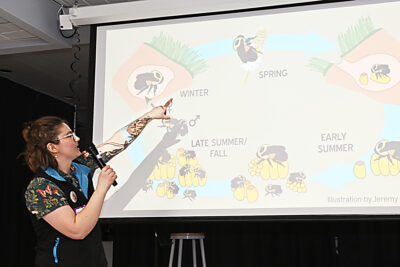
Rachel Morris explains the life cycle of bumblebees during the SACPA weekly meeting at the LSCO Thursday.
Herald photo by JOE MANIO
Rachel Morris explains the life cycle of bumblebees during the SACPA weekly meeting at the LSCO Thursday.By Joe Manio
Lethbridge Herald
If you needed a reminder that spring is inching back into southern Alberta, you could do worse than listening for a low, familiar buzz.
Bumblebees are among the first pollinators to emerge after winter, often appearing before the landscape has fully shaken off the cold. Fuzzy, loud and a little clumsy in flight, they’re also far more important than most of us realize.
That was the message at Thursday’s Southern Alberta Council on Public Affairs (SACPA) session in Lethbridge, where speakers Chantel Youmans and Rachel Morris unpacked the outsized role these small insects play in keeping ecosystems and food systems running.
The short version: without bumblebees, a lot of what we take for granted simply doesn’t work as well.
Pollination—the transfer of pollen between flowers—is essential to plant reproduction and underpins everything from backyard gardens to broader food webs.
“When a bee visits a flower, it’s really just out to get lunch,” Morris told the audience. “Any pollination that happens is incidental, but it’s still incredibly beneficial.”
As bees move from flower to flower, they leave pollen behind, allowing plants to produce fruits and seeds that sustain wildlife and regenerate landscapes.
To understand them, Morris stepped far back in time, asking the audience to imagine a world long before flowering plants or land animals. Bumblebees evolved about 34 million years ago in alpine regions of eastern Asia.
“With their fuzzy bodies and ability to regulate their temperature, they’re really well suited to cooler climates,” Morris said. “That’s why they do so well in places like Canada.”
Over time, they spread across continents, establishing the diverse pockets of species found today, including in southern Alberta.
Not all bees, however, are the same.
“This is not a bumblebee,” Morris said, pointing to a honeybee slide. “Honeybees are not native to North America. They’re more like livestock. They’re managed.”
That distinction matters. Unlike managed honeybees, wild bumblebees rely on natural habitat, often nesting underground in abandoned burrows or sheltered soil.
Their life cycle is also fragile. Each colony lasts just one season, with only a single queen surviving the winter to start again in spring.
“What that means is the successful overwintering of those queens is absolutely essential,” Morris said. “If they don’t make it, there are no bumblebees next year.”
Bumblebees are also highly effective pollinators thanks to buzz pollination, where they vibrate flowers to release tightly held pollen—especially important for plants like blueberries and raspberries.
Despite all this, they are in decline.
Habitat loss, climate change, pesticide use and disease all play a role, though the exact causes can vary by species.
“It’s complicated,” Youmans said. “Different species are declining for different reasons, and we don’t always know exactly why.”
Some species are faring better than others. Generalist bumblebees that feed on a wide range of plants appear to be holding steady, while more specialized species are declining more quickly.
Even so, the trend is concerning, particularly in regions like southern Alberta that still host a relatively high diversity of species. More than 20 types of bumblebees have been recorded in the Oldman watershed alone.
The good news is that helping them can start close to home.
Providing habitat is key. Bumblebees need flowers blooming from early spring through late fall, along with undisturbed places to nest and overwinter.
“If you’ve got a slightly messy corner of your yard, that’s actually a good thing,” Youmans said. “Those patches of soil or old grass can be exactly what queens are looking for.”
Early-season blooms are especially critical. Even common dandelions can provide an important first food source when little else is available.
For those looking to go a step further, native plants and flowering shrubs can help fill seasonal gaps. Even a shallow dish with water and stones can give bees a safe place to land and drink.
Another step is contributing to community science through platforms like iNaturalist, where residents can upload photos of bumblebees to help track local populations.
“You don’t need to know what species it is,” Youmans said. “The important thing is that the observation gets recorded.”
That small act, she added, can have an outsized impact.
-3