


Second Chances – one repair at a time
By Lethbridge Herald on March 31, 2026.
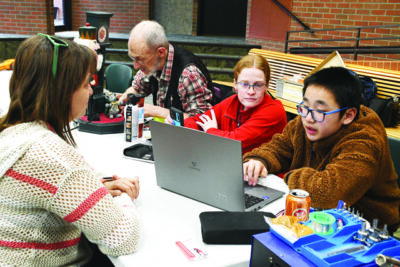 Twelve-year-old Shawn Yang and Amber Smith troubleshoot an overheating laptop while Sjoerd Schaafsma works on a Nutracker-themed clock during the Lethbridge Public Library (LPL) Repare Cafe at the Main Branch Saturday.
By Joe Manio
Lethbridge Herald
At a table inside the Theatre Gallery of the Lethbridge Public Library (LPL), a laptop hums louder than it should, its fan straining under the heat. Twelve-year-old Shawn Yang leans in alongside Amber Smith of Nerds On Site, working through the overheating issue piece by piece. For now, it’s not headed for the landfill.
Beside them, Sjoerd Schaafsma disassembles a large Nutcracker-themed clock, its inner workings spread across the table. Across the room, volunteers with sewing machines stitch new life into worn clothing and torn fabric.
People gather, not just to watch but to learn.
On March 29, the second Repair Café, hosted with Environment Lethbridge, transformed the library into a hands-on hub where neighbours helped neighbours fix what might otherwise be thrown away.
“We hope repair cafes provide an alternative so damaged items don’t have to be discarded,” said Kathleen Sheppard of Environment Lethbridge. “The fewer items in the garbage, the better for the environment.”
Circular Economy Coordinator Tristen Mysyk saw the impact firsthand.
“We got great community support,” he said. “Many left with repaired items or instructions to complete repairs that couldn’t be done on site.”
A Repair Café invites residents to bring broken household items—clothing, appliances, electronics—and work with volunteer “fixers” to repair them or learn how. The goal is to reduce waste, build skills, and reconnect people with the value of repair.
That shift was visible all afternoon.
A dozen volunteers, ranging from hobbyists to experienced tinkerers, worked side by side with community members, tackling sweaters with holes, broken zippers, lamps, kettles, and coffee makers.
“We had a bit of everything,” Sheppard said. “Textiles are definitely the most popular… it’s great to see people wanting to have those items repaired.”
For Schaafsma, the appeal is as much about people as objects.
“The best part is seeing someone realize their item isn’t just garbage,” he said. “You can fix it, and they can learn how too.”
The Repair Café also doubled as a meeting place, where generations and skill sets overlapped, bringing together volunteers and participants willing to spend part of their weekend repairing instead of replacing.
“One of the best things was how many volunteer fixers returned,” Sheppard said. “Many told us how much they enjoy helping others.”
Yang first learned about the opportunity from a poster at CASA. Working alongside more experienced fixers, he quickly found his footing diagnosing computer issues, including the overheating laptop in front of him.
“My favourite part is using the knowledge I’ve been learning,” he said. “There are a lot of people willing to share what they know.”
That exchange of knowledge is something Schaafsma sees firsthand.
“Everyone brings something different,” he said. “You might have years of experience in one area and learn something new from someone else at the next table.”
Even when a repair fails, there’s value in the process.
“Throwing something away is easy; figuring out how to fix it can be difficult,” Sheppard said. “Repair cafes bridge that gap. People leave more confident to try repairs in the future.”
When something can’t be fixed on site, Mysyk said the focus shifts to reuse and responsible disposal.
“We encourage reusing components when possible and provide resources for proper disposal so electronics and other recyclables don’t end up in landfills,” he said.
For Yang, that sense of growth is part of the appeal.
“Go for it,” he said. “Volunteering builds skills that will come in handy someday.”
Behind it all is a network of volunteers and growing interest in becoming one.
“I think we are seeing more people wanting to be ‘fixers’ in their own lives,” Mysyk said. “They see the need for repair over replacement, whether for economical or environmental reasons.”
“We couldn’t do this event without them,” Sheppard added. “They make it possible.”
The first Repair Café, held in October 2025, drew strong interest. The second built on that momentum, with another session planned for Sunday, June 22 at 1:30 p.m., as organizers work toward making the event a regular community fixture.
Back in the Theatre Gallery, the work continues.
A clock is pieced back together. A seam is reinforced. A once-overheating laptop cools under careful attention. Items that might have been discarded are given another chance.
And in that shared effort, something else takes shape: a shift away from throwaway habits toward something more sustainable, connected, and community-driven, one repair at a time.
35-34