

Poll
Do longer days actually improve your mood?
- Yes (70%, 332 Votes)
- No (30%, 141 Votes)
Total Voters: 473
 Loading ...
Sponsored
Farming Smarter kicks off 2026 with focus on practical research and real-world results
By Lethbridge Herald on April 1, 2026.
 Herald photo by JOE MANIO
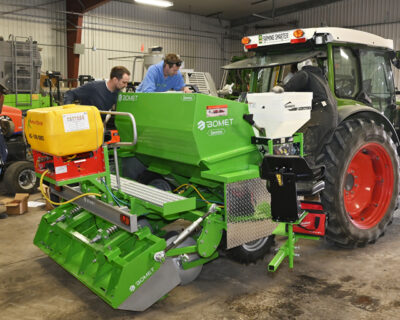
Farming Smarter technicians inspect and learn the workings of a research tractor with a specialized potato seeding attachment, gearing up for a season of hands-on crop trials near Lethbridge.
Herald photo by JOE MANIO
Farming Smarter technicians inspect and learn the workings of a research tractor with a specialized potato seeding attachment, gearing up for a season of hands-on crop trials near Lethbridge.By Joe Manio
Lethbridge Herald
If you ate today, this story concerns you.
That’s the quiet reality behind the work of Farming Smarter, a Lethbridge-area non-profit that officially launched its 2026 season Tuesday with a clear message: agricultural research isn’t just about farmers—it’s about food security, economic stability and how well southern Alberta adapts to an increasingly uncertain future.
“Healthy agriculture creates healthy communities,” said external communications lead David Opinko in opening remarks.
Based just east of Lethbridge, Farming Smarter operates as an agricultural innovation hub, working directly with producers and agribusinesses to test ideas, solve problems and translate science into something usable in the field. Or, more accurately, in your field—whether you farm it or simply rely on what comes out of it.
Executive director Ken Coles said the organization is entering 2026 with fresh momentum.
“There’s a lot of change here—new people, new purpose, some restructuring—as we try to meet the needs of farmers,” said Coles. “But we’ve got a great crew, strong support, and a full slate of projects.”
From lab coats to tractor tires: at its core, Farming Smarter fills a critical gap between research and real-world application. Its work ranges from small-plot agronomy trials to full-scale, on-farm testing through its “Field Tested” program, as well as third-party product validation for industry.
That work is becoming even more vital.
Recent federal decisions to close several agriculture research centres—including one in Alberta—have left fewer public resources available, increasing pressure on organizations like Farming Smarter to pick up the slack.
“I think organizations like ours are the obvious solution to those cuts,” said Coles. “But those are big shoes to fill.”
Research manager Lewis Baarda sees the impact firsthand.
“We’ve effectively lost half of our weed science capacity in the province,” he said. “The problems don’t go away, so groups like us have to step in and make sure that work continues.”
And those problems are anything but theoretical.
Water, soil and the bottom line: among this year’s headline projects is new research into growing spring wheat under reduced irrigation—an increasingly relevant question as southern Alberta grapples with water constraints.
“We’re trying to answer a simple question,” said Baarda. “How much water do you actually need to grow a wheat crop—and how much can you safely cut back?”
The goal is to help farmers redirect limited water supplies to higher-value crops without sacrificing overall productivity.
Other ongoing work includes the multi-year “Saving Soils” initiative, which tackles wind erosion—an ever-present challenge on the Prairies—as well as updated fertilizer response research aimed at improving efficiency amid rising input costs.
“We haven’t really reset those benchmarks in decades,” Baarda said. “With better genetics and better practices, we need to ask what optimal looks like now.”
Even weeds are getting attention, with kochia—an aggressive, drought-tolerant plant—emerging as one of the region’s biggest threats to crop yields.
Precision tools for practical answers: backing all of this research is specialized equipment designed to mimic real farm conditions as closely as possible.
Coles pointed to a modified potato planter—about the size of a scaled-down field unit—as an example. Outfitted with custom compartments and variable-rate controls, it allows researchers to test different fertilizer applications and seed spacing with precision.
“It’s one of those things where the modifications cost more than the machine itself,” he said. “But you need the right tools if you’re going to generate results farmers can actually use.”
Why it matters beyond the farm gate: while much of the work is rooted in agriculture, its ripple effects extend far beyond.
A stronger farm sector supports local jobs, attracts investment and helps maintain Canada’s role as a global food producer. There are environmental stakes as well, from soil conservation to water use and carbon management.
“The better farmers do, the better the whole region does,” said Baarda. “And at the end of the day, we all depend on that system.”
Looking ahead: for Coles, success in 2026 won’t be measured by a single breakthrough, but by connection.
“The biggest goal is engagement,” he said. “We need people—farmers, industry, the public—to be part of what we’re doing. Because if we lose that connection, we lose everything.”
With nearly 200 trials planned this season and a growing role in Canada’s research landscape, Farming Smarter is betting that practical, boots-on-the-ground innovation will continue to carry the day.
And if it works, most people won’t notice.They’ll just keep eating.
32-31