


A daring scene on Broadway this season has audiences talking, in more ways than one
By Canadian Press on December 23, 2025.
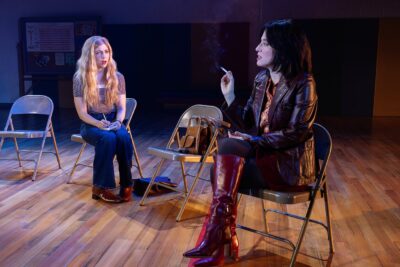
NEW YORK (AP) — On any given evening as the lights come up on Act 2 of “Liberation,” Bess Wohl’s intergenerational Broadway play about a women’s consciousness-raising group, you can hear supportive cheers of “Whoo!” and “Yeah!” — and sometimes, a round of applause. All before a single word has been uttered.
There’s a reason for the burst of appreciation — or solidarity? — from the crowd. Onstage, six characters are launching one of the bolder scenes on Broadway in this, and perhaps many a season. Each one — members of a makeshift group sometime in the ’70s — strips naked, for some 15 minutes of dialogue.
Wohl says she wondered, back when she was writing, whether “Liberation” might become known as “that play with the naked scene” — with the rest collapsing around it. Thankfully, the playwright says, the conversation has been much larger.
“I’ve been very gratified,” she says of the reaction. “It doesn’t feel titillating or gratuitous or gimmicky. It feels like a really important piece of the work that the women in the consciousness-raising group are doing.”
The idea came to Wohl as she was researching what such groups — women of different ages, races and economic backgrounds — actually did. She learned that exploring their bodies was a major need.
The play is set mainly in the ’70s, occasionally toggling to the present. For context, it was in 1970 that “Our Bodies, Ourselves,” the groundbreaking work on women’s health and sexuality, was initially self-published, with the first commercially published print edition in 1973.
“They were growing up in a time where their doctors were male, gynecologists were male, obstetricians were male,” says actor Susannah Flood, who performs the scene every night. “There was no conversation about female anatomy that was considered polite. And they needed, as a way of taking agency … to get to know their bodies. So, they got naked.”
The scene — in which the women try an exercise they saw in Ms. Magazine — begins with discomfort. “It doesn’t seem sanitary,” one says, about sitting in the gym chairs. The “assignment” is for each to describe one thing they like about their body, and one they don’t. The answers range from laugh-out-loud raunchy to poignant.
The 60-ish Margie, played by Betsy Aidem, hates the unsightly scar from her C-section. “It feels unfair somehow,” she says. Her children got life, her husband got the family he wanted, “and I ended up this sad husk with this hideous scar.”
Flood, whose character, Lizzie, is both protagonist and host, finds there’s been a lucky convergence of the play’s subject matter — people talking to each other — and the buzz she feels in the audience each night: also, people talking to each other.
A key reason: Theatergoers must surrender their phones upon arriving, to be secured in special pouches which remain with them but can only be opened by staff. And so, with no emails to send or texts to check, people truly seem to be doing more talking.
The power of conversation — and freedom from phones
“The real power of conversation — it’s a theme of the play,” says Flood, whose Lizzie travels in time to better understand choices her mother made. “And because we have this scene where we all get naked, people have to surrender their cellphones. Honestly, I think that’s a huge reason the show has garnered the organic response it has.”
The no-phone rule — flagged on the show’s website — is scrupulously followed. One recent evening, a guard spotted a theatergoer scrolling on her phone during intermission; she’d neglected to offer it for lockup. The guard politely but firmly led her from her seat to theater staff in the lobby, to pouch the offending device.
Mostly, though, people seem grateful to be rid of their phones, says producer Daryl Roth.
“Over and above the nude scene, it’s a sense of freedom for the audience,” Roth says. “They can only think about this play right now. And isn’t that what we want? Come in for two and a half hours and give yourself over to what’s on the stage. It’s liberating.”
New York theatergoer Tracy Bonbrest, who attended “Liberation” with her book club, says she found herself “much more attentive, immersed in the experience than if I’d had my phone with me.” She was sitting next to someone she hadn’t met before. “If I’d had my phone, or she had hers, we probably wouldn’t have engaged in conversation,” says Bonbrest, 62.
Wohl even addresses the phone issue in her script — before action gets started. “They took your phones. Are we OK?,” Lizzie asks the crowd, earning a laugh.
It’s not the only precaution. Monitors backstage also go black every night — all to avoid recordings or photos. But the result, Wohl adds, gets at something deeper about live theater.
“It’s never going to happen again,” she says of each night’s scene. “You have to be in the room. And it’s very alive, for that reason.”
A delicate process, from rehearsals to performance
The delicate work of pulling the scene off began with the very first rehearsals.
“It was its own miniplay,” says Kelsey Rainwater, the production’s intimacy coordinator. She began by meeting actors individually and led intensive rehearsals to choreograph movement.
’It was a really involved process,” says Rainwater, who’s also an actor and teaches at Yale’s drama school. “I’ve never had a security team that was taking sensitivity training, which is really exceptional. ”
Rainwater calls the scene “a huge ask” for the actors. “It’s not just being nude onstage,” she says. “They also have to talk about and draw attention to their bodies.” Rehearsals went step by step. Some actors needed that, while others wanted to rip off the Band-Aid.
Wohl notes each character approaches the nudity exercise differently — just like the actors do. “That’s part of the complicated contradictions of feminism that I was trying to unpack in the play,” she says. One of the more interesting reactions she got was from her own father.
“He asked: ‘Do women really talk to each other about their bodies like this?’”
Audiences have been respectful, Rainwater says, if sometimes startled. “On TV and film, there’s a bigger separation,” she says. “But when you’re breathing the same air, there’s definitely a reaction. Sometimes you feel a little bit like a voyeur. That’s part of the experience.”
The scary part? Not the nudity
For the actors, repetition has brought comfort — and confidence that the scene works. Flood feels it’s harder for the audience than the actors at this point. (The show, which opened at the end of October, is currently running through Feb. 1.)
The scary part, Flood says she’s come to realize, is not the nudity — but the emotional vulnerability of the acting itself.
“My parents were acting teachers, and they always said acting is controlled humiliation,” she quips. “So, is it any more humiliating than doing a scene you think is the most important thing on Earth, and having someone fall asleep in the front row?”
And there’s a bonus: For two hours, nobody’s distracted by a phone.
“People are really having a live experience, with other people, in the moment,” Flood says. “I think people are dying for that. They’re desperate for that, whether they’re aware of it or not.”
___
Brooke Lefferts contributed to this report.
Jocelyn Noveck, The Associated Press
-39