


Nézet-Séguin’s path to the Vienna New Year’s concert began when he replaced banned conductor in 2022
By Canadian Press on December 30, 2025.
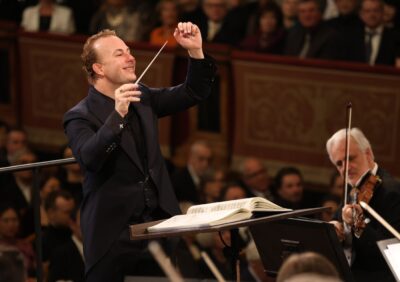
Yannick Nézet-Séguin’s path to the Vienna Philharmonic’s New Year’s Day concert started when he replaced a banned Russian conductor at New York’s Carnegie Hall in 2022 with the help of a pianist who traveled trans-Atlantic after practicing all night in a Berlin hotel bar.
Just four days before Valery Gergiev was to lead the famed Austrian orchestra on tour at Carnegie, Nézet-Séguin was walking into the hall to lead his Philadelphia Orchestra when he noticed a wall poster for Vienna’s performance.
“This looks like a Yannick program,” he remembers thinking to himself. “The rest is history indeed.”
Russia’s invasion of Ukraine in February 2022 caused the orchestra to replace Gergiev and pianist Denis Matsuev, both supporters of Russian President Vladimir Putin. For taking over on that short notice, Nézet-Séguin was rewarded with leading Thursday’s concert of waltzes, to be televised around the world to an audience of millions.
“That was kind of us saying thank you, that he helped us to save the tour,” said violinist Daniel Froschauer, the Vienna Philharmonic chairman.
Nézet-Séguin, 50, is music director of the Philadelphia Orchestra, the Metropolitan Opera and Montreal’s Orchestre Métropolitain. Three days after his performance of Beethoven’s Ninth Symphony at Carnegie, Russia invaded Ukraine.
The Vienna Philharmonic had just arrived for three concerts in New York starting on Feb. 25 followed by two in Florida. Its leadership met at the office of Carnegie artistic director Clive Gillinson, and they determined Gergiev and Matsuev would not appear as scheduled.
Gillinson called Nézet-Séguin and reached voicemail.
“I was working out virtual with my personal trainer online at home,” Nézet-Séguin said.
He called Gillinson back after the session and accepted the engagement, squeezed in before the Feb. 28 Met premiere of the original French version of Verdi’s “Don Carlos” on a weekend that already included a rehearsal of Puccini’s “Tosca.”
Nézet-Séguin agreed to keep the original programs, which started with Rachmaninoff’s Piano Concerto No. 2 and Symphony No. 2. Carnegie learned from Seong-Jin Cho’s manager that the South Korean pianist was available and willing to travel from Germany, only Cho wanted to switch to Tchaikovsky’s Piano Concerto No. 1, which he had played more recently. But the orchestra didn’t have those parts on the road and insisted on the Rachmaninoff, which Cho last played in 2019.
Late night in hotel bar
Cho’s apartment building in Berlin’s Mitte district has a rule preventing him from playing at night. Staff at Cho’s Deutsche Grammophon recording label arranged for him to play the piano at the Hotel nhow’s BPM Bar. He got there late at night after going for a coronavirus test that he needed to get on a 7 a.m. flight.
“People were still there. They were drinking and I was practicing Rach 2,” Cho said. “When I needed some rest, to relax, whenever I stopped playing, they clapped because they thought that I was performing.”
Cho sat at the piano until 4 a.m. and took a flight to Frankfurt and then to New York’s JFK International Airport, where he landed at 2 p.m. He got to the Thompson Central Park New York hotel an hour later and went to nearby Carnegie to rehearse. Nézet-Séguin, however, was at the Met conducting the “Don Carlos” final dress rehearsal. By the time the conductor reached Carnegie, there was only about 10 minutes available to work together.
“Very pale,” Nézet-Séguin recalled. “I could tell that he didn’t sleep.”
That night’s concert was a success along with the programs on Saturday and Sunday.
“It changed his life and changed our relationship,” Froschauer said.
Cho played without a score in his Vienna Philharmonic debut. When he got back to his hotel after all that stress, blood streamed from both nostrils.
After the “Don Carlos” premiere, Nézet-Séguin and Cho repeated the opening program on March 1 in Naples, Florida. Nézet-Séguin was diagnosed with the coronavirus about 10 days later and missed the March 26 “Don Carlos” televised worldwide.
“I wouldn’t blame only that part for making me catch COVID, but that certainly contributed,” Nézet-Séguin said of the congested schedule causing him to get run down. “But I don’t regret that this relationship with the Vienna Philharmonic happened this way.”
Relationship had not been close
Nézet-Séguin debuted with the Vienna Philharmonic in 2010, but they hadn’t worked together in five years until that weekend in New York. The orchestra then engaged him for its June 2023 Summer Night Concert outside Schönbrunn Palace, a California tour this past March followed by a week of concerts in Vienna and a high-profile event at Paris’ Palais Garnier.
“Yannick was very focused on North America. … In Europe he was not so well-known,” said double bass Michael Bladerer, the orchestra’s managing director. “We also knew we had a lot of older conductors, and we will need some young ones for the future.”
Nézet-Séguin’s distinguished predecessors leading the New Year’s concert include Herbert van Karajan, Carlos Kleiber, Claudio Abbado, Riccardo Muti and Daniel Barenboim.
After Muti programmed Constanze Geiger for 2025 as the first work by a woman composer at Vienna’s New Year’s concert, Nézet-Séguin selected compositions by Josefine Weinlich and Florence Price to be mixed among Strauss family pieces for 2026.
Nézet-Séguin will conduct in a bespoke Louis Vuitton suit.
“I still pinch myself,” he said. “I think every young conductor is dreaming at some point to conduct this, but this seems like something that is maybe not reachable because you can’t really apply for such a gig — pardon the expression.”
Ronald Blum, The Associated Press
-31