

Poll
Do you agree with the province’s decision to up unlimited parental access to children’s health records from 12 to at least 16 years old?
- Yes (73%, 334 Votes)
- No (27%, 125 Votes)
Total Voters: 459
 Loading ...
Sponsored
‘Heated Rivalry’ spotlighting Montreal and its renowned bagels
By Canadian Press on February 7, 2026.
MONTRÉAL — The popular TV series “Heated Rivalry” is putting the spotlight on Montreal and among those reaping the benefits is one of the city’s iconic bagel shops.
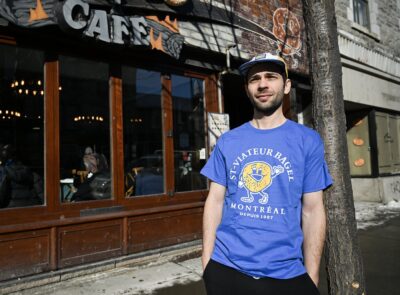
In the opening moments of the fifth episode, Rose Landry, a character played by Quebec actress Sophie Nélisse, appears wearing a T-shirt bearing the St-Viateur Bagel logo.
The scene lasts less than a minute but was a boon for the famous Montreal institution, which has been producing its famous bagels since 1957.
Online orders “exploded” in the weeks following the episode’s release on Dec. 12, according to the company’s marketing director, Benjamin Choquette.
“Merchandise sales, especially the logo T-shirt, have almost tripled,” he said in an interview. Bagel orders have also increased, to a lesser extent, he added.
Sales were mainly concentrated in Quebec and Ontario, but there was also interest in other provinces such as British Columbia and Saskatchewan. The Montreal bakery even shipped a few packages to Europe. And there was a bit of a boom in the United States, where the series has also proven very successful.
The Mont-Royal Avenue branch, where Choquette works, saw orders go from about 100 to around 200 to 300 in the two weeks after the episode aired.
Choquette noted that many customers in the store no longer limit their purchases to bagels.
“Since we display the logo on T-shirts in all our stores, they recognize it right away and tell us they saw it in the series, so they leave with one more souvenir,” Choquette said.
The enthusiasm for the promotional item took the St-Viateur Bagel team by surprise. The company knew that the production of “Heated Rivalry” would use its famous T-shirt. However, the bakery had no idea that it would benefit from such exposure.
“It’s really a scene where there’s no one else on screen except the actress with our logo. It took us a little by surprise,” Choquette said.
“Looking at online sales, that’s when we realized that even in our stores, we would also have more traffic because our online orders were coming in really fast,” he said.
Choquette said the buzz is starting to subside and there’s a return to normal merchandise sales. During an interview this week, St-Viateur management said they were hoping for a visit from Nélisse to conclude “this chapter.”
But Montreal as a whole is seeing an uptick in interest among tourists, and Tourisme Montréal notes social media buzz abound as fans express their desire to visit thanks to the immensely popular gay hockey drama.
“For now, we’re seeing a visible craze on social media, there’s a proliferation of videos of people saying they want to come to Montreal because of the series,” said Aurélie de Blois, a spokeswoman for the tourism office.
“Some are even filming themselves in Montreal and clearly stating that they are there because of the series — these are telling signs.”
Although the series was filmed in Ontario, part of the story between Shane Hollander and Ilya Rozanov, two rival hockey players who become lovers, takes place in Montreal. Portrayed by Hudson Williams and Connor Storrie, they are the respective captains of the fictional teams, the Montreal Metros and the Boston Raiders.
The series, created by Montreal director and screenwriter Jacob Tierney shows only one real image of the city. The fourth episode features a few seconds of aerial views of Parc Jean-Drapeau and the Montreal Biosphere.
Even though Montreal is not the main character, as the French capital is in “Emily in Paris,” the Canadian series on the Crave platform helps reinforce the city’s image, de Blois said.
“Heated Rivalry” depicts Montreal “as a vibrant, intense, and inclusive city,” de Blois said.
“Heated Rivalry isn’t going to fill planes to Montreal on its own, but it clearly contributes to fuelling the imagination around Montreal,” she added, noting that the series’ impact on tourism will be measured over time.
Marketing professor Marc-Antoine Vachon, holder of the Transat Chair in Tourism at the Université du Québec à Montréal, agrees.
The series manages to resonate with Montreal’s DNA. This may explain the enthusiasm for the city without having actually seen it, he said.
“We don’t need to see buildings or landscapes, it’s part of the territorial fabric, part of the story of who we are,” Vachon said.
“It’s realistic, and in tourism, that’s what we call authenticity: it’s so ingrained in Montreal’s DNA that we believe in it, and that’s what makes it an authentic story.”
As for whether Montreal’s tourism industry should try tor ride the wave of enthusiasm created by the series, Vachon suggested an “elegant” and “delicate” approach.
“We mustn’t fall into the trap of commercial exploitation. That would kill the concept of authenticity,” Vachon said, noting Montreal already has plenty to offer.
“People who want to come and see the highlights of the series shouldn’t be disappointed.”
This report by The Canadian Press was first published Feb. 7, 2026.
Frédéric Lacroix-Couture, The Canadian Press
33-32