


David Suzuki is turning 90. Environmentalists may have ‘lost, big time,’ but he still has hope
By Canadian Press on March 18, 2026.
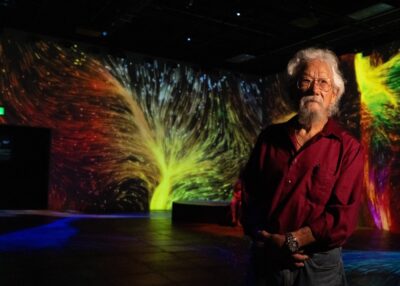
David Suzuki admits defeat — at least in some respects.
The geneticist-turned-environmentalist, who is days away from his 90th birthday, reflected on his legacy as he prepared to release his latest book, “Lessons from a Lifetime,” which compiles photos and stories from his life, as well as testimonials written by those he inspired.
“To me, the important legacy that I want to tell my grandchildren is, look, I tried. I love you. I did the best I could for you. And I tried,” he said on a video call last month.
“The measure of a person is not whether they succeeded — because we’ve lost, environmentalists have lost, big time — but that we tried.”
That failure can be quantified in two ways, he said: first, in the markers we’ve missed; the goals we’ve overshot.
The scientists warned, for example, that we couldn’t let temperatures rise 1.5 degrees above pre-industrial levels before 2100 — a threshold that passed last year.
“We won’t be able to go back and we have no idea what lies ahead,” he said.
But the failure can also be seen in how little we prioritize the environment, he said — which is tough to see, because he’s devoted his life to encouraging people to care more.
His new book, out now, borrows much of the text from “David Suzuki: The Autobiography,” published in 2006. It details his time as a geneticist studying fruit flies, how he parlayed his career as a professor into one as a science broadcaster on CBC, and the decades of environmental activism that took him all over the world.
“Lessons from a Lifetime” is, in some ways, a record of Suzuki’s legacy. In others, he said, the testimonials it contains make it feel like a premature memorial.
“With funerals, people give all these speeches about how nice the person was, but the guy’s dead,” he said, chuckling.
“I always said I’d like to have my funeral before I die. And in a way, the book is kind of like a funeral.”
In the book, his eldest daughter Tamiko Suzuki recalled how her father took her on tours of a nearby swamp as a kid; financier and Suzuki Foundation board member Stephen Bronfman said he sees the activist as a brother in the fight for Mother Earth; author Margaret Atwood called him “timeless.”
Former prime minister Justin Trudeau called Suzuki “a teacher, an inspiration, and a friend but also a critic, an antagonist, and a royal pain in the ass,” and actress-activist Jane Fonda recalled meeting him in the ’80s and “being struck by his handsome face, the lively twinkle in his eyes, and his strong body. (He was wearing shorts.)”
Though the book details Suzuki’s many victories, he said he feels governments have not taken his key message to heart.
“People forget that the word economics comes from the same word as ecology. Ecos is our household, our domain, where we live,” he said.
“Ecology is the study of our home. Economics is the management of our homes.”
Why, then, Suzuki asked, do world leaders consider short-term finances before the planet’s long-term fate?
“You would think that our economic system, our political system, our legal systems would all be based on that understanding that air, water, the soil that gives us our food, the plants that capture sunlight, the energy in sunlight, those are what keep us alive and healthy,” he said.
While he is still pushing for governments and corporations to change their priorities, the goal is no longer the prevention of climate catastrophe.
“I am saying: Look, the science is in. We’ve passed all of these tipping points and there’s nothing we can do about it,” he said. “We’re going into unknown territory, but at least we can try to minimize the effect of what’s coming.”
Part of that, he said, can be done by encouraging people to connect with one another.
Over the last several weeks, he and his wife Tara Cullis — cofounder of the David Suzuki Foundation — have embarked on a 16-date tour with their theatre production “What You Won’t Do For Love,” which sees the couple reflect on their 50-year partnership.
“Together, Tara and I showed what two people in love with each other and with the Earth can do,” Suzuki said.
Part of what he loves about the production is how it brings people together into one space, facilitating connections.
That, he said, is where individuals can make a difference when disasters strike.
“Who are the people on your block?” he said. “Are there people that can’t walk and they’re gonna need help? Do you know how to operate a chainsaw? Are you a pipe fitter that can get access to water? Does someone have a generator?”
If people forge relationships in times of relative calm, he said the crises will be much easier to manage.
To that end, the day after each performance, he held gatherings where community members who work in different fields — some in housing, others in public health, for example — could meet and talk.
“I think people will find it a joyous activity. It’s all there within the community,” he said.
This report by The Canadian Press was first published March 17, 2026.
Nicole Thompson, The Canadian Press
-34