

Poll
Have you started your Spring cleanting yet?
- No (55%, 16 Votes)
- Yes (45%, 13 Votes)
Total Voters: 29
 Loading ...
Sponsored
Movie Review: Ian McKellen and Michaela Coel are razor-sharp in art comedy ‘The Christophers’
By Canadian Press on April 8, 2026.
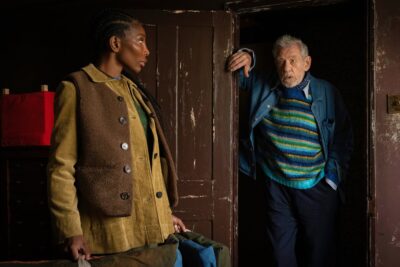
“The Christophers” looks like an art heist movie at first. A couple of wannabe heirs (James Corden and Jessica Gunning) hire a restoration specialist (Michaela Coel) to finish a series of paintings by their famous father (Ian McKellen), who wants nothing to do with them or the uncompleted works that would surely command an astronomical price tag.
The offspring, whom McKellen’s Julian Sklar vividly describes as wrecks — one a train wreck, one a shipwreck — feel they deserve an inheritance they’re smart enough to know they won’t receive through any will — or talent of their own. The specialist and sometimes forger Lori (Coel) has other motives. There’s the promise of paying rent, yes, but there’s also an element of revenge. Lori and Julian have a kind of history that the movie will reveal in time. She’s also been publicly critical of his later works.
But “The Christophers” is not an “Ocean’s” movie or a “Logan Lucky,” which is to say it’s not really a heist. There’s the tease of one, right up until the end, and the promise of the con. This latest film by the great and astonishingly prolific Steven Soderbergh is not out to give the audience what they think they want from him. Instead, it’s a meditation on art, legacy, creativity and the oh-so-touchy subject of who has the right to critique. It might sound a bit dreary, but Ed Solomon’s razor-sharp script and the brilliant pairing of McKellen and Coel make this lean two-hander breeze by.
You can read however much you want into how much Soderbergh (or Solomon) may or may not relate to Julian, who is determined to burn, bury and shred the unfinished “Christophers,” a series of paintings of a former boyfriend that became his most famous. It’s a fun and prickly exercise for any creative person to reconcile with the peaks and lulls of a long career in the arts — and Julian is luckier than most. He actually got famous and relatively wealthy from his paintings.
Julian huffs that “to judge art one must possess the skills to make said art.” It’s the kind of statement that, if given in an interview, might launch a thousand think pieces. Julian is both old and a devout rebel, with a lifetime’s worth of wisdom, wit and burned bridges in his arsenal. It’s a potent combination ripe for internet virality, but at the moment his online presence is mostly relegated to something akin to Cameo messages for 149 pounds a pop (249 if he mimes a signature).
When Lori arrives, he suddenly has an audience for his theatrical, nonstop musings: fun for McKellen, his character and the audience, but not so much for Lori, who absorbs the monologuing with steely indifference until she decides to take more control of the situation. There’s a bit of the generational disconnect that happens, but it’s somehow never cliche or predictable. The story zigs and zags with its characters as they work through the situation at hand and the larger issues both seem to be plagued by. The script throws a lot of ideas out there and, refreshingly, none of them is to be taken as dogma, especially not Julian’s comment about who has the right to judge art. Like many things he says, it’s probably just the most withering thing he could think of at the moment.
It is a funny thing, though, to critique a movie that does have so much to say about criticism, about what the person behind the keyboard might actually have the guts to say out loud to the person courageous enough to make something and put it out in the world. Perhaps it’s not actually that hard when the movie is as solid as “The Christophers,” or when the filmmaker in question is on a roll like Soderbergh with both “Presence” and “Black Bag.” His movies may have gotten smaller, but the verve remains.
“The Christophers,” a Neon release in New York and LA on Friday and nationwide on April 17, is rated R by the Motion Picture Association for “language.” Running time: 100 minutes. Three stars out of four.
Lindsey Bahr, The Associated Press
-11