


I want to ride my bicycle!
By Lethbridge Herald on December 24, 2025.
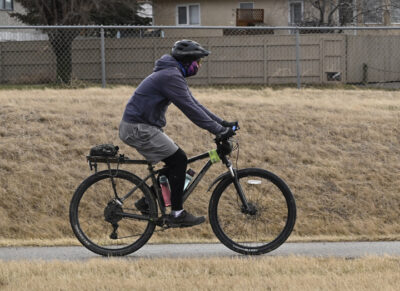 Biking in winter snow, ice, cold, short days but it requires a different mindset and preparation than fair-weather cycling; starting with Òbefore you rideÓ (preparation) and then Òhow you ride.Ó During a late fall thaw cycle, this bicyclist riding down scenic drive is wearing a balacava to shield his face, a helmet liner, thick cycling gloves and layered clothing to protect against the cold.
Joe Manio
Lethbridge Herald
Local Journalism Initiative Reporter
Cycling in snow and icy conditions demands different skills than warm-weather riding, including careful braking, visibility planning, and equipment designed for traction. Bicycling advocates say with proper infrastructure and education, winter biking can be a safe option even during colder months.
Biking in places with real winters–snow, ice, cold, short days–is totally doable; but it requires a different mindset and preparation than fair-weather cycling; starting with “before you ride” and then “how you ride.”
If bicyclists remember nothing else, three things are essential for safe winter bicycling: studded tires, layered clothing and slow upright riding.
“Start with making sure your bike is in good repair,” says Mat Hellawell, owner of BikeLane. “Sometimes it’s nice to find an older bike and put the (studded) winter tires on it, if you can afford it.”
Studded tires are the single biggest safety upgrade for bicycles, because they grip ice and not just snow. Even just one studded tire on the front is better than none, and slightly lower tire pressure should be used for better traction.
Brakes must work perfectly keeping in mind that rim brakes lose power when wet/icy. Lube the chain with wet or winter-specific lubricant; and expect faster wear-and-tear as salt plus grit destroy parts.
“I recommend adding fenders,” says Hellawell. “The stuff coming from above is nice and clean, while the stuff coming from the ground is dirty.”
Make sure the bicycle itself is visible. Front and rear lights should be fully functional and on at all times while riding. Reflectors or reflective tape should be on wheels, pedals and frame.
Other things to carry include a phone with battery protection (cold kills batteries quickly), a small multi-tool and spare gloves (cold wet gloves equal misery).
Dress for cold, not just warm, remember that layering beats bulk. Bikers should begin with a base layer of moisture-wicking fabric (not cotton), followed by a second insulating layer of fleece or wool; and finally a windproof outer layer.
Your extremities matter most, so protect your hands by using warm, windproof gloves or mitts; your feet with thermal socks with waterproof shoes or covers; and a neck gaiter or balaclava (covers face in wind). Rule of thumb…if you’re slightly cold for the first 5 minutes, you’re dressed right.
“Most bicycle helmets are built to maximize airflow. A helmet liner is essentially a customized toque that provides a lot more warmth. If a person owns other winter sport equipment it can usually also be used for winter bicycling. I use a snowboarding helmet when I ride myself,” he says.
Bicyclists should ride for the conditions and know how to ride in the conditions. When riding on snow ice, slow down.
Momentum is your enemy. Brake gently and early—mostly rear brake. Stay upright; avoid leaning in turns. Ride straight through snow…don’t fight small slides.
For steering and balance, look where you want to go, not at the ice. Keep pedaling smoothly as sudden acceleration usually results in a spin-out; and if you use clipless pedals, unclip early.
Proper route choice equals safety, so favor plowed roads, bike paths and quiet streets; while avoiding untreated intersections, shaded areas (where ice lingers) and slush ruts that can grab tires. Assume that any and all bridges or overpasses are icy.
“‘Snirt’ (or the snow-dirt slush ruts) produced by snow plows should be glided through or avoided altogether,” says Hellawell.
In a standoff between a car and a bicycle, the car always wins so it’s important to be seen as well as being predictable. Bicyclists should wear bright or reflective clothing, signal clearly and obey all traffic signs and signals.
The last word on winter bicycling safety is simple…know when to ride and when not to. Studded tires, warm layers and good lights can handle a lot—but ice storms, deep snow and poor visibility change the equation. If you have access to a car, SUV, or truck, there are days when four wheels are simply the safer choice.
21-20





Great article! It’s also surprising how many days in Lethbridge are dry and reasonably warm. More often than not I’m just fine with my regular bike and a simple coat.