


BTSA celebrates Shinran Shonin
By Lethbridge Herald on January 6, 2026.
 herald photo by JOE MANIO
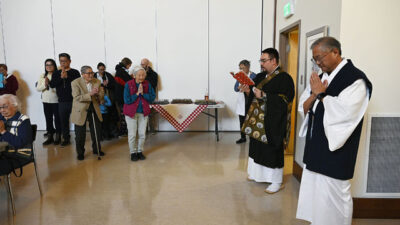
After the annual HoÕonko and New YearÕs Service at the Buddhist Temple of Southern Alberta Sunday, members of the congregation and guests put their palms together and say ÒItadakimasuÓ before the post-service celebratory meal.
herald photo by JOE MANIO
After the annual HoÕonko and New YearÕs Service at the Buddhist Temple of Southern Alberta Sunday, members of the congregation and guests put their palms together and say ÒItadakimasuÓ before the post-service celebratory meal.By Joe Manio
Lethbridge Herald Local Journalism Initiative Reporter
The bells, whistles, horns and fireworks of 2026 had barely quieted-down as the bell at the Buddhist Temple of Southern Alberta (BTSA) rang in gratitude on January 4 during the annual Ho’onko Service for Shinran Shonin the founder of Jodo Shinshu Buddhism, which is also called Shin Buddhism.
Held just three days after New Year’s Day this year, remembrance met renewal at the BTSA Ho’onko and New Year’s Service which invites followers and guests to reflect not only on Shinran’s enduring legacy but also on the vows, hopes and awakenings they carry into the year ahead.
“The New Year is a time of hope,” says BTSA Rev. Roland Ikuta. “In many cultures, the idea is that the New Year is a time to celebrate, a time for renewal and a time to look ahead. I think that’s universal.”
“I don’t think it’s an accident that we celebrate these things at this time of year, along with the life of our founder. He interpreted the Buddha’s teachings in a new way, offering a new understanding.”
While all schools of Buddhism emphasize compassion and empathy, Jodo Shinshu (Pure Land) centers on entrusting, gratitude, humility, and reliance on Amida Buddha’s wisdom and compassion–practices expressed in everyday life rather than through ascetic discipline.
Like Martin Luther during the Protestant Reformation, Shinran was a religious boat rocker who challenged the orthodoxies of his time; questioning the idea that salvation or enlightenment could be achieved through ritual, discipline or clerical authority.
His teachings shifted the focus toward trust and accessibility, opening the spiritual path to ordinary people.
Shinran established the Jodo Shinshu school around 1224 and 800 years later it remains one of the largest and most influential schools of Buddhism in Japan.
Born into an aristocratic family in Kyoto in 1173 during a period of social upheaval, Shinran became a monk at age nine and has been called a “super monk” by scholars.
“By all accounts, he was a phenomenal monk,” Ikuta says. “He was a skilled meditator, read many Buddhist teachings and sutras, and excelled at much of what he did.”
Over 20 years, however, Shinran grew disillusioned with the strict practices of traditional monastic Buddhism which he believed were inaccessible to most people.
After leaving the temple, Shinran became a disciple of Honen, whose radical teachings held that salvation came through simple faith in Amida Buddha and the recitation of the Nembutsu—the phrase “Namu Amida Butsu”—rather than through monastic discipline or ritual expertise.
Like Martin Luther’s challenge to the Catholic Church, Honen’s teachings unsettled Japan’s religious establishment, drawing opposition from elite clergy and members of the imperial court.
When Honen’s movement was suppressed by authorities, Shinran was defrocked and exiled to Echigo Province in what is now Niigata Prefecture.
During his exile and later life as a lay teacher, Shinran developed a radical message for his time: “enlightenment did not depend on rituals, moral perfection or monastic discipline, but on sincere trust in Amida Buddha’s compassion.”
Like Luther, Shinran married, raised a family and taught ordinary people…farmers, fishermen and outcasts — insisting that all were equally embraced by Amida’s vow.
The vow promises liberation for sentient beings through rebirth in Amida’s Pure Land—often understood as Nirvana—if they sincerely call his name, Namu Amida Butsu, even as few as 10 times, freeing them from suffering and the cycle of rebirth.
After eventually being pardoned, Shinran returned to Kyoto and died on Jan. 16, 1273, at the age of 90—a remarkable lifespan for the era.
His writings, particularly the Kyogyoshinsho, laid the foundation for Jodo Shinshu which continues to shape Buddhist practice in Japan and in Shin Buddhist communities around the world including in Canada.
In an increasingly polarized world marked by hardship and suffering, Ikuta sees a growing sense of need and understanding—and a renewed focus on living with compassion and gratitude.
“Gratitude is a big thing, but it’s often overlooked, underused and underappreciated,” he says.
Ikuta says hardship can be made positive or negative, depending on one’s attitude. He says suffering often arises not from the hardship itself, but from how people respond to it, and that the right approach is grounded in compassion and gratitude.
“In Buddhism, there’s a common saying that a fellow minister came up with: ‘Hardships are inevitable in life, but suffering is optional.’”
26-25