


Hess art gallery displays an Indigenous-led exploration into AI
By Lethbridge Herald on January 16, 2026.
 Herald photo by alexandra Noad
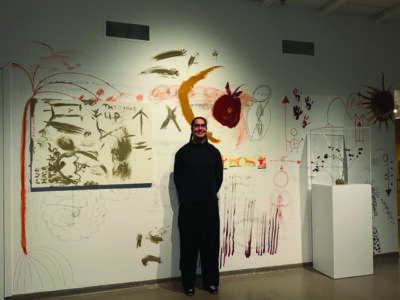
Walker English is one of nine artists part of the Niisitapi Pod, whose works can be found in the Hess Gallery exhibit Abundant Memory, Relational Intelligence which will be on display until next Friday.
Herald photo by alexandra Noad
Walker English is one of nine artists part of the Niisitapi Pod, whose works can be found in the Hess Gallery exhibit Abundant Memory, Relational Intelligence which will be on display until next Friday.By Alexandra Noad
Local Journalism Initiative Reporter-Lethbridge Herald
The University of Lethbridge’s Art Gallery’s latest exhibit feature’s the creative outcomes of nine Indigenous artists who were part of the Niitsitapi Pod-one of five research pods in the Abundant Intelligences research program.
The Abundant Intelligences Research Program is an Indigenous-led research program which conceptualizes designs, develops and deploys AI base on Indigenous Knowledge system and is led by Amethyst First Rider and Leroy Little Bear.
One of the feature artists of the Abundant Memory, Relational Intelligence exhibit, Walker English, says throughout his time as an artist in residence in the Niisitapi Pod, they spent time at various sites significant to the Blackfoot people including the Buffalo drum, Majorville Medicine Wheel and Writing on Stone (Aisinai’pi.)
It was at Writing on Stone where English got most of the inspiration for his work because while the petroglyphs and pictograms may appear to be simple, there is deep meaning behind them.
“You could spend the entire day learning about the stories behind all of the symbols and drawings at Writing on Stone, so that’s where I got the majority of my inspiration.”
English’s exhibit also features a canvas with an experimental painting representing the displacement of Blackfoot people, which was inspired by the documentary “Skoden” about a homeless Blackfoot man.
There is also a sculpture inspired by a beaver bundle ceremony which English used sticks and mud from the Old Man River ,along with little balls of his hair he saved, which he explains represents processing grief.
“It’s about grieving and it’s about those processes of going through grief. The hair on it is from my own head and in Blackfoot culture whenever you lose someone close to you, you cut your hair.”
For English the exhibit as a whole is a way for people to not only understand more about Blackfoot ways of knowing but also get a glimpse as to what people go through on a daily basis.
English explains that AI can be used to revitalize Indigenous ways of knowing, but it should be used wisely and with caution especially when dealing with sacred Indigenous teachings.
“Even though it has a lot of positives, it also has a lot of negatives and it’s very important to approach AI hesitantly when it comes to our traditional knowledge and sacred knowledge and ceremonies.”
He hopes those who take in his exhibit leave with new knowledge or experience along with a sense of enjoyment, curiosity and interest
“I would like them to walk out of this gallery knowing something they didn’t know before coming in here or just having an experience they haven’t had before.”
English hopes to be able to do his master’s in fine arts (MFA) at the Banff Centre for Arts and in the meantime will continue creating art.
Abundant Memory Relational Intelligence will be on display until next Friday at the Hess Gallery located at the University of Lethbridge and is free to attend.
18-17