


Community connection and the call of the drum
By Lethbridge Herald on January 21, 2026.
 HERALD PHOTO BY JOE MANIO
From the heartbeat of a newborn to the rhythm of a festival drum circle, drumming has been a part of human life for millennia. In Lethbridge, community drum circles are bringing people together again, offering a space for connection, expression and shared rhythm—no musical experience required.
Across cultures and throughout history, the drum has been one of humanity’s oldest instruments, appearing independently in societies around the world. Its steady beat mirrors the human heartbeat, a connection that has given drumming universal symbolism tied to life, rhythm and shared experience.
Because rhythm is felt physically as much as it is heard, drumming has long brought people together.
Traditionally, drums have marked important life events such as births, initiations, marriages and funerals, or accompanied prayer, dance and ritual. They have also served as tools of communication, helping communities signal gatherings or convey messages over long distances.
Today drum circles are used in both community and therapeutic settings. Community drum circles are open, inclusive gatherings that require no musical experience. Participants play percussion instruments together to foster connection, reduce stress and encourage self-expression.
They are often held in schools, festivals and workplaces with a focus on participation rather than performance. Janice Harmer currently runs one out of her South Side home.
“An Integrated Community Drum Circle (ICDC) is a welcoming space where people can meet, learn basic rhythms and play together,” said Harmer, the Lethbridge facilitator.
“It is inclusive, non-judgmental and uplifting, and honours the ancient practice of drumming. It is not tied to any particular religion or cultural belief.”
Therapeutic drum circles, often led by trained facilitators like Harmer, use rhythm to support emotional and mental well-being. Sessions may include structured activities and reflection, offering participants a guided way to engage with rhythm in a supportive setting.
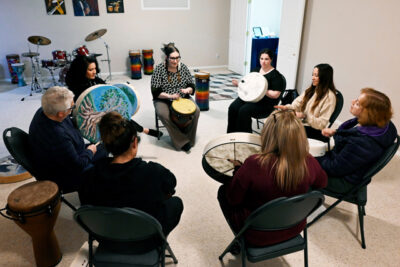
Last week Harmer hosted a drum circle attended by seven participants, most of them first-timers.
“I opened the circle with a brief introduction to what ICDC is and isn’t. I introduced the frame drums and the heartbeat rhythm…the first rhythm we are introduced to while we are developing in our mother’s womb. Playing this rhythm has been scientifically shown to reduce anxiety. After that I introduced the tubano and djembe drums, and a few basic rhythms we played together,” she says.
Harmer received her training from Julien Lepage, a Calgary-based mental-health professional and musician who leads Circles of Rhythm, an organization that uses community drum circles to promote connection and wellbeing.
“From the first beat to the last, Janice’s drum circle was a vibe,” says participant Bobbi Jo Pols. Calming yet grounding, it stirred the spirit, raised the energy and brought strangers together in the most joyful, rhythmic way. Janice is an incredible, warm and knowledgeable instructor whose passion for drumming radiates, amplifies the energy, and makes everyone feel welcomed and inspired.”
Harmer plans to continue hosting small circles on Monday and Tuesday evenings from 6:30 - 8 p.m. at her home. Space is limited. Those interested can reserve a spot by emailing rhythm.unites@outlook.com, calling or texting 403-795-0755 or following the Rhythm Unites Facebook page.
The University of Lethbridge (U of L) also hosts world-percussion programs such as Global Drums. These ensembles are open to students and community members and focus on inclusive, participatory drumming rooted in global traditions.
Whether at Harmer’s South Side home or through University of Lethbridge ensembles, drum circles in the city are giving residents a chance to connect, relax and explore rhythm together. In a world that moves fast, these circles offer a simple, timeless way to come together—one beat at a time.
HERALD PHOTO BY JOE MANIO
From the heartbeat of a newborn to the rhythm of a festival drum circle, drumming has been a part of human life for millennia. In Lethbridge, community drum circles are bringing people together again, offering a space for connection, expression and shared rhythm—no musical experience required.
Across cultures and throughout history, the drum has been one of humanity’s oldest instruments, appearing independently in societies around the world. Its steady beat mirrors the human heartbeat, a connection that has given drumming universal symbolism tied to life, rhythm and shared experience.
Because rhythm is felt physically as much as it is heard, drumming has long brought people together.
Traditionally, drums have marked important life events such as births, initiations, marriages and funerals, or accompanied prayer, dance and ritual. They have also served as tools of communication, helping communities signal gatherings or convey messages over long distances.
Today drum circles are used in both community and therapeutic settings. Community drum circles are open, inclusive gatherings that require no musical experience. Participants play percussion instruments together to foster connection, reduce stress and encourage self-expression.
They are often held in schools, festivals and workplaces with a focus on participation rather than performance. Janice Harmer currently runs one out of her South Side home.
“An Integrated Community Drum Circle (ICDC) is a welcoming space where people can meet, learn basic rhythms and play together,” said Harmer, the Lethbridge facilitator.
“It is inclusive, non-judgmental and uplifting, and honours the ancient practice of drumming. It is not tied to any particular religion or cultural belief.”
Therapeutic drum circles, often led by trained facilitators like Harmer, use rhythm to support emotional and mental well-being. Sessions may include structured activities and reflection, offering participants a guided way to engage with rhythm in a supportive setting.
Last week Harmer hosted a drum circle attended by seven participants, most of them first-timers.
“I opened the circle with a brief introduction to what ICDC is and isn’t. I introduced the frame drums and the heartbeat rhythm…the first rhythm we are introduced to while we are developing in our mother’s womb. Playing this rhythm has been scientifically shown to reduce anxiety. After that I introduced the tubano and djembe drums, and a few basic rhythms we played together,” she says.
Harmer received her training from Julien Lepage, a Calgary-based mental-health professional and musician who leads Circles of Rhythm, an organization that uses community drum circles to promote connection and wellbeing.
“From the first beat to the last, Janice’s drum circle was a vibe,” says participant Bobbi Jo Pols. Calming yet grounding, it stirred the spirit, raised the energy and brought strangers together in the most joyful, rhythmic way. Janice is an incredible, warm and knowledgeable instructor whose passion for drumming radiates, amplifies the energy, and makes everyone feel welcomed and inspired.”
Harmer plans to continue hosting small circles on Monday and Tuesday evenings from 6:30 - 8 p.m. at her home. Space is limited. Those interested can reserve a spot by emailing rhythm.unites@outlook.com, calling or texting 403-795-0755 or following the Rhythm Unites Facebook page.
The University of Lethbridge (U of L) also hosts world-percussion programs such as Global Drums. These ensembles are open to students and community members and focus on inclusive, participatory drumming rooted in global traditions.
Whether at Harmer’s South Side home or through University of Lethbridge ensembles, drum circles in the city are giving residents a chance to connect, relax and explore rhythm together. In a world that moves fast, these circles offer a simple, timeless way to come together—one beat at a time.By Joe Manio
Local Journalism Initiative Reporter- Lethbridge Herald
From the heartbeat of a newborn to the rhythm of a festival drum circle, drumming has been a part of human life for millennia. In Lethbridge, community drum circles are bringing people together again, offering a space for connection, expression and shared rhythm—no musical experience required.
Across cultures and throughout history, the drum has been one of humanity’s oldest instruments, appearing independently in societies around the world. Its steady beat mirrors the human heartbeat, a connection that has given drumming universal symbolism tied to life, rhythm and shared experience.
Because rhythm is felt physically as much as it is heard, drumming has long brought people together.
Traditionally, drums have marked important life events such as births, initiations, marriages and funerals, or accompanied prayer, dance and ritual. They have also served as tools of communication, helping communities signal gatherings or convey messages over long distances.
Today drum circles are used in both community and therapeutic settings. Community drum circles are open, inclusive gatherings that require no musical experience. Participants play percussion instruments together to foster connection, reduce stress and encourage self-expression.
They are often held in schools, festivals and workplaces with a focus on participation rather than performance. Janice Harmer currently runs one out of her South Side home.
“An Integrated Community Drum Circle (ICDC) is a welcoming space where people can meet, learn basic rhythms and play together,” said Harmer, the Lethbridge facilitator.
“It is inclusive, non-judgmental and uplifting, and honours the ancient practice of drumming. It is not tied to any particular religion or cultural belief.”
Therapeutic drum circles, often led by trained facilitators like Harmer, use rhythm to support emotional and mental well-being. Sessions may include structured activities and reflection, offering participants a guided way to engage with rhythm in a supportive setting.
Last week Harmer hosted a drum circle attended by seven participants, most of them first-timers.
“I opened the circle with a brief introduction to what ICDC is and isn’t. I introduced the frame drums and the heartbeat rhythm…the first rhythm we are introduced to while we are developing in our mother’s womb. Playing this rhythm has been scientifically shown to reduce anxiety. After that I introduced the tubano and djembe drums, and a few basic rhythms we played together,” she says.
Harmer received her training from Julien Lepage, a Calgary-based mental-health professional and musician who leads Circles of Rhythm, an organization that uses community drum circles to promote connection and wellbeing.
“From the first beat to the last, Janice’s drum circle was a vibe,” says participant Bobbi Jo Pols. Calming yet grounding, it stirred the spirit, raised the energy and brought strangers together in the most joyful, rhythmic way. Janice is an incredible, warm and knowledgeable instructor whose passion for drumming radiates, amplifies the energy, and makes everyone feel welcomed and inspired.”
Harmer plans to continue hosting small circles on Monday and Tuesday evenings from 6:30 – 8 p.m. at her home. Space is limited. Those interested can reserve a spot by emailing rhythm.unites@outlook.com, calling or texting 403-795-0755 or following the Rhythm Unites Facebook page.
The University of Lethbridge (U of L) also hosts world-percussion programs such as Global Drums. These ensembles are open to students and community members and focus on inclusive, participatory drumming rooted in global traditions.
Whether at Harmer’s South Side home or through University of Lethbridge ensembles, drum circles in the city are giving residents a chance to connect, relax and explore rhythm together. In a world that moves fast, these circles offer a simple, timeless way to come together—one beat at a time.
20-19