

Poll
Would you vote to see non ‘Alberta-approved’ immigrants lose provincial public services like education, health care and social services?
- Yes (52%, 337 Votes)
- No (48%, 309 Votes)
Total Voters: 646
 Loading ...
Sponsored
Polytech research scientist developing better ways to irrigate
By Lethbridge Herald on January 29, 2026.
 Herald Photo by Alexandra Noad
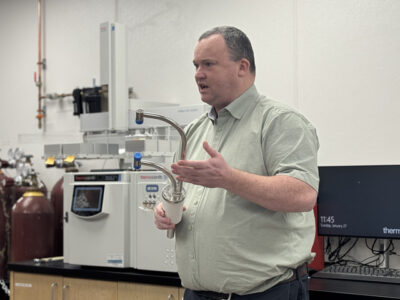
Michael Kehoe, research scientist at Lethbridge polytechnic is studying how irrigators can implement new technologies and strategies to improve irrigation management.
Herald Photo by Alexandra Noad
Michael Kehoe, research scientist at Lethbridge polytechnic is studying how irrigators can implement new technologies and strategies to improve irrigation management.By Alexandra Noad
Local Journalism Initiative Reporter -Lethbridge Herald
Agriculture is Alberta’s second largest industry and is entirely reliant on irrigation to thrive.
As water supplies becomes less predictable a research scientist at Lethbridge Polytechnic has been developing software tools to help irrigators make informed decisions and make sure every drop counts while growing their plants.
Michael Kehoe has been a research scientist with the Mueller Irrigation Research Group within the Centre for Applied Research, Innovation and Entrepreneurship (CARIE) at Lethbridge Polytechnic since 2020.
He is currently working on a three-year project which focuses on optimizing irrigation sensors to improve irrigation management.
Kehoe explains that the Polytechnic has the four main types of sensors and have been measuring the water cycles to develop forecasting tools, so farmers can better predict how much water they need to order.
“That’s one of the key things people miss is irrigators need to know ahead of time, not today, whether they’re going to need that water.”
One of the studies he worked on last summer compared subsurface drip irrigation (SDI), which are lines under the field that emit water directly to the root zone, to centre pivot irrigation, where it is sprayed from above onto the grown.
To Kehoe’s surprise, the water usage for both of these was almost identical, but there was a big difference in efficiency.
“We expected a big difference in the water usage between the two crops and what it came out as, it was almost identical, but the efficiency was far greater on the SDI, so it was really a proof of (the) concept that SDI is more efficient at using water, at least in that one season.”
While there still is more research to be done to see conclusive evidence on the efficiency of new technology such as SDI actually are, Kehoe says many irrigators are flying blind when it comes to irrigation and he hopes his work will eliminate that guess work in the future.
“Currently a lot of irrigators are sort of flying blind and they’ve got a lot of experience so they’re doing a reasonably good job, but we just think there’s a lot of potential through measurement to improve irrigation management.”
Implementing new technology and strategies in irrigation will not only help irrigators, it will benefit all of southern Alberta who relies on irrigation.
16-15





As a person who spent over 35 years in the irrigation industry (as a supplier of irrigation systems), I feel compelled to respond to some of the very misleading statements in this article.
The agricultural industry in Alberta is not “entirely reliant” on irrigation to thrive. Irrigation represents 5% of Alberta’s farmland and is and allows growers the opportunity for greater crop diversity and increased yields. But to suggest that dryland farming does not thrive is very misleading. What irrigation has done, is allowed the semi-arrid portion of Alberta to be farmed that otherwise would be very difficult to farm.
Regarding drip irrigation, I find the comments misleading and speculative. To suggest that crop water usage would be affected by the irrigation method is simply wrong. A plant doesn’t care “how” the water is delivered, it simply draws available water from the soil as it needs it.
And, to state that the efficiency “was far greater” with drip irrigation was unsubstantiated. How much more efficient? What measurement was used? Please explain how you came up with any form of a number.
It is important to note that drip irrigation has been around for decades. It is a very effective method of applying water, particularly to high value crops in very harsh environments. However, it is not a huge energy saver due to the filtration requirements and is extremely expensive on large scale farming. Furthermore, if it was cost effective and allowed growers to irrigate more land with the same water allocation it would be used by Southern Alberta farmers.
Lastly, I don’t disagree that soil moisture monitoring offers great advantages, but to suggest that the growers now are “flying blind” is completely untrue. The advancements in the technology available to irrigators has arguably improved faster than the ability to adopt it. And let’s not forget that we are blessed with the resources available through the Research Station that has been working with irrigated crops since it’s inception.
I apologize if this sounds “preachy” but I am tired of seeing articles written that have no fact based evidence to support an opinion. And I do hold the reporters accountable for not searching for evidence to support a claim. You are simply taking the easy road for a story without searching for the truth.