


New U of L exhibition digs deeper into the meaning of soil
By Lethbridge Herald on January 31, 2026.
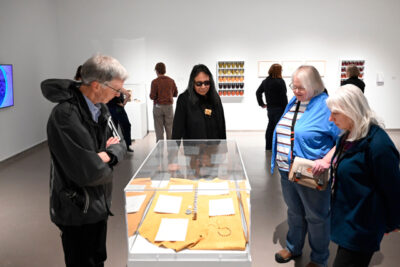 Herald photo by JOE MANIO
ApiÕsoomaahka (Running Coyote) speaks with visitors gathered around him during the opening of (Re)mediating Soils: Field Notes at the University of Lethbridge Art Gallery on Friday.
Herald photo by JOE MANIO
ApiÕsoomaahka (Running Coyote) speaks with visitors gathered around him during the opening of (Re)mediating Soils: Field Notes at the University of Lethbridge Art Gallery on Friday.By Joe Manio
Local Journalism Initiative Reporter-Lethbridge Herald
Most people don’t think much about soil unless it is clinging to their boots or smudged on their hands — something to be brushed off, swept away or worked through to get to what really matters. A new exhibition opening at the University of Lethbridge Art Gallery suggests it may be time to slow down and pay closer attention to what is underfoot.
(Re)mediating Soils: Field Notes, which opened Jan. 30, brings together artists, scientists, gardeners, farmers and Indigenous knowledge holders to explore soil not as inert dirt, but as something alive, layered and deeply connected to how people live, eat and relate to the land. The exhibition is part of a national project that will travel to galleries across Canada.
At its core, the exhibition asks why soil should matter to people who may never step into a field or dig a garden bed. Organizers frame soil as central to food security, climate resilience and cultural knowledge, arguing the global soil crisis is not only an environmental issue, but a crisis in the relationship between humans and the land that sustains them.
Developed in collaboration with the Yukon Art Centre, the Woodstock Art Gallery and the McMaster Museum of Art, (Re)mediating Soils: Field Notes is the first exhibition in a series supported by a Social Sciences and Humanities Research Council grant. Participating artists completed residencies in Alberta, Yukon and Ontario, working alongside scientists, conservation workers and community members.
Rather than offering technical solutions to soil depletion, the exhibition takes a slower approach, inviting visitors to observe, listen and reflect — mirroring the gradual processes through which soil itself is formed. Curators say this kind of attention is something art and soil share, as both reward patience and care.
“The (Re)mediating Soils project shows that art and soil have a lot in common — both are processes,” said Mills. “It really matters, especially in relation to the climate crisis.”
Mills said the artists involved focus on engaging people and reframing soil as a living system rather than something to be taken for granted.
“It’s not just dirt,” Mills said. “It’s a living process, and we have a responsibility to care for it in ways that make improvement possible and give hope.”
Scientists and policymakers have warned that soils are being depleted faster than they can regenerate, threatening food systems and ecosystems worldwide. The exhibition reframes that warning, suggesting restoring soil also means restoring relationships — between people and land, and between human and non-human life.
The University of Lethbridge installation includes works that connect global concerns to everyday experience. Artist Beany Dootjes presents jars of preserved vegetables, berries and fruit grown in her urban garden, transforming something familiar into a quiet record of care, seasonality and place.
Also featured is the work of Api’soomaahka, who shares knowledge about Blackfoot land, minerals and plants, grounding the exhibition in Indigenous relationships with the land that long predate contemporary environmental debates.
“We all share the land regardless of history, treaty and colonization,” Api’soomaahka said. “We share the land and we each have a responsibility to protect it. This exhibition shows the connection between soil and life — how integral it is.”
As visitors move through the gallery, they are encouraged to encounter soil at different scales and through different senses. The experience is designed to reveal what often goes unnoticed, making visible the layers, labour and living systems that make life possible.
Project lead Katherine Lawless said conversations with farmers revealed the complexity behind soil stewardship.
“As we were doing research with scientists, artists and farmers, we interviewed farmers who were trying to use management practices shown to retain soil health,” Lawless said. “But there are real barriers to adopting those practices, including economic pressures.”
Lawless said the research revealed the challenge is not only financial, but relational.
“When we started thinking about it at a deeper level, we realized the disconnect wasn’t just about economics,” she said.
In a region shaped by agriculture and resource extraction, (Re)mediating Soils: Field Notes connects global conversations about climate and sustainability to local realities, suggesting change often begins with attention — looking closely at what people depend on every day and reconsidering how they care for it.
The exhibition runs through Apr. 4 at the University of Lethbridge Art Gallery.
23-22