

Poll
Do longer days actually improve your mood?
- Yes (70%, 332 Votes)
- No (30%, 141 Votes)
Total Voters: 473
 Loading ...
Sponsored
South Campus vision discussion takes centre stage at SACPA
By Lethbridge Herald on February 1, 2026.
 Herald photo by JOE MANIO
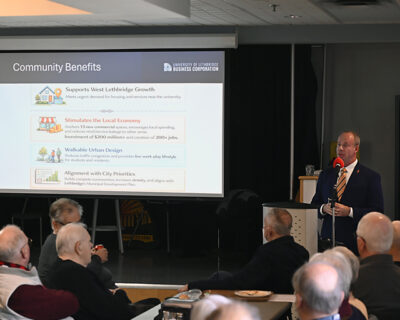
Trevor Lewington, board chair of the University of Lethbridge Property Group, presents the proposed South Campus development during a Southern Alberta Council on Public Affairs meeting.
Herald photo by JOE MANIO
Trevor Lewington, board chair of the University of Lethbridge Property Group, presents the proposed South Campus development during a Southern Alberta Council on Public Affairs meeting.By Joe Manio
Local Journalism Initiative Reporter- Lethbridge Herald
With a near-capacity audience filling the room for its regular Thursday meeting, the Southern Alberta Council on Public Affairs heard how open land west of the Oldman River could help shape Lethbridge’s future for decades to come.
The packed crowd gathered to hear Trevor Lewington present “South Campus: How can we Plan for Tomorrow, Together?”—a discussion centred on the University of Lethbridge’s proposed South Campus development and the broader question of how the city should manage growth.
Located south of the University of Lethbridge and west of the Oldman River, the South Campus lands were described as a rare, once-in-a-generation opportunity to create a new kind of neighbourhood shaped by community input and long-term planning rather than short-term pressures.
Lewington, board chair of the University of Lethbridge Property Group and director of growth and engagement for Lethbridge County, told the audience the project is intended to benefit more than the university alone, emphasizing collaboration between campus and city.
“At the end of the day, this is a 100-acre development. The South Campus is meant to be a community within a community,” said Lewington. “It’s going to provide services and access to amenities for all of the West Side.”
He said the development is intended to become a destination for people on campus while also helping address community needs such as housing and access to services, including medical clinics.
“I think it’s a very exciting opportunity that is going to have a very positive impact, not just on the campus, but also on the broader city,” Lewington said.
A key question raised during the presentation focused on what the development means for residents living outside the university, particularly those on Lethbridge’s West Side.
Lewington said the vision includes a mixed-use community designed to complement existing neighbourhoods, support economic growth and strengthen connections between the university and the city as a whole.
He noted that extensive public engagement helped shape the guiding principles behind the concept, including sustainability, flexibility and accountability, with feedback continuing to inform planning decisions.
Lewington stressed that South Campus is a long-term initiative expected to unfold over many years, allowing time to adapt plans as community needs and conditions evolve.
“This is not happening overnight,” he said. “There is a long-term progression here—about 15 years until you see the full build-out, and that will depend on sales flow and market demand.”
In the short term, Lewington said the focus remains on planning and groundwork rather than construction. Over the next year, priorities include continued consultation, technical studies, finalizing agreements and completing design and engineering work.
“This year we’re really focused on ironing out our master lease with the university and securing all provincial government approvals,” he said. “Toward the end of the year, we’ll have lease agreements in place for businesses that want to locate there, and early next spring we expect to break ground on the first two phases.”
Concerns raised by audience members included the potential impact on traffic, particularly in nearby neighbourhoods such as Riverstone. Several residents questioned how increased development could affect already busy roadways on the city’s West Side.
Lewington acknowledged traffic as a key consideration and said transportation studies and mitigation strategies would be part of the planning process before any development proceeds.
Student representatives also questioned how much student tuition would be directed toward the project and how students’ input is being incorporated into decision-making.
Lewington said, aside from initial seed funding, the project is not being financed through tuition dollars.
“Other than some initial seed money, the university is not funding this project,” he said, adding that early loans provided to establish the corporation and cover legal costs must be repaid. He said the development is intended to be self-sufficient and eventually generate net revenue for the university.
While the discussion reflected both enthusiasm and caution, Lewington said those perspectives are essential to shaping a development that delivers long-term value.
As the meeting concluded, he returned to the evening’s central theme—planning together—saying the future of South Campus will depend as much on continued community involvement as on the land itself.
25-24