

Poll
Do longer days actually improve your mood?
- Yes (70%, 332 Votes)
- No (30%, 141 Votes)
Total Voters: 473
 Loading ...
Sponsored
Studying bird brains not as dumb as it may sound
By Lethbridge Herald on February 6, 2026.
 Herald photo by JOE MANIO
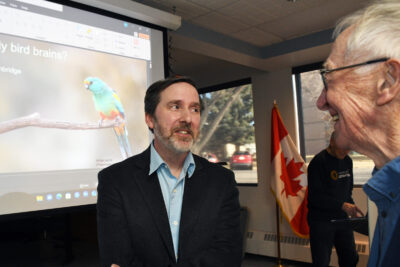
Dr. Andrew Iwaniuk, U of L neuroscientist engages with an audience member after his presentation “Why would anyone bother studying bird brains?” at SACPA’s weekly meeting Thursday.
Herald photo by JOE MANIO
Dr. Andrew Iwaniuk, U of L neuroscientist engages with an audience member after his presentation “Why would anyone bother studying bird brains?” at SACPA’s weekly meeting Thursday.By Joe Manio
Lethbridge Herald
Speaking to the Southern Alberta Council on Public Affairs (SACPA) on Thursday, University of Lethbridge (U of L) neuroscientist Dr. Andrew Iwaniuk argued that bird brains—often assumed to be small and simple—have played a crucial role in reshaping how scientists understand intelligence, behaviour, and the brain itself.
Iwaniuk’s presentation, “Why would anyone bother studying bird brains?” drew a strong turnout to the Atrium Dining Room at the Lethbridge Senior Citizens Organization (LSCO). A professor of neuroscience and research chair in comparative neuroscience at the U of L, Iwaniuk studies how and why brain anatomy varies within and across animal species.
“The biggest misconception is that all birds are stupid,” says Iwaniuk. “When we see birds engage in behaviour we don’t understand—like crashing into windows, attacking their reflection in mirrors, or building poorly constructed nests—we interpret that as stupidity. But it’s exactly what birds are supposed to be doing. It’s the rapid change in their environment that they haven’t adapted to yet.”
One of the most influential discoveries to emerge from bird research was that adult brains can grow new neurons. For much of the 20th century, scientists believed brains were fixed after early development. Research on birds helped overturn that assumption, opening new avenues for studying brain injury, aging, and neurodegenerative disease in humans.
“Many people still think brain size is a good measure of cognition,” says Iwaniuk. “We’re still trying to convince people this isn’t the case. The strongest evidence is that birds pack far more neurons into a small amount of space than many other animals.”
Bird research has also provided early evidence that hormones can influence brain anatomy and function—findings that were initially controversial but are now central to modern neuroscience.
Beyond their relevance to human health, bird brains offer insight into bird behaviour itself. Iwaniuk illustrated this with examples from his research on hummingbirds, vultures, parrots, and even the extinct dodo. His laboratory at the U of L houses one of the world’s largest collections of bird brains.
Hummingbirds show specialized brain regions linked to memory and navigation, while vultures display adaptations related to long-distance soaring and social information-sharing. Even the dodo, reconstructed through comparative anatomy, helps scientists understand how brains evolve alongside environment and behaviour.
Ironically, some of the birds most often dismissed as “birdbrains” are among the most cognitively sophisticated. Crows and parrots excel at problem-solving, memory, and social learning—abilities that rival those of much larger-brained animals.
Asked by an audience member to share one of his favourite research memories, Iwaniuk pointed to a bird that is often dismissed or derided—the humble pigeon.
“I think pigeons get a really bad rap, especially in places where people see them as pests,” he said. “But we’ve been breeding them for centuries for homing, and even today—through racing clubs here in Lethbridge and across Alberta—we still understand remarkably little about how they do it. We know they can somehow detect the Earth’s magnetic field, but how that works remains one of the biggest mysteries in biology.”
That same pattern of underestimation, Iwaniuk said, extends well beyond pigeons to other everyday birds that people rarely think of as intelligent.
“People often think ducks are simple or stupid,” he says. “They actually have remarkable brains with an extremely keen sense of touch, and we think they’re thinking more than people give them credit for.”
Raised in Edmonton, Iwaniuk studied in Canada and Australia and at the Smithsonian Institution. He has published more than 100 scientific papers and contributed to museum exhibits, National Geographic, and documentary series such as The Nature of Things.
“Don’t underestimate the smartness of birds,” he says.
SACPA’s next weekly presentation takes place next Thursday, February 12, with Don McIntyre, Professor of Indigenous Governance and Business Management speaking on “Whatever Happened to Good Old-Fashioned Manifest Destiny? Imperialism and Colonialism in Our Modernity.”
20-19