


Farming Smarter Conference puts people and innovation at forefront
By Lethbridge Herald on February 12, 2026.
 HERALD PHOTO BY JOE MANIO
Herald photo by JOE MANIO
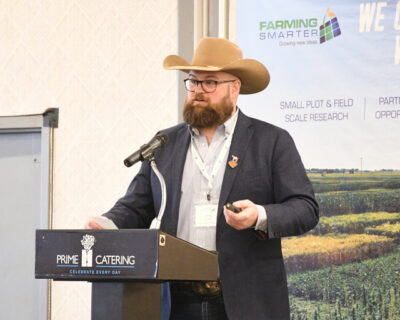
Ashley Nicholls kicks off Farming Smarter 2026, setting the tone for the conference with his keynote: ÒIf Agriculture Feeds the World, Who Feeds Agriculture?Óon Wednesday at the Sandman Signature Lethbridge Lodge.
HERALD PHOTO BY JOE MANIO
Herald photo by JOE MANIO
Ashley Nicholls kicks off Farming Smarter 2026, setting the tone for the conference with his keynote: ÒIf Agriculture Feeds the World, Who Feeds Agriculture?Óon Wednesday at the Sandman Signature Lethbridge Lodge.By Joe Manio
Lethbridge Herald
If agriculture feeds the world, who feeds agriculture?
That question framed discussions at the Farming Smarter 2026 Conference and Trade Show, where producers, agronomists and industry leaders gathered to examine what the future of farming requires — and who will help shape it.
For speaker Ashley Nicholls who gave the breakfast keynote the answer begins with people.
“The most important part of our operations in agriculture are the people that are in them,” Nicholls said. “It doesn’t always come down to equipment and technology. It’s about having the right people in the right seats — and taking care of them.”
While innovation and efficiency remain critical, he said long-term success depends on building strong teams and supporting rural communities.
“If you have a strong business, you can economically support the community you’re in,” he said. “Those two things are reciprocal. We live in rural areas, so strong communities matter.”
Nicholls also pointed to what he called the “Yellowstone effect” — the surge of interest in ranching and rural life fueled by popular television — as an unexpected opportunity for agriculture.
“It’s putting agriculture in the spotlight,” he said. “There are positive attributes in showing the work we do day-to-day.”
That visibility, along with initiatives such as Agriculture in the Classroom Canada and Alberta-based Ag for Life, could help address labour shortages by encouraging youth to see agriculture as a viable career path.
“There are fantastic programs helping young people understand where their food comes from,” Nicholls said. “They’re also showing that agriculture offers real career opportunities.”
Attracting young workers is only part of the equation. Retaining them, he said, requires investment in leadership and professional development.
“Professional development creates loyalty and longevity,” Nicholls said. “It raises the quality of our industry.”
Farming Smarter CEO Ken Coles expanded on the idea of working smarter in an increasingly complex sector.
“There are so many aspects to farming now,” Coles said. “We almost need specialized experts in different components.”
For some farms, that means dividing responsibilities such as agronomy, marketing and risk management. For others, it means consulting outside expertise.
“It’s about using the best available knowledge,” Coles said. “Breaking it into skill sets that allow you to make plans — and implement them — while managing risk.”
Research, he added, must remain grounded in producers’ real-world challenges.
“It begins with meaningful relationships with farmers,” Coles said. “It’s up to us to prioritize what areas need work most and support those challenges through research.”
As artificial intelligence and digital tools generate buzz across industries, Coles urged measured expectations in agriculture.
“The biggest opportunity with AI is how we share stories from agriculture,” he said, noting that widespread operational change will likely take time.
Youth engagement, he added, remains one of the sector’s greatest opportunities.
“Agriculture is an incredibly exciting and diverse industry,” Coles said. “Every time I’ve engaged with youth, they fall in love with it.”
From journalism and mechanics to crop science and data analytics, nearly every field intersects with agriculture in some way, he said.
Coles also emphasized the importance of maintaining agriculture’s “social license” by engaging the broader public.
“Agriculture is a public asset,” he said. “When it comes to research funding or risk management, we’re competing with priorities like health care and education. It’s up to us to ensure that public support is continual.”
The message from the conference was clear: farming has never been simple. Weather, markets and regulations remain unpredictable. But resilience comes from investing in people, grounding decisions in credible research and strengthening rural communities.
If agriculture feeds the world, it is informed, supported and adaptable people who ensure it continues to grow.
30-29





I always learn something interesting whenever I engage with Farming Smarter.