


Chinese New Year celebrates the Year of the Horse
By Lethbridge Herald on February 16, 2026.
 Herald Photo by Joe Manio
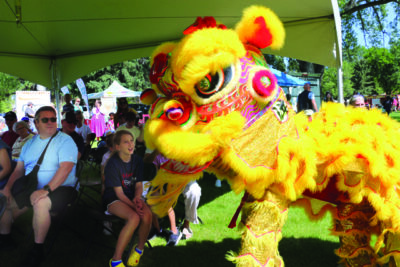
Lion dancers interact with the crow Ñ a high-energy tradition believed to chase away evil spirits and spread good fortune. They are a staple at Chinese New Year celebrations, as well as any cultural event. Lion dances are most often performed by a pair of Chinese martial artists - One controls the head (blinking eyes, opening mouth, expressive movements) while the other forms the body and tail, matching footwork precisely.
Herald Photo by Joe Manio
Lion dancers interact with the crow Ñ a high-energy tradition believed to chase away evil spirits and spread good fortune. They are a staple at Chinese New Year celebrations, as well as any cultural event. Lion dances are most often performed by a pair of Chinese martial artists - One controls the head (blinking eyes, opening mouth, expressive movements) while the other forms the body and tail, matching footwork precisely.By Joe Manio
Lethbridge Herald
On Feb. 17, 2026, doorsteps will be swept clean, red lanterns will glow against winter skies and dinner tables will fill with dumplings, fish and long noodles as families welcome the Lunar New Year. Firecrackers will pop in Chinatowns from Vancouver to Toronto. Drums will thunder. Lions will blink, bow and leap into motion.
And this year, the celebration gallops in under the banner of the Horse.
The Lunar New Year follows a calendar based on the cycles of the moon, with roots stretching back more than 3,000 years to ancient China. Traditionally, it marked the end of winter and the beginning of spring planting — a time to honour ancestors, feast with family and invite good fortune for the year ahead.
While often called Chinese New Year in the West, the holiday is observed across Asia. In China, it’s the Spring Festival. In Vietnam, families celebrate Tet. In South Korea, it’s Seollal. In Malaysia and Singapore, Lunar New Year blends Chinese customs with vibrant local traditions. Across the diaspora — including here in Canada — the celebration continues to evolve.
Each year in the 12-animal zodiac cycle carries symbolic traits. The Horse, the seventh sign, represents energy, independence, charisma and forward momentum. Those born in Horse years — including 1966, 1978, 1990, 2002 and 2014 — are said to embody determination and an adventurous spirit.
In Canada’s largest cities, parades wind through downtown streets with floats, cultural performances and the unmistakable pulse of lion dance troupes weaving through crowds. Banquets fill hotel ballrooms. Temples welcome worshippers offering incense and prayers for prosperity.
In smaller centres like Lethbridge, the celebration may be more intimate but no less meaningful. Families gather at home for reunion dinners — the most important meal of the year — featuring symbolic dishes such as whole fish for abundance, long noodles for longevity and dumplings shaped like ancient gold ingots for wealth.
If there’s one sound that signals the New Year has truly begun, it’s the crash of cymbals and the steady beat of a drum as a lion bursts into the room. Despite the common mix-up, lion dancers are not dragons. The dragon dance features a long, serpentine figure carried by a team of performers.
A lion dance involves two dancers inside a single ornate costume — one controlling the expressive head, the other forming the body and tail. During many performances, a head of lettuce or cabbage is hung high above the crowd.
In Cantonese, the word for lettuce — choy — sounds like the word for wealth. The lion “eats” the greens, then shreds and scatters them, symbolically spreading prosperity to onlookers.
Traditionally performed by martial arts practitioners, the lion is believed to chase away evil spirits and usher in good luck.
According to the 2021 census, Canadians of Chinese ethnic origin make up about 4.7 % of the national population, outnumbering those of Vietnamese and Korean origins, each at roughly 0.6 %. In Alberta, Chinese residents account for about 4 % of the population, with Korean and Southeast Asian (including Vietnamese) backgrounds each near 1 %.
In Lethbridge, roughly 1.6 % of residents reported Chinese heritage. Korean and Japanese origins appear at very small proportions, while Southeast Asian origins represent about 0.8 %. These numbers reflect the city’s steadily diversifying cultural tapestry.
Locally, celebrations begin Feb. 17 at Pure Casino Lethbridge, which will welcome the Year of the Horse with an evening buffet from 4:30 to 7:30 p.m., followed by a “Lucky Fortune Giveaway.”
Festivities continue Saturday, Feb. 21, with a joint Lunar New Year and Tennō Tanjōbi (the Emperor’s Birthday) celebration at Nikka Yuko Japanese Garden from 5 to 9 p.m., blending cultural traditions in a high-energy evening of performances and community gathering.
What began as an ancient agricultural observance has become a global celebration of fresh starts and shared tables. As the Year of the Horse gallops in, it brings with it motion, optimism and the promise of prosperity — carried on the rhythm of drums and scattered, perhaps, like shredded cabbage at our feet.
19-18