

Poll
Do longer days actually improve your mood?
- Yes (70%, 332 Votes)
- No (30%, 141 Votes)
Total Voters: 473
 Loading ...
Sponsored
Budget 2026 to have a $9.4 billion deficit, if passed
By Lethbridge Herald on February 27, 2026.
 CANADIAN PRESS PHOTO
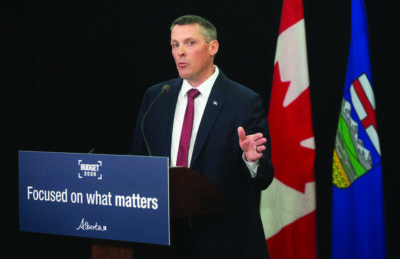
Alberta Finance Minister Nate Horner speaks about the proposed 2026 provincial budget in Edmonton on Thursday.
CANADIAN PRESS PHOTO
Alberta Finance Minister Nate Horner speaks about the proposed 2026 provincial budget in Edmonton on Thursday.By Alejandra Pulido-Guzman
Lethbridge Herald
President of Treasury Board and Minister of Finance, Nate Horner spoke to media Thursday afternoon and said Budget 2026 is focused on what matters most for Albertans, as the province prepares for a challenging year ahead.
Minister Horner said this year Alberta’s finances reflect global uncertainty, rising costs and our staggering population growth, all of which are placing real pressure on essential services, and stretching our systems capacity to their limit.
“I’ll say it upfront, Budget 2026, if passed, will have a deficit of $9.4 billion, dropping to $7.6 billion and $6.9 billion in the following years,” said Horner.
He said, “I recognize that this is a tough pill to swallow,” while chuckling, and added that this deficit reflects their commitment to providing top quality services like education, health care and social supports while managing substantial drops in the price of oil.
“We want to be clear with Albertans that we won’t sacrifice our public services to make the deficit disappear and we are raising personal income tax,” said Horner.
He said Budget 2026 is their plan to face a hard year head on and focuses on what matters, makes careful choices, and takes decisive action where it counts.
“Budget 2026 focuses on what we can control, limiting spending increases and setting clear priorities so taxpayer dollars are spent wisely,” said Horner.
He said that means investing in our healthcare system to meet the needs of a growing and aging population, as well as record support for students, teachers, and classrooms across the province.
“Budget 2026 keeps priorities clear and supports Albertans who need it most. It provides predictable funding for communities and invest in businesses to support stronger and a more diverse economy,” said Horner.
He said that because Alberta’s economy continues to face a shifting global economic landscape, they are taking a responsible conservative approach to their forecasts.
“Projections in Budget 2026 are grounded in evidence and facts, not knee-jerk reactions to current events or the ups and lows in the oil market,” said Horner.
He said Alberta’s economy is expected to grow at a slower pace in 2026. US tariffs, trade uncertainty and low oil prices will slow growth this year, just like they have in hundreds of other jurisdictions around the world.
“Even with the slowdown in growth, Alberta is still expected to outperform the rest of the country. Real GDP (Gross Domestic Product) is forecast to rise to 1.8 per cent this year, and Alberta is expected to lead the country in Real GDP growth in 2026-2027,” said Horner.
He said population growth is forecast to slow to 1.1 per cent this year and in 2027 as changes to federal immigration policy lessen the pressure of provincial services.
“While the province is not expected to add jobs at the same rate as last year, the unemployment rate is expected to decline significantly to 6.6 per cent,” said Horner.
On the energy side, Horner said oil prices are expected to remain under pressure in 2026 as global crude oil supply is expected to outpace demand.
“We’re forecasting WTI (West Texas Intermediate oil price) average $60.50 per barrel for 26/27. This is significantly lower than the $71 per barrel we were forecasting for the same year and budget 2025 and we anticipate that every $1 drop in the WTI price to carve out about $680 million of our bottom line,” said Horner.
He said they also expect highly unpredictable U.S. trade policy in 2026, but despite this oil production and exports will continue to expand right here at home.
“In 2026, Alberta’s bitumen and conventional oil production is expected to average a record 4.2 million barrels a day and we’re expecting to see more egress capacity to get our production to market,” said Horner.
He said all of these factors will be closely monitored by their teams and in the meantime, they will continue strengthening Alberta’s financial foundation so they can be ready to meet this year’s challenges and keep building towards long term success.
When talking about the revenue outlook for Budget 2026, Horner said the revenue is estimated at $74.6 billion, down over $700 million from the 2025-2026 third quarter forecast.
“On the income tax side, personal income tax revenue is expected to increase by $1.2 billion from the 2025-2026 third quarter forecast,” said Horner.
He said total expense in 2026-2027 is forecasted as $83.9 billion, an increase of $4.5 billion or 5.7 per cent from the 2025-2026 third quarter forecast.
“This includes a $2 billion contingency to cover unexpected end-year expense increases, including support to individuals and communities across Alberta during natural disasters,” said Horner.
27-26





Expenditures of over $83 billion. 40% more than the bad ol’ Notley government. These are not the fiscal conservatives of the past … but we can sleep well knowing foreign corporations will be well-cared for.
I wonder where they would borrow this money from as an independent nation? The ATB?
Get the Premier and her royal entourage to resign and the deficit would also disappear. It’s a spending on stupid initiatives problem, a not enough royalties problem, and a lack of common sense problem. Again they put the debt, onus and responsibility on the citizens.
Alberta is calling my ass. Albertans are suffering.
Now is the time for a massive letter writing campaign to the Lieutenant Governor of Albereta, Her Honour, the Honourable Salma Lakhani, AOE, BSc, LLD (hon), to strongly request that she not give royal assent to this budget, but send it back the the premier and her cabinet to be revised.
A cc to the Governor General of Canada, Her Excellency, the Right Honourable Mary Simon, C.C., C.M.M., C.O.M, C.D., is also in order.
shucks, this deficit never would be needed were it not for ndp having been in power.