

Poll
Do longer days actually improve your mood?
- Yes (70%, 332 Votes)
- No (30%, 141 Votes)
Total Voters: 473
 Loading ...
Sponsored
Alberta separation debate takes center stage at weekly SACPA forum
By Lethbridge Herald on February 28, 2026.
 Herald photo by JOE MANIO
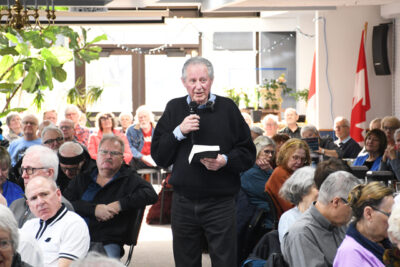
Tom Sindlinger walks and speaks among a record SACPA audience of 150 Thursday, holding his book The Russian Ballerina and the Alberta Separation Referendum: AmericaÕs First 51st State; explaining the stakes of AlbertaÕs potential separation and its broader political and economic implications.
Herald photo by JOE MANIO
Tom Sindlinger walks and speaks among a record SACPA audience of 150 Thursday, holding his book The Russian Ballerina and the Alberta Separation Referendum: AmericaÕs First 51st State; explaining the stakes of AlbertaÕs potential separation and its broader political and economic implications.By Joe Manio
Lethbridge Herald
A question that once lingered on Alberta’s political fringe is edging closer to the mainstream — and at Thursday’s Southern Alberta Council on Public Affairs (SACPA) forum, former MLA Tom Sindlinger made it clear Albertans should think carefully before answering it.
Should Alberta separate from Canada — and, for some advocates, eventually become the 51st U.S. state?
A record 150 people packed the Atrium Dining Room at the Lethbridge Senior Citizens Organization (LSCO) for the noon-hour session, peppering Sindlinger with pointed questions in a lively back-and-forth indicating this was not a fringe coffee-shop debate.
“If a referendum were held and even 30 per cent voted Yes, that’s huge in political terms,” Sindlinger said. “That’s enough to start a snowball rolling.”
That’s what worries him — not necessarily an orderly divorce from Canada, but the momentum that could follow even a narrow result.
The forum comes amid renewed debate over Alberta’s place in Confederation. Premier Danielle Smith’s government passed the Alberta Sovereignty Act in 2022, billed as a defence against federal overreach and criticized as a step toward separation.
Meanwhile, the Alberta Prosperity Project is gathering signatures aimed at triggering a referendum later this year.
Sindlinger, who served in the legislature from 1979 to 1982 and sat on the Heritage Savings Trust Fund committee, sees echoes of earlier waves of Western alienation — but believes this moment carries more force. He has also written on the subject in his book, The Russian Ballerina and the Alberta Separation Referendum: America’s First 51st State (Paperback – Nov. 18 2025).
“It’s always been there, but somehow now it has more strength. Technology changes things. What you say in a room used to disappear. Now it can circle the world in seconds,” he says.
During the Q&A, audience members pressed him on what would happen the day after a Yes vote and whether separation would be automatic.
“There are people who think if Alberta votes to leave, that’s it — you just go the next day. Forget the Constitution. Forget treaty rights. They think that’s Canada’s problem,” he says.
In reality, he argued, the legal, financial and diplomatic negotiations would be anything but simple — markets would react long before lawyers finished.
Pocketbook issues dominated the discussion. Would Albertans be better off?
“If you want to talk in those terms, you will not be better off joining the United States,” Sindlinger said.
He pointed to uncertainty around pensions, currency and health care. Contributions to the Canada Pension Plan come from workers and employers, not a provincial treasury, he noted, and shifting systems would bring upheaval.
“In the United States, tens of millions of people don’t have coverage. And many more have high deductibles. That’s very different from what we have here,” he says.
Even mortgages, he added, would likely cost more in a U.S. framework, with exposure to currency conversion and different lending structures.
On energy, Sindlinger rejected the argument that separation is necessary to unlock Alberta’s resource potential. The province already controls its oil and gas, he noted, cautioning against viewing pipelines and production solely through short-term revenue.
“The more oil we pump today, the less there is for future generations. Oil isn’t like wheat — you can’t plant it again next spring,” he says.
He also warned that escalating trade measures — such as tariffs on Canadian oil exports — could have explosive consequences given how integrated the two economies are.
Perhaps the sharpest exchange centred on unintended consequences — ripple effects voters may not consider five years down the road.
“Anywhere you go in the world, Canadians are seen as fortunate people. Why would you want to move away from that?” he says.
A narrow Yes vote, he argued, could rattle markets, push up borrowing costs and erode confidence in public institutions. Even a failed referendum might not end the movement.
Sindlinger hopes he’s wrong about the separation momentum he sees building. In the end, he suggested, voters won’t be choosing between two tidy columns of numbers.
“You’re going to have two sides arguing like hell. You won’t be able to decide which number is right or wrong. So you’ll have to vote on something beyond dollars and cents — on culture, on ties, on who we are,” he says.
Judging by the size — and engagement — of Wednesday’s audience, the conversation is already well underway.
-3





Alberta is facing a mass immigration policy that already lowered the standard of health care, education, quality of life and standard of living for born Canadians. Liberal Government has sold out Canada to gather Votes and care less that they have brought Canada down, time to leave Canada.