


Down in the Valley exhibit unveiled
By Lethbridge Herald on March 6, 2026.
 Herald Photo by Joe Manio
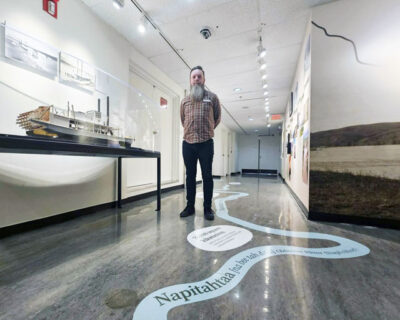
Curator Tyler Stewart stands along the winding floor decal representing the Oldman River beside a replica paddleboat inside the new ÒDown in the ValleyÓ exhibition at the Galt Museum & Archives. The exhibition explores how the river shaped communities, industry and culture in southern Alberta while introducing visitors to Blackfoot language and history.
Herald Photo by Joe Manio
Curator Tyler Stewart stands along the winding floor decal representing the Oldman River beside a replica paddleboat inside the new ÒDown in the ValleyÓ exhibition at the Galt Museum & Archives. The exhibition explores how the river shaped communities, industry and culture in southern Alberta while introducing visitors to Blackfoot language and history.By Joe Manio
Lethbridge Herald
Visitors stepping into a new exhibition at the Galt Museum & Archives may find themselves following the curves of a river across the floor.
A floor decal winds through the gallery like the Oldman River itself, guiding visitors from display to display. Along the way markers introduce words from the Blackfoot language inviting people to expand their vocabulary while tracing the long history of the waterway that has shaped life in southern Alberta.
The exhibition Down in the Valley explores the many ways people have depended on the river for millennia, from early Blackfoot communities to settlers and the modern city that grew along its banks.
The exhibition opened Thursday and runs until Aug. 9.
For curator Tyler Stewart the show is meant to remind residents of something that can easily be overlooked in daily life.
“The best thing about this exhibition is just reminding visitors that without this river, our lives here in Lethbridge would basically not exist,” Stewart says. “So this exhibition really is a celebration of the importance of this river, but also a look at the history of it and the many twists and turns in the river itself but also throughout its history.”
The displays draw heavily on the museum’s extensive archives, blending historical photographs, contemporary images and artifacts connecting past and present. Stewart says curators began with a vast collection of material before narrowing their focus to a few key themes about how the river has shaped the region.
“Archives are a wealth of information.We’ve got hundreds of thousands of images and documents and artifacts to select from for any exhibition. This one was really about narrowing things down to focus on a few key stories,” he says.
Those stories include lesser known chapters of local history.
One section explores housing that once existed in the river valley which offered shelter and resources to people for thousands of years. Another highlights the short-lived era of paddlewheel boats that once travelled between Medicine Hat and Lethbridge.
“There’s a section looking at the paddle wheelers, the boats that used to go up and down from Medicine Hat to Lethbridge which a lot of people don’t know about,” Stewart says.
The exhibition also examines how bridges helped connect communities across the valley and how the city’s early development was tied to industry.
“One of the key reasons Lethbridge was settled by European folks is because of the coal mining industry,” Stewart says, referring to the early discoveries that helped establish the city as a regional hub.
Another major chapter focuses on the construction of the Oldman River Dam near Pincher Creek, a project that stirred strong opposition when it was built.
“We look at what was a very controversial part of southern Alberta history. It was developed in spite of large opposition from the community and from a wide swath of people down here in southern Alberta.”
Throughout the exhibition, curators also highlight the deeper cultural connections between the river and the Blackfoot people, who have relied on the waterway for generations before European settlement.
Stewart says incorporating Blackfoot language was an important part of telling that story.
“One thing that’s really exciting about this exhibition is our continued focus on sharing Blackfoot language,” he says.
“So we hope when people visit they leave with a better understanding of some Blackfoot concepts but also a few more words in their vocabulary.”
Beyond the gallery walls the museum plans to expand the conversation through public programs and guided walks in the river valley over the coming months.
Stewart hopes visitors leave with a renewed appreciation for the waterway that continues to define the landscape and the communities around it.
“I hope what people take away from this exhibition is that the river and the river valley have been an important gathering place for Blackfoot people and for non Indigenous people for thousands of years,” says Stewart..
“And it’s up to all of us to think about how we can take everyday actions to preserve the quality of our water and the culture of the river valley and not take it for granted. Because without this river, we don’t live here. We don’t exist. We don’t survive without the river.”
26-25