


Straschnitzki speaks to college students about rising above challenges
By Lethbridge Herald on March 11, 2026.
 Herald Photo by Alexandra Noad
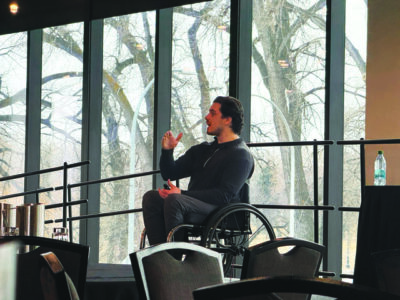
Ryan Straschnitzki, a former Humboldt Bronco, speaks at Speaker Series hosted by Lethbridge Polytechnic and Bruce McKillop at Excite Lethbridge last Wednesday.
Herald Photo by Alexandra Noad
Ryan Straschnitzki, a former Humboldt Bronco, speaks at Speaker Series hosted by Lethbridge Polytechnic and Bruce McKillop at Excite Lethbridge last Wednesday.By Alexandra Noad
Local Journalism Initiative Reporter- Lethbridge Herald
Life takes resilience, especially when it gives you unexpected curveballs like the one it gave Ryan Straschnitzki, who was one of the few survivors of the Humboldt Broncos Hockey team crash in 2018.
Despite becoming paralyzed from the chest down, he has not given up hope and strives to inspire others to chase their dreams, no matter how challenging it may appear.
Last week, Straschnitzki spoke to Lethbridge Polytechnic students and community members at Lethbridge Polytechnic’s annual Speaker Series presented by Bruce McKillop.
He says the morning of the crash was like any other game day. He got up went for breakfast with his teammates, went back to his billets to rest and then went back to the rink to pack the equipment and load up the bus.
About 30 minutes before arriving to Nipawin, Saskatchewan, Straschnitzki put in his headphones to get in the zone for the game and he describes everything as quiet, when suddenly he heard a scream from the front of the bus where he saw the driver with both hands on the wheel and saw a semi-truck coming towards them on the right, then the world went black.
When he came to, Straschnitzki says his back was against the semi track and there was debris scattered all around him and his first thought was to get up, but due to his injuries he couldn’t and he also couldn’t yell for help.
He was then life flighted to the hospital in Saskatoon where he received spinal cord surgery the following day.
Following the surgery, he got the devastating news that because of his injuries he only had a two per cent chance of ever walking again.
Straschnitzki says that during his hospital stay his thoughts were going a million miles an hour of “how am I getting out of this one,” and he decided that he would do what he has always done-make small attainable goals, with the big goal being getting back to the sport he loved most.
“Any other goal I set for myself, I know with the right mindset and worth ethic, I’m going to get there.”
Before beginning physiotherapy, he knew he had to learn how to live with his injury, from small things like putting socks on to larger tasks like learning to use a wheelchair.
He says while some days were challenging, he showed up every day to get better and stronger.
“It was challenging and I had to fight these mental barriers, but eventually because I kept showing up and working on these tasks, I got good enough. The next step for me was physiotherapy.”
He says in physiotherapy he had to start from square one which was reaching out and touching an object, which when you have no control of your core muscles is not an easy task and he quickly learned that the journey towards walking again would take more than just resilience.
“What I needed was that self-belief, choosing to believe in myself even when the results weren’t there yet.”
While he loves physiotherapy, he knew he had to get back into sports somehow, so he decided to try sledge hockey.
He describes his first day on the sled as “waking up on Christmas morning,” but it also lit a fire inside him of how far he could take it.
Straschnitzki would then spend about 5 years getting bigger, stronger and better at this new sport and would try and make the Canada Paralympic roster.
In 2023 he got the invite to the week long camp, but got cut on the final day, but he knew he still wanted to play for team Canada and wanted to be a Paralympian so he tried various different sports such as mountain biking, golf and eventually landed on basketball.
Not only did he have to learn how to play up to 40 minutes per game, he also had to learn how to play basketball, something he hadn’t played since junior high. He is hopeful to compete in the 2028 summer Olympics.
Sports in general aren’t cheap and they get even more expensive when they need adaptive equipment.
While he had his own struggles with learning two new sports and also learning to navigate his new life, it was instilled in him that he could be a good person no matter what happens to you.
With that mindset Straschnitzki started the Straz Strong Foundation, which empowers athletes with disabilities a better quality of life through adaptive sports.
He says that by removing those barriers many disabled athletes have andthey are able to reap the rewards the sport has to offer.
He concluded by encouraging the attendees that the next time they face adversity, to choose to RISE.
“Choose to be resilient, choose to constantly improve each and every day, choose to believe in yourself, even when the results may not be there yet and choose to empower those around you along the way.”
While life may not have gone the way he may have envisioned when he was 18, through choosing to RISE, Straschnitzki truly believes the saying “when one door closes, another one opens.”
30-29