


CURA, Grand Forks Concrete to build facility in Taber to decarbonize cement
By Lethbridge Herald on March 18, 2026.
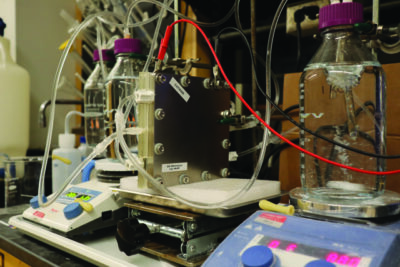 submitted photo
Electrolyzer used in the process of decarbonizing cement.
submitted photo
Electrolyzer used in the process of decarbonizing cement.By Alejandra Pulido-Guzman
Lethbridge Herald
CURA Climate Inc. a Canadian climate‑tech company developing electrochemical solutions to decarbonize cement production, announced a partnership with Grand Forks Concrete Ltd.
The partnership includes a formal agreement to jointly deploy both a pilot‑scale demonstration plant and a first‑of‑kind commercial facility to convert agricultural spent lime into low‑carbon cement and agricultural co‑products.
CEO of CURA Erin Bobicki explains that cement production accounts for eight per cent of all global carbon emissions, and it is the largest single industrial source of greenhouse gas emissions.
“Right now, there’s no scalable cost competitive solution to solve this problem. The world really needs low-carbon cement that performs exactly like the cement we use today and doesn’t cost more,” says Bobicki.
She says typically, cement is made by heating limestone, which is calcium carbonate, to very high temperatures in a kiln and this burns off Carbon Dioxide from the rocks, which results in high carbon emissions.
“What we do at CURA instead, is that we take the carbon out of the rock before it goes in a cement kiln. We use electricity to split the rock at low temperature, to produce a pure stream of CO2 that can be directly compressed for storage or use,” says Bobicki.
She says after that they isolate the calcium for cement production. The calcium they extract, then goes into a conventional cement kiln to make ordinary Portland cement or general use cement.
“The product is the same as conventional cement used everywhere. And that’s intentional because by making regular cement low carbon, we can avoid the need to certify a new kind of cement,” says Bobicki.
She says they are able to produce cement with 85 per cent less carbon emissions.
“Our company is a start-up. The technology was developed at the University of British Columbia, and we incorporated last year in 2025,” says Bobicki. “We’ve got some lab space at the University of Calgary and are working with some local businesses to build our pilot facility.”
She shares that she met David and Kevin Torrey owners of Grand Forks Concrete at an emissions reduction Alberta event in Calgary, that was all about decarbonizing the built environment.
“They are a local precast manufacturer in the Taber region, and they were looking for a low carbon cement input to make their concrete, and have been struggling to find it,” says Bobicki.
Under a Memorandum of Understanding, CURA and GFC will execute a three‑phase program feasibility assessment, pilot demonstration, and commercial deployment to demonstrate how spent lime from agricultural processing can be upgraded into low‑carbon cement and nutrient‑rich agricultural inputs.
“The partnership represents a major step toward closing material loops across construction, agriculture, and carbon management,” says Bobicki.
She explains that together with Grand Forks Concrete, they are building the first pilot and commercial facilities capable of producing low‑carbon ordinary Portland cement through electrochemistry, something that simply doesn’t exist anywhere today.
“It’s transformational for the circular economy and for the future of low‑carbon cement production,” says Bobicki.
The collaboration aims to create the world’s first commercial platform capable of producing low-carbon cement and agricultural products from legacy industrial materials.
“Cement is typically made from mined limestone. But in this case, Grand Forks Concrete identified a source of what’s called spent lime, waste from sugar processing,” says Bobicki.
She says this waste is almost identical to limestone. It contains some impurities from the sugar process, but it is mostly limestone.
“We can use this waste material to make cement from. It’s a really nice circular economy story,” says Bobicki.
CURA’s patent-pending electrochemical process upgrades spent lime waste into low-carbon cement and agricultural products by selectively extracting high-value components and removing impurities.
“As demand for low‑carbon building materials accelerates across Canada, the commercial facility will provide the first broadly applicable, low‑carbon cement solution that integrates seamlessly into existing construction supply chains,” says Bobicki.
The partnership is structured across three phases:
Phase 1 – Characterization and Feasibility: Laboratory and bench-scale testing to validate material performance, emissions reductions, and economic potential.
Phase 2 – Pilot Demonstration and Product Qualification: A cost-shared pilot facility producing low-carbon cement and agricultural co-products for real-world testing and early revenue generation.
Phase 3 – Commercial Deployment: Formation of a joint venture to design and operate a first-of-kind commercial facility converting spent lime into low-carbon construction materials and agricultural inputs at scale.
Beyond emissions reductions, the CURA–GFC partnership demonstrates how climate technology can unlock new circular-economy pathways, connecting construction materials, agricultural productivity, and carbon management into a single integrated system.
“This is about more than cleaner cement,” says Bobicki. “It’s about redesigning industrial systems, so yesterday’s waste becomes today’s feedstock supporting farmers, builders, and communities at the same time.”
31-30