


Danielle Smith becomes first Alberta premier in 90 years to face citizen recall
By Canadian Press on December 10, 2025.
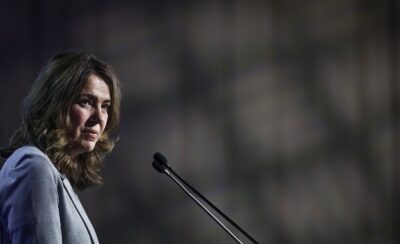
EDMONTON — Danielle Smith has become the second Alberta premier – and the first in almost 90 years – to face a citizen-led petition drive to get her removed from her seat in the legislature.
Smith and two more of her United Conservative Party caucus members saw recall campaigns officially approved and launched Wednesday by Elections Alberta.
In total, 20 in the 47-member UCP caucus are facing recall petitions. A formal signature-gathering drive has also been launched against one Opposition NDP member, Amanda Chapman.
Heather VanSnick is leading the petition drive in Smith’s southern Alberta riding of Brooks-Medicine Hat. VanSnick needs to collect just over 12,000 signatures to move the process forward.
In her application, VanSnick writes that Smith has been ignoring local constituents and experts in developing policies.
“Effective leadership requires genuine connection and consistent engagement, both absent in her tenure,” VanSnick wrote.
VanSnick also said Smith needs to go because the premier has been weakening public services in favour of privatization.
“Ms. Smith is no longer fit to serve,” VanSnick said.
Smith, in a statement to Elections Alberta in response to the petition, denied ignoring local voices.
“I regularly make myself available to meet with constituents and I routinely host town halls across my riding,” Smith said. “I’m proud to serve the people of Brooks-Medicine Hat and I use the feedback I hear from all of you to help inform all decisions, big or small, that our government makes.”
The premier was scheduled to hold a news conference later Wednesday.
Petitions were also issued Wednesday for Technology Minister Nate Glubish in Strathcona-Sherwood Park, east of Edmonton, and Environment Minister Rebecca Schulz in Calgary Shaw.
Like many other petitioners, those behind the campaigns to unseat Glubish and Schulz said the politicians have failed to address concerns and viewpoints of constituents. Glubish and Schulz both said they’re communicating while getting tangible results for constituents.
Out of Alberta’s 19 premiers, only Smith and Social Credit leader William Aberhart have faced a citizen recall. Their scenarios are similar despite being decades apart.
Aberhart’s party campaigned on and, after winning government, passed in 1936 the Legislative Assembly (Recall Act) to hold representatives accountable between elections. A year later, it was turned on Aberhart by members of his Okotoks-High River constituency, unhappy with what they called failed promises, mainly around monetary reform.
Aberhart blamed shadowy forces behind the scenes pulling strings to orchestrate his ouster. Weeks later, his government voted to repeal the act.
In 2019, the UCP under Jason Kenney ran on introducing the Recall Act once again. His government passed the law in 2021.
Earlier this year, under Smith, the UCP changed the law to make it easier for citizens to collect enough signatures to trigger a recall.
As recall petitions mounted in recent weeks against members of Smith’s caucus, the UCP and the bill’s original architect, Kenney, said it’s being misused as its intent is to address serious ethical breaches rather than resolve policy disputes.
Smith has mused about changing the act, citing concerns shadowy foreign actors or unions are behind the recall drives. The Alberta Federation of Labour has denied the allegation.
The process to get a legislature member recalled is daunting and lengthy. The petitioners have three months to collect signatures equal to 60 per cent of the total number of votes cast in the constituency in the 2023 election.
If successful, a vote would be held on whether the MLA keeps their seat. If the member loses, a byelection is held.
The fixed date for Alberta’s next general election is less than two years away, on Oct. 18, 2027.
This report by The Canadian Press was first published Dec. 10, 2025.
Jack Farrell, The Canadian Press
28-27



So lets get this straight!
“passed in 1936 the Legislative Assembly (Recall Act) to hold representatives accountable between elections.”
“A year later, it was turned on Aberhart by members of his Okotoks-High River constituency,” 1937
1937 “Aberhart blamed shadowy forces behind the scenes pulling strings to orchestrate his ouster. Weeks later, his government voted to repeal the act.“
So, it was only active for 1 year, then in 2019 Jason Kenney promised to bring it back in and “His government passed the law in 2021.”
So the act has only been in place for 5 years in total, and both times it was in place shadowy forces behind the scenes pulling strings to orchestrate the ouster.
Sound about right? The shadowy forces this time are the united NDP, special interest groups and unions: all socialists who by their actions show a complete disrespect for democracy and the taxpayer!
This will cost over $35 million of taxpayer dollars in the end, just because the NDP won’t wait until the next election 20 months away, instead, many of us will end up having to go vote AGAIN this spring! I hope this blows up in their faces and the NDP loses more seats than the last election!
The big question is, how much foreign influence is involved from the globalists and the US who historically have tried to kill the Alberta economy?
If the NDP gains power once again, all the gains we have made in the addiction crisis will be lost and once again we will see major funds pumped into enabling and encouraging drug addiction, like BC along with high fatal overdose rates. Perhaps even organized crime may be trying to influence these uprising due to the losses they will suffer as they hope to increase their presence in Alberta as they have in BC?
Trust the NDP to use an act put in place to allow the average, respectful citizen to use if their MLA was not doing their job, like NDP MLA Shannon Phillips in the end of her ‘reign’, and instead abuse it, using it to gain power, with no concerns to the costs to the public! Give me, give me, give me’s!