


Drenching rain triggers Fraser Valley state of emergency, and memories of 2021 floods
By Canadian Press on December 10, 2025.
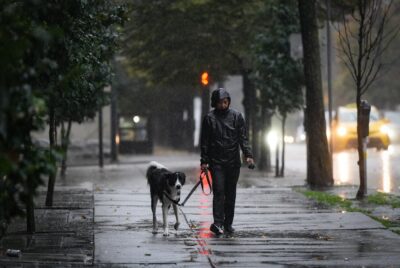
VANCOUVER — As rain pummeled the Fraser Valley on Wednesday, poultry farmer Corry Spitters and his family started to calculate their possible losses, with memories of the devastation from flooding four years ago still vivid.
An atmospheric river is washing over southern British Columbia, triggering a state of local emergency in the Fraser Valley and the evacuation of several properties, amid warnings of up to 110 millimetres of rain in the forecast.
The B.C. River Forecast Centre has warned of possible spillover from the Nooksack River in Washington state — the same scenario that unfolded in November 2021, when overflowing rivers and flooding caused billions in damage.
“We’re just going through what our liabilities are if things get any worse,” said Spitters, whose Oranya Farm lost 200,000 chickens during the catastrophic flooding in 2021.
“One of our neighbours right now has got a full crew out there harvesting Brussels sprouts, because they’ve got to salvage what they can because it’s probably going to be underwater by tomorrow.”
Spitters’ remarks reflect the unease in the Fraser Valley as the river forecast centre issued a flood warning Wednesday for the Lower Fraser and Skagit basins, spanning the entirety of the Fraser Valley and most of Metro Vancouver.
“Rivers are expected to rise through Wednesday in response to heavy rain and snowmelt, with peak levels forecasted later Wednesday, and into Thursday for larger river systems,” the warning said.
“Heavier rainfall south of the border may lead to flooding along the Nooksack River, with a potential for spilling into the Sumas River,” it said. “The highest river levels are currently expected around the Fraser Valley, including the Chilliwack River and surrounding areas.”
Evacuation orders have been issued for eight properties along the Chilliwack River, with residents told to leave immediately.
There was a risk of landslides, debris flows, mudslides and flooding due to the heavy rain, the Fraser Valley Regional District said in its emergency declaration issued Wednesday.
It said the emergency order would remain in place for 14 days unless conditions improve enough to rescind it earlier.
The deluge follows a month of above-average rainfall.
Dave Campbell, with the river forecast centre, told a news briefing that the rain was more intense in Washington state, with the potential for the Nooksack River to flood into the Fraser Valley again.
He said U.S. authorities have indicated the river would peak at 148.5 feet and it was just a few feet below that on Wednesday afternoon.
By comparison, he said the river peaked at 150.3 feet during the 2021 flood, sending a torrent of water over dikes and into the Fraser Valley, flooding farms and overrunning Highway 1, cutting off the main route to and from B.C.’s Lower Mainland.
B.C. Emergency Management Minister Kelly Greene also said “the primary risk” was water surging from the Nooksack.
“What this means is that we are in a very dynamic situation, and people and communities must prepare for potential flooding, particularly in low lying areas,” she told the briefing.
She said that while officials don’t yet know exactly what Wednesday and the days ahead would bring, the province was “preparing for all eventualities,” and there have been improvements since 2021.
Greene pointed to new monitoring stations on both sides of the border, cameras on the Canadian side, better communication and a new alert system, while upgrades to Abbotsford’s Barrowtown Pump Station, which narrowly avoided inundation in 2021, were underway.
The storms began washing over southern B.C. on Monday. Environment Canada said up to 110 millimetres of rain would fall before it pushed out.
A statement from the City of Abbotsford said it had established an emergency operations centre in response to the flood warning.
A number of roads along the U.S. border would likely be flooded if the Nooksack River overflows, it said.
The water has historically taken around seven hours to reach the city, where officials were closely monitoring key locations and dikes, with staff posted full time at the Barrowtown Pump Station, it said.
“We are preparing to close roads at low spots later today,” said the statement.
While the forecast was indicating water levels would be below those of the 2021 flood, it said officials were considering similar levels as a “possible scenario” if rainfall totals land at the higher end of the predicted range.
Environment Canada said the heaviest rainfall was forecast for the eastern Fraser Valley from Chilliwack east along the Highway 3 corridor to Princeton.
This report by The Canadian Press was first published Dec. 10, 2025.
Chuck Chiang, The Canadian Press
31-30