


Year in review: A look at events in November 2025
By Canadian Press on December 15, 2025.
A look at news events in November 2025:
1 – Prime Minister Mark Carney said he told Ontario Premier Doug Ford not to run an ad campaign that’s being blamed for ending trade talks with the U.S. Speaking at the close of the APEC forum in South Korea, Carney also confirmed that he apologized to Donald Trump, as the president was offended by the ad, adding that it was not something he would have done.
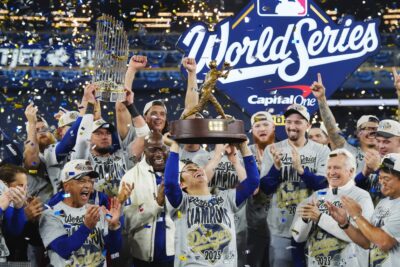
1 – The Los Angeles Dodgers became World Series champions after defeating the Toronto Blue Jays 5-4. The game went into extra innings after the Dodgers tied it up in the top of the ninth inning.
2 – Canada signed a key defence agreement with the Philippines. Philippine officials said the two countries would work together on joint readiness drills and expand security alliances to deter aggression. The two countries had been vocal critics of China’s increasingly coercive actions in the disputed South China Sea.
2 – Cleanup got underway after 17 cars of a Canadian Pacific Kansas City train derailed near Kamloops, B.C., spilling fuel and gypsum. Officials said fuel leaked from two cars and containment booms were deployed to prevent further spread. No injuries were reported, and authorities said there was no immediate risk to the Savona Community Water System.
3 – People magazine crowned “Wicked” and “Bridgerton” star Jonathan Bailey “Sexiest Man Alive” for 2025. The British actor called the honour completely absurd, but said he was proud to represent confidence and kindness. Bailey had also recently starred in “Jurassic World Rebirth.” He followed last year’s pick of John Krasinski, joining a list of incredibly sexy men, including Patrick Dempsey, Paul Rudd and Chris Evans.
3 – Dick Cheney, one of the most powerful and polarizing vice-presidents in American history, died of complications of pneumonia and cardiac and vascular disease at the age of 84. The hard-charging conservative had been a leading advocate for the invasion of Iraq, and led the armed forces as defence chief during the Persian Gulf War under president George H.W. Bush, before returning to public life as vice-president under his son, George W. Bush. He alleged links between the Sept. 11, 2001, attacks against the United States and prewar Iraq that didn’t exist, and he said U.S. troops would be welcomed as liberators, but they were not. In recent years, he became a stout defender of his daughter, Liz Cheney, when she became the leading Republican critic and examiner of Donald Trump’s actions surrounding the 2021 insurrection on the U.S. Capitol.
4 – Prime Minister Mark Carney’s first federal budget took a big swing at making Canada a more attractive place to invest. The 406-page budget included almost $90 billion in net new spending items over five years. Those included billions of dollars for infrastructure as well as new tax opportunities for businesses. The budget projected a deficit of $78 billion for that fiscal year, more than double the prior year’s estimates. Finance Minister Francois-Philippe Champagne defended the shortfall by saying the government needed to meet the current generational shift in the economy. Ottawa also cut foreign aid by nearly $3 billion over four years, despite a campaign promise not to. The Carney government said it was refocusing Canada’s aid toward countries most in need, while critics called it a retreat from Canada’s global role. Funding to a world-renowned aid research centre was also reduced. Aid groups warned the cuts would hit programs fighting hunger, disease and climate disasters.
4 – Zohran Mamdani was elected mayor of New York City, capping the young Democrat’s ascent from obscure lawmaker to one of the most talked-about politicians in the U.S. Mamdani defeated former governor Andrew Cuomo and Republican candidate Curtis Sliwa. He became New York’s first Muslim mayor, the first of South Asian heritage, the first born in Africa and its youngest mayor in more than a century.
5 – The U.S. government shutdown became the longest in history as the impasse between Republicans and Democrats continued into its 36th day, breaking the record set during Donald Trump’s first term as president. Mounting pressure came from thousands of federal workers dealing with missed paycheques, and all kinds of Americans faced delays and cancellations at airports as air traffic controllers working without pay called in sick more frequently. McGill University lecturer in aviation management John Gradek said Canadian travellers might not be able to avoid the effects of the U.S. government shutdown. He said the North American air travel system was integrated and U.S. airport delays for Canada-bound planes could cause additional delays here too.
5 – The man who ran the Fairmont Jasper Park Lodge was saluted for saving the iconic hotel from the prior year’s devastating wildfire. General manager Garrett Turta was named hotelier of the year by Historic Hotels Worldwide. The organization said the award went to the person making the highest contribution to leadership in the industry and was considered its most prestigious prize. He said his jaw dropped when he got the call informing him of the award, and said it meant a lot after all his team had been through.
6 – The NDP helped the minority Liberal government stay alive through the first of a series of confidence votes on the budget. NDP interim leader Don Davies said his caucus would vote with the Liberals in the first of three confidence tests of the federal budget. Government House leader Steven MacKinnon’s office said the votes were considered matters of confidence because both opposition amendments called on MPs to reject the budget. If the government had lost either vote or the vote on the budget itself, it could have triggered a snap election.
6 – After years of calling for Ottawa to cut the number of non-permanent residents in the province, Quebec said the federal government had gone too far. Quebec Immigration Minister Jean-Francois Roberge said the federal government’s efforts to cut the number of temporary foreign workers had left many businesses in a tough spot. Premier Francois Legault had said non-permanent residents strained housing, health care, education and the French language. But in recent months, Quebec business owners and industry groups warned that the new temporary foreign worker limits could have catastrophic consequences.
7 – A Conservative MP announced his resignation, just days after another caucus member crossed the floor to join the Liberals. In a letter released publicly, Edmonton Riverbend’s Matt Jeneroux explained that it was not an easy decision, but the right one for him. Tory leader Pierre Poilievre later said that Jeneroux planned to step down as a member of Parliament the following spring. On Tuesday, Nova Scotia MP Chris d’Entremont left the Conservative caucus and joined the Liberals.
7 – Gunshots echoed across a British Columbia ostrich farm Thursday evening, where the Canadian Food Inspection Agency moved ahead with a cull of hundreds of the birds. The dramatic scene unfolded more than 10 months after the owners of Universal Ostrich Farms near Edgewood, B.C., pressed their case against the killings all the way to the Supreme Court of Canada. Earlier in the day, however, the court decided against hearing an appeal of the cull order, which was triggered by an outbreak of avian flu the prior year.
8 – The day marked Indigenous Veteran’s Day, spotlighting the more than 4,000 Indigenous people who served in uniform during the First World War and over 3,000 First Nations people who served in the Second World War. B.C. historian Scott Sheffield disputed the Canadian government’s numbers, saying it had never recorded a person’s ethnicity or race. He believed as many as 4,300 Indigenous soldiers served in the Second World War. The government acknowledged unfair treatment of Indigenous soldiers, noting many thought their sacrifice would “improve rights and standing in Canada.”
8 – Prince Harry was in Toronto during the week, attending events supporting veterans and the military community ahead of Remembrance Day. During the trip, he apologized to Canadians for wearing an L.A. Dodgers cap at a World Series game against the Toronto Blue Jays. Harry apologized and humorously referred to the “blue-hatted elephant in the room,” explaining he had worn the hat under duress because he had been given the seats to Game 4 by the Dodgers owner. He donned a Blue Jays cap during an interview about the incident.
9 – The Vancouver Fraser Port Authority said plans to dredge Burrard Inlet were still in early stages, with final scope and costs yet to be determined. Spokesperson Sarah Matak said the authority was consulting with governments, industry, communities and First Nations before moving forward. Preliminary plans called for deepening the navigation channel under the Second Narrows bridge to allow Aframax-class tankers to load more fully at the Trans Mountain Westridge terminal. Field studies began in May, and dredging could have started the following year, though environmentalists warned the project could worsen Canada’s reliance on large fossil fuel infrastructure.
9 – The Rockefeller Center Christmas tree arrived in Manhattan, marking the start of New York’s holiday season. The year’s donated tree was a 75-foot Norway spruce from upstate. Workers used cranes to position the nearly 10,000-kilogram tree at 30 Rockefeller Plaza. The spruce would be decorated with over 50,000 LED lights and lit on Dec. 3.
10 – Toronto cleaned up after its earliest snowfall in more than five decades. Environment Canada said a total of 9.8 centimetres of snow was reported at Pearson International Airport. In addition to being unusually early, it was the most snow that had fallen on a Nov. 9 at that site, ever. The snow led to tricky driving conditions, with Ontario Provincial Police reporting hundreds of collisions on Toronto-area roads.
10 – Canadian-born author David Szalay won the Booker Prize for his novel “Flesh.” It tells the story of an emotionally detached Hungarian man who climbed England’s socioeconomic ladder after serving in Iraq. Jurors for the prestigious U.K. award praised the novel’s economical use of language that propelled the protagonist’s story forward. It was the first time a Canadian had taken home the award since 2019, when Margaret Atwood was named one of two winners for her sequel to “The Handmaid’s Tale.” Szalay was selected from 153 entries by a jury that praised his ability to reveal character with restraint and precision. He was born in Montreal and raised in England, and was previously shortlisted in 2016 for “All That Man Is.”
11 – Eighty years after the end of the deadliest conflict in history, the number of living Second World War veterans dwindled to a few thousand. The Department of Veterans Affairs estimated that as of this year, there were fewer than 3,700 surviving Canadian veterans from the war. More than 45,000 Canadian service members lost their lives and nearly 55,000 others were injured fighting Nazi Germany and shaping the global order to come. More than one million Canadians took part in the fight against Adolf Hitler’s Nazi Germany. The year also marked 25 years since the entombment of Canada’s Unknown Soldier, a tribute to a fallen First World War soldier who remained unidentified. In a rare occurrence, Governor General Mary Simon did not preside over that day’s ceremonies in the nation’s capital. Rideau Hall said Simon was in hospital recovering from a respiratory virus. Standing in for her at the cenotaph in Ottawa was Chief Justice Richard Wagner. That year’s National Silver Cross Mother, Nancy Payne—whose son was killed in Afghanistan in 2006—laid a wreath on behalf of all Canadian mothers who lost their children due to military service.
11 – Oscar-nominated actress Sally Kirkland died at a hospice in Southern California at age 84. The one-time model became a regular on stage, film and TV. She was best known for her part in “The Sting,” but her biggest role was in the 1987 film “Anna,” where she played a fading Czech movie star remaking her life in the United States.
12 – A Calgary-born soccer referee received another dose of industry recognition. Forty-five-year-old Drew Fischer was voted by his peers and the media as Major League Soccer’s referee of the year for the second season in a row. Fischer had refereed 220 career MLS games and a host of Olympic and FIFA Club and World Cup matches. He began refereeing as a young teenager and soon realized he had a knack and a passion for it. He said reffing was part art, part science — understanding the rules while drawing on creative conflict resolution skills on the field.
12 – A massive ensemble of bagpipers claimed a new world record in Australia. “The Great Melbourne Bagpipe Bash” took place in Melbourne’s Federation Square, featuring 374 bagpipers playing AC/DC’s “It’s a Long Way to the Top.” The same spot on Swanston Street had been the scene of the Australian rock band’s 1976 film clip in which they played the hit on the back of a flatbed truck. The Australian Book of Records certified the achievement, breaking a previous record set by 333 pipers in Bulgaria in 2012.
13 – The list of Canada’s major projects grew to include liquefied natural gas exports, hydroelectricity transmission and critical minerals mines. Prime Minister Mark Carney announced the next batch of projects being considered for fast-track approval. He called Canadian LNG exports like B.C.’s Ksi Lisims project key to Canada realizing its full potential as a major natural-resource exporting nation. Carney said getting shovels in the ground was crucial as U.S. tariffs threatened Canada’s economic activity.
13 – B.C.’s human-rights commissioner said the province was letting stigma drive its toxic-drug response, not science. Kasari Govender said B-C was treating addiction as a “moral failing,” which she called a breach of basic rights. Govender added that the recent push toward involuntary care ignored evidence from the province’s own health experts. More than 16,000 people had died since the public-health emergency was declared in 2016.
14 – The parliamentary budget officer said Ottawa was set to run much deeper deficits than the federal Liberals had projected, raising fresh questions about the government’s new fiscal anchors. Jason Jacques said the next five years would see average shortfalls of more than $64 billion, driven mostly by higher day-to-day program spending. His report said the government had added $87 billion in new operating costs, even as the prime minister framed Budget 2025 as a shift toward long-term investments. Jacques also warned that the government’s definition of “capital spending” was so broad that it risked overstating how much money was going toward lasting assets rather than ongoing programs.
14 – The Law Society of British Columbia said some of the province’s lawyers were receiving extortion threats. B.C.’s legal profession regulator notified members that its lawyers had been targeted with threats to their physical safety, and it urged victims to contact police. The province set up a task force to investigate dozens of extortion attempts and subsequent shootings, many of them aimed at South Asian businesspeople. The Law Society did not immediately respond to a request for comment.
14 – Folk, rock and country singer Todd Snider died at the age of 59, his record label said in a statement. Snider’s family and friends had said he had been diagnosed with pneumonia at a hospital in Tennessee, and that his situation had since grown more complicated.
15 – Pope Leo returned 62 Indigenous artifacts from the Vatican Museums to Canada as a gift, initiated by the late Pope Francis, who had wanted to support their relationship with the Indigenous Peoples of Canada. The artifacts were transferred to the National Indigenous Organizations and later reunited with their originating communities. The items had been sent to the Vatican 100 years earlier for the 1925 World Missionary Exposition. They were to be sent back to Canada on Dec. 6.
15 – The Vancouver Rise rallied for a dramatic 2-1 comeback win over AFC Toronto in the history-making Northern Super League final, the first in the Canadian professional women’s soccer league. Toronto squandered many first-half chances, keeping Vancouver in the game before an announced crowd of more than 12,000 at BMO Field. AFC outshot the Rise 16-8 and went into a weather break up 1-0. A lightning warning forced the players off the field in the 38th minute, with spectators taking shelter in the concourses.
16 – Prime Minister Mark Carney paid tribute to Métis leader Louis Riel on the 140th anniversary of his execution by attending a ceremony at Riel’s grave in Winnipeg, noting that Riel had fought for the rights of the Métis amid injustice. He said Riel’s execution had divided Canada at the time, but his legacy now helped unite the nation. The Manitoba Métis Federation said Carney was believed to be the first sitting prime minister to attend the annual ceremony.
16 – The Saskatchewan Roughriders won their first Grey Cup since 2013. The Roughriders beat the Montreal Alouettes 25-17 at Princess Auto Stadium in Winnipeg to capture the CFL championship. Prime Minister Mark Carney kicked off the game by doing the customary coin toss at centre field. Canadian rockers Our Lady Peace played the pre-game show while Machine Gun Kelly performed at halftime.
17 – The UN Security Council approved a U.S. plan for Gaza, authorizing an international stabilization force to provide security in the devastated territory. The plan also envisioned a possible future path to an independent Palestinian state. The vote was a crucial next step for the fragile ceasefire and efforts to outline Gaza’s future after two years of war between Israel and Hamas.
17 – The minority Liberal government survived a crucial budget vote in the House of Commons by two votes. The fall budget passed 170-168, preventing Canadians from heading back to the polls that winter. Green Party Leader Elizabeth May joined the governing Liberals in voting for the budget. She said she decided to support the budget after Prime Minister Mark Carney committed in the House of Commons that Canada would meet its Paris climate targets.
18 – Canada and Sweden signed a strategic partnership covering defence, trade and the environment. King Carl Gustaf and Queen Silvia of Sweden signed the agreement in Ottawa as part of their state visit to Canada. The Swedish royal couple’s three-day visit included stops in Ottawa and Montreal, along with a state dinner at Rideau Hall.
18 – The Alberta government invoked the Charter’s notwithstanding clause to protect three laws affecting transgender people. It was the second time in less than a month that Premier Danielle Smith’s government applied the clause to a bill to prevent court challenges. Both LGBTQ+ advocacy groups and the Canadian Medical Association had challenged one of the laws that banned gender-affirming care for young people. The law prohibited doctors from providing treatment such as puberty blockers and hormone therapy to those under 16 for the purposes of gender reassignment.
19 – U.S. President Donald Trump signed a law forcing the U.S. Justice Department to release its files on Jeffrey Epstein within 30 days. The records included roughly 100,000 pages covering multiple federal investigations into Epstein, his longtime associate Ghislaine Maxwell and the circumstances around Epstein’s 2019 death in federal custody. Some material would be withheld, including victim identities and classified information, but the bill barred redactions for political sensitivity or embarrassment. Trump had resisted the push for months, but signed the bill while accusing Democrats of exploiting the issue.
19 – A new agreement would soon allow tens of thousands of products to move freely across Canada’s provinces and territories. The federal government planned to put the Canadian Mutual Recognition Agreement into effect the following month. The agreement allowed a product sold in one province to be sold in any other without additional rules or approvals. The deal excluded food, beverages, plants and animals, but B.C. said it wanted the next phase to include food and services. The federal government said cutting duplicate regulations could boost Canada’s GDP by nearly eight per cent.
20 – Prime Minister Mark Carney’s trip to the United Arab Emirates resulted in an investment pact with the country. Carney met with the president of the U.A.E. and also launched talks for a full trade deal. The prime minister also met with the U.A.E.’s industry minister and with local sovereign wealth funds and investment companies. The visit came one month after the two countries signed an agreement to boost collaboration on artificial intelligence and data centres.
20 – British Columbia approved fast-tracked construction of a northern power line. The legislation squeaked through with the speaker casting the deciding vote. The planned power line would service several resource projects in northwestern B.C., including mines and the Ksi Lisims LNG project, which was also being considered by Ottawa for fast-tracking.
21 – Prime Minister Mark Carney announced a $1-billion project to expand critical minerals processing in Canada, alongside a $70-billion investment from the U.A.E. The announcements were made at the conclusion of Carney’s Abu Dhabi visit, which focused on trade amid concerns about the war in Sudan. The U.A.E. investment was expected to support critical minerals, energy, ports and AI, though no timeline was provided.
21 – Canada contributed just over $1 billion over three years to the Global Fund to combat infectious diseases in low-income countries. The announcement was made in Johannesburg by Prime Minister Mark Carney’s G20 representative, Cindy Termorshuizen, ahead of his arrival at the summit. The Global Fund fought AIDS, tuberculosis and malaria, and provided treatments, medications and mosquito nets to vulnerable populations. Canada had supported the fund since 2022, with the latest pledge covering the years 2027 to 2029.
22 – Canada joined European peers in rejecting U.S. President Donald Trump’s plan for ending Russia’s invasion. Foreign Affairs Minister Anita Anand said Ukraine must be in control of how peace was forged but would not specify what was wrong with Trump’s plan. Anand said Ukraine was “top priority” in Canada’s foreign policy for ensuring a rules-based international order. The U.S. plan was widely seen as favouring Moscow, in that it called for Ukraine to hand over territory, reduce the size of its army and not join the NATO alliance, with limited security guarantees for Kyiv.
23 – Prime Minister Mark Carney said countries that signed on to a joint declaration at the G20 summit in Johannesburg represented three-quarters of the global population and two-thirds of the world’s economic output. He told reporters in South Africa that Canada believed the G20 must remain a bridge at a time when too many countries were retreating into geopolitical blocs or the battlegrounds of protectionism. The joint declaration touched on climate change and gender equality, despite an American boycott of the summit led by U.S. President Donald Trump. Carney also said he was not in a hurry to resume trade talks with Trump but would be ready for when America wished to return to the table on trade.
23 – Former Brazilian President Jair Bolsonaro told a judge that a nervous breakdown and hallucinations had led to him violating his ankle monitoring device while on house arrest. A Supreme Court Justice had ordered the 70-year-old former leader’s preemptive jailing due to him being considered a flight risk. Bolsonaro had been sentenced to 27 years in prison in September for attempting a coup to stay in the presidency after his 2022 electoral defeat. He told the judge the hallucinations he experienced were caused by a change in his medication.
24 – An Ontario First Nation sought to create a sovereign wealth fund for Indigenous groups, hoping to bypass the government and move major projects forward faster. The First Nations Sovereign Wealth Fund aimed to make it easier for First Nations to buy into major projects in their territories. Chippewas of the Thames First Nation Chief Joe Miskokomon said the fund could operate as a critical tool in bolstering the economic capacity of First Nations in Canada.
24 – The federal government announced more than $35 million in dental student training funds over three years. The announcement aimed to help 30 oral health programs at universities and colleges train future dentists and dental hygienists. Health Minister Marjorie Michel said the money would help cover competency gaps and ensure more Canadians could access dental care.
25 – A border security bill was discussed at meetings of the House of Commons immigration and national security committees. Bill C-12 faced criticism from rights groups who said no migrants impacted by the proposal had spoken to the committee after the groups failed to get on witness lists for the study. The bill included a host of immigration and asylum measures, including one that would bar individuals from filing refugee applications if they had been in Canada for more than a year. The co-executive director of the Canadian Council for Refugees said that restriction could limit individuals’ ability to claim asylum based on changing conditions in their home countries.
25 – Legendary curler and broadcaster Colleen Jones died at age 65. The world champion curler’s effervescent personality made her a popular presence on the CBC over nearly four decades with the national broadcaster. The Halifax native had been diagnosed with cancer in early 2023. Her son Luke announced she died that morning in a post on X.
26 – The Coastal First Nations in B.C. said an oil pipeline to the province’s north coast would never happen. The group slammed the federal government for negotiating with Alberta on a possible pipeline deal without involving First Nations. The federal energy minister was expected to brief B.C. Liberal MPs on the deal. It came a day before Prime Minister Mark Carney was expected to unveil details of a memorandum of understanding with the Alberta government on the pipeline project.
26 – Prime Minister Mark Carney unveiled a suite of new supports for the tariff-stricken steel and lumber sectors at an event on Parliament Hill. He told reporters that since U.S. President Donald Trump had launched his global tariff campaign, many of Canada’s “strengths had become our vulnerabilities.” Ottawa’s new Buy Canadian plan meant firms had to prioritize the use of Canadian materials in federal government defence or construction contracts worth $25 million or more. Enhanced enforcement against foreign steel dumping was included, as was a 25 per cent tariff on target imported steel products such as wind turbines, prefabricated buildings, fasteners and wires.
27 – Prime Minister Mark Carney and Alberta Premier Danielle Smith agreed to a plan to build an oil pipeline to the West Coast. The memorandum of understanding said Ottawa’s commitment was contingent on the pipeline being approved as a project of national interest. It was also dependent on providing opportunities for Indigenous co-ownership and shared economic benefits. For its part, Ottawa would enable the export of oil through a deep sea port to Asian markets and, “if necessary,” adjust the tanker ban to make that happen.
27 – York United FC rebranded to become Inter Toronto FC. It was the third name change for the Canadian Premier League side, but the first under the current ownership group. One of the CPL’s original franchises, the team had started as York 9 FC in 2019—a nod to the nine municipalities that make up the York region north of Toronto. It became York United FC in December 2020, billing the change as a move to bring in both the city of Toronto and the surrounding region.
28 – Ottawa was set to open a new national operations centre designed to co-ordinate Canada’s response to major disasters and security emergencies. Officials were given a tour of the facility’s mission-control-style room, with two massive screens that could display real-time intelligence, weather data and federal briefings. The space could house up to 80 staff during day-to-day operations, with room for another 70 during major crises—including military officers and Environment Canada specialists. Emergency Management Minister Eleanor Olszewski said the site would help federal teams work faster and more cohesively as extreme weather and cyberthreats became more frequent.
28 – Liberal MPs insisted their caucus was holding together after Steven Guilbeault resigned from cabinet over Ottawa’s pipeline agreement with Alberta. The NDP said BC Liberals appeared uneasy, warning the pact opened the door to undoing the long-promised coastal tanker ban. Guilbeault said he stepped down because several climate policies he had fought for were being softened or reversed, though he would stay on as an MP. Some of Alberta’s UCP members openly celebrated his exit, while Liberal MPs said debate was healthy.
29 – The Trump administration halted all asylum decisions and paused issuing visas for people travelling on Afghan passports, as it seized on the shooting of two National Guards in Washington to intensify efforts to rein in legal immigration. The suspect in Wednesday’s shooting that killed one service member and left another critically injured was an Afghan national who had worked with the CIA during the Afghanistan war before receiving asylum that year. U.S. President Donald Trump called the shooting a “terrorist attack,” while criticizing the Biden administration for enabling entry to the U.S. by the Afghans who had worked with American forces.
29 – Two Canadian short track speedskaters won gold at a Short Track World Tour stop in the Netherlands. Moncton’s Courtney Sarault grabbed the top spot in the women’s 1,000-metre final, while Montreal’s William Dandjinou won gold in the men’s 1,500 metres. Sherbrooke, Quebec’s Felix Roussel finished second to win silver in the men’s 1,500. Racing was set to wrap up with the men’s relay and 1,000 metres, the women’s 500 and 1,500, and the mixed relay.
30 – The Carney government said a cut to foreign aid and global health funding brought spending back in line with Canada’s pre-pandemic allocations. This came as the head of the United Nations’ HIV/AIDS program urged Prime Minister Mark Carney to reverse his government’s planned funding cuts. Winnie Byanyima was at the recent G20 leaders’ summit in South Africa to help present a report on rising global inequality. It argued economic polarization within and among countries was generating resentment, which was chipping away at political cohesion and risking instability.
The Canadian Press
64-63