


Liberals’ stricter crime policy is a response to public concern: justice minister
By Canadian Press on January 3, 2026.
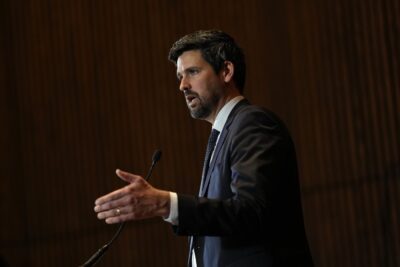
OTTAWA — Prime Minister Mark Carney’s government has so far put a heavy emphasis on stricter crime policies, tabling three justice bills in the fall sitting of Parliament.
They incorporate a long list of Criminal Code amendments, from making bail tougher to obtain to imposing mandatory minimum and consecutive sentencing to creating new offences relating to intimidation and obstruction, promoting hatred and coercive control of an intimate partner.
The tough-on-crime approach is a huge swing from the Trudeau government — not that Justice Minister Sean Fraser, who introduced the three bills, uses that phrase.
“I’ll leave it to others to characterize what’s tough or not tough, but we are increasing penalties for serious and violent criminals and making it harder for people to be released on bail if they pose a risk to public safety,” Fraser said in a year-end interview with The Canadian Press.
“I prefer, rather than to use adjectives people may agree or disagree on, to actually talk about what the bill is going to do.”
Crime policy has been a priority for the Carney government because it’s a priority for Canadians, Fraser said.
“It is that simple. People have been loud and clear. They want the federal government to change the criminal law to ensure that they are protected,” he said.
Fraser said Canadians want action on car thefts, home invasions, sexual offences, hate crimes and exploitation of children.
“We are responding to very real concerns around public safety that Canadians have raised with us,” he said.
That response first came in September’s hate crime legislation, Bill C-9. It would create new crimes of obstruction and intimidation aimed at protecting places of worship and institutions used by an identifiable group. It would also make it a criminal offence to wilfully promote hate through the use of hate symbols.
Next up was Bill C-14 in October. It would make it more difficult to get bail for a variety of crimes, including some vehicle theft, extortion and human trafficking offences. It proposes to impose a reverse onus on bail for those offences, moving the burden of proof from the prosecutor to the accused, meaning they would have to justify being granted bail.
It would also allow for consecutive sentences, so multiple sentences could not be served at the same time. The changes would apply to repeat violent offences, vehicle theft, breaking and entering, extortion and arson.
Finally, shortly before the House of Commons rose for the holidays, Fraser introduced Bill C-16.
It would treat killings driven by control, hate, sexual violence or exploitation as first-degree murder and define them as femicide when the victim is a woman. It would also create a new offence for engaging in patterns of coercive or controlling conduct against an intimate partner.
The bill would prohibit the non-consensual distribution of intimate deepfake images and threatening to distribute child sexual abuse and exploitation material.
It would also restore all mandatory minimum imprisonment penalties found unconstitutional by the courts, with a safety valve meant to guard against future court challenges. That safety valve would give judges the ability to impose a less severe sentence in circumstances where the mandatory minimum penalty would be considered cruel and unusual punishment.
Bill C-16 would also require courts to consider remedies other than a stay of proceedings as a way to reduce the number of cases being tossed out due to delays.
Critics have said that element of the bill is unconstitutional, and violates the Charter right to be tried in a reasonable time period. They have also said they expect to see a Charter challenge to the bail law, and warned the hate crime bill could criminalize peaceful protest. The bills have not yet made it through the Parliamentary process.
University of Toronto law professor Kent Roach said the legislation includes “some of the most significant changes in criminal justice that I’ve seen over my 35-year-plus career.”
Roach said it “would be helpful if the government issued some kind of policy paper about how it sees criminal justice.”
“I think the underlying philosophy behind these bills has not really been either outlined or defended by the government,” said Roach.
Canadians may agree with the approach, given their concerns about crime, Roach said.
“It may be good politics, but I’m not sure it’s good in the longer-term interest of the criminal justice system,” he said.
The Conservatives have long attacked Liberal justice policies as being too lenient, and during the spring election, the Tories pitched significant crackdowns on crime.
Fraser maintains this isn’t about “managing the political dynamic between the government and Opposition.”
“I don’t want to turn the motivation for this different approach to criminal justice into a contest between Liberals and Conservatives,” he said.
“It’s not the Conservatives I’m trying to get help with; it’s Canadians that we’re trying to deliver help to.”
What differentiates the Liberal approach from the Conservatives’, Fraser said, is that Liberals see the need to support “actors on the front line,” such as law enforcement and victim support organizations, as well as the need to invest in things like mental health and addictions, affordable and transitional housing and initiatives for at-risk youth.
But unless there are more floor crossings this year to give the Liberals a majority, the government will need the support of another party to pass the legislation.
That effort has become more complicated in the case of Bill C-9. In exchange for Bloc Québécois support, the Liberals agreed to remove a religious exemption on hate speech from the Criminal Code, something that’s drawn harsh criticism from the Conservatives.
Fraser accused opponents of spreading misinformation.
“When I see some of my parliamentary colleagues suggest that this will criminalize faith or somehow prevent a religious leader from reading the texts that are sacred to them, nothing is further from the truth,” he said.
The Liberals didn’t initially propose to remove the religious exemption, but then it became clear the amendment would be needed in order to pass the bill, Fraser said.
He said a House of Commons committee, not the government, has made the decision to vote for the amendment.
“As it stands now, I’m willing to support the removal of the religious exemption if it means we can offer the protections to (communities) that we promised them during the last federal election,” he added.
Roach said the government has put so much forward, it may be a challenge to get the bills through the committee process.
“I wouldn’t be surprised if they’re somewhat overwhelmed by the extent of these changes … They’re three very complex, very large bills.”
This report by The Canadian Press was first published Jan. 3, 2026.
— With files from Jim Bronskill and David Baxter
Anja Karadeglija, The Canadian Press
43-42