


‘Frostbite capital’: Efforts to reduce frostbite amputations underway in Edmonton
By Canadian Press on January 5, 2026.
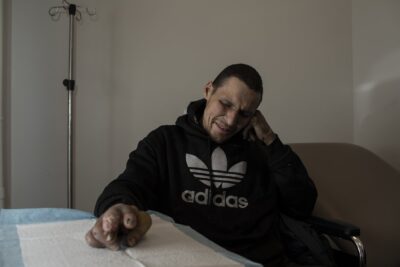
EDMONTON — Trevor Logan winces in pain as a nurse cleans the blistered middle finger on his right hand, swollen to twice its size due to frostbite.
Inside a clinic of a downtown Edmonton homeless shelter, Logan says he can’t look at his hand while the nurse moves what’s left of his index finger to make room for bandaging.
The 35-year-old from Calling Lake, Alta., who has been homeless for years, had the finger amputated last year due to frostbite.
“I try not to comprehend it as much as I can,” he says in an interview at the Hope Mission, one of the city’s largest shelters.
The nurse tells him that his hand could heal if the golf-ball-sized boil and other wounds on it are kept disinfected. She says it isn’t clear whether his left arm, which also has frostbite, can fully heal.
Logan says a doctor recommended he amputate both limbs last month after he couldn’t find warmth while roaming Edmonton’s freezing streets.
But Logan says he doesn’t want the surgeries.
“My limbs will heal over time,” he says.
Statistics from Alberta Health Services show the number of amputations due to frostbite saw a stark uptick last winter in Edmonton.
There were 81 amputation procedures related to frostbite in the Edmonton area alone in 2023. That number jumped to 120 in 2024.
Beth Klingenberg, the manager of health services at Hope Mission, says the shelter has had to hire more nurses in recent years because a majority of procedures involve Edmonton’s homeless population.
“Year over year, we’re just getting worse and worse,” she says.
“And a lot of the times it’s the same people losing new limbs as the years progress and life becomes harder. I’ve known people, unfortunately, who have lost all of their limbs directly to frostbite.”
The AHS numbers don’t include the cases of people who have had their fingers and toes fall off on their own due to frostbite, she adds.
She says a lot of patients are young.
“I remember we had one client who was quite young, and didn’t understand the full gravity of the loss of his fingers,” Klingenberg says.
“While watching him trying to find a way to eat his food and having to relearn everything that he’s known how to do, he broke down as a wave of grief hit him.”
The Canadian Frostbite Care Network calls Edmonton Canada’s frostbite capital due to the increase in cases as well as amputations.
“Edmonton is reporting higher numbers of frostbite cases in general than we are aware of anywhere else in the country,” said Caitlin Champion, a surgeon at Ontario’s West Parry Sound Health Centre, and a founding member of the network.
“Such a significant jump in amputations is something to take notice of and ask ourselves what we can do better from both a prevention and an acute treatment standpoint.”
It’s unclear why Edmonton has seen such a dramatic spike, but Klingenberg, Champion and an Edmonton physician say it’s an emerging problem and likely the devastating outcome of increasingly complex crises unfolding in the city and across the country.
Dr. Louis Francescutti, an ER physician at the Royal Alexandra Hospital, says his colleagues have been seeing frostbite patients every hour in recent years when temperatures drop below freezing.
“Some patients are coming in needing a new amputation year over year,” he says.
“That’s because they leave our hospital and are back on the streets because they don’t have a home. You can imagine the moral distress health-care workers face seeing this. We need more homes.”
Francescutti says another factor Edmonton could be frostbite capital because it’s the most populated northern Canadian city.
Klingenberg says drug addiction could also be behind the spike.
“Those cases have been really distressing, more people just losing sense of reality.”
Other times, amputations have become unavoidable because people don’t want to go to a hospital to wait long hours in emergency rooms.
Champion agrees that lack of affordable housing could also be behind the increase in frostbite cases.
“Data in Ontario also shows there were a higher proportion of severe frostbite patients in folks who are unhoused,” she said.
But, Champion adds, Alberta has also improved in recent years in collecting frostbite data.
The office of Alberta Social Services Minister Jason Nixon says the spike is due to increased awareness and early intervention in frostbite and cold exposure and that the province is taking action.
“Through Budget 2025, Alberta’s government is investing an unprecedented $220 million into combating homelessness, supporting record numbers of shelter spaces across the province,” Nixon’s press secretary Amber Edgerton said in a statement.
The government has also recently created a frostbite guide to help front-line workers assess and refer vulnerable people who may be at risk.
The guide is being shared with front-line support workers, as well as staff at city recreation centres and libraries.
But Chris Gallaway, executive director of Friends of Medicare, a coalition of doctors and community groups, says more attention, and public awareness, is needed.
“Our government should be treating this as the public health crisis that it is and acting urgently on solutions,” Gallaway said.
Champion says increased outreach efforts that inform unhoused people how to prevent and identify frostbite is a good start to reduce the numbers.
She says vulnerable members of society need to know to go to a hospital within 48 hours to receive an injection of a blood-clot-busting agent that can widen blood vessels and revive dying tissue.
Small changes, she said, can bring critical improvements.
“Amputations are a devastating, life-altering consequence.”
This report by The Canadian Press was first published Jan. 5, 2026.
Fakiha Baig, The Canadian Press
-45