


Michael Kovrig says Carney must defend values while seeking trade in China visit
By Canadian Press on January 9, 2026.
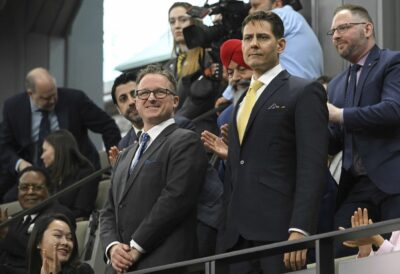
OTTAWA — Canada needs to be clear-eyed about the risk of economic coercion as Prime Minister Mark Carney looks to rebuild ties with China after years of political and economic tensions, Michael Kovrig said this week.
Kovrig, a former Canadian diplomat in China and now a senior adviser on Asia for the International Crisis Group, was one of two Canadians Beijing detained for nearly three years.
As Carney prepares to make the first visit to China by a Canadian prime minister in nearly a decade, Kovrig said Carney needs to hold the line on Canada’s interests and values as he pushes for stronger economic ties.
“It’s ultimately about keeping hold of your values and your integrity, and having a strategic approach that prioritizes your holistic national interests, rather than just looking at relations deal by deal and agreement by agreement,” Kovrig said in an interview.
Kovrig said Canada should be prudent about when and how it speaks out on China — but if it stays quiet about egregious acts in exchange for economic benefits, it will allow Beijing to “condition it into silence.”
“That’s a very delicate diplomatic dance to manage,” he said.
In 2019, China detained Kovrig and Michael Spavor for more than 1,000 days in retaliation for the arrest of Chinese tech executive Meng Wanzhou at the Vancouver airport on a U.S. extradition warrant.
Kovrig said that while Carney’s visit to China could expand trade and investment in fields like energy and agricultural exports, it comes with risks. Canola and seafood sectors are suffering from Chinese tariffs — something Kovrig said is part of China’s pattern of exploiting foreign access to its markets.
“It’s not like China has changed its behaviour one iota since the Michaels-Meng crisis,” Kovrig said. “It’s just that Canada’s leaders and diplomats are trying to find new ways of managing that challenge.”
He said Carney’s goal should be to leave Beijing with a better mutual understanding of where Canada and China can co-operate. It would help, he said, if President Xi Jinping sent a message internally that he wants his government to remove obstacles in relations with Canada.
“Success could be measured as clearer communication, fewer surprises, and mechanisms to manage disputes before they escalate,” Kovrig said.
“What Mark Carney is trying to do now is rebuild personal relations, leader-to-leader, and relations between his ministers and everyone on down, so that at least if we have disagreements in future, the hope is that the Chinese will seek diplomatic channels to address them.”
Kovrig said he will be watching for any changes in Ottawa’s public statements about China. That could include a shift in the government’s language on its Indo-Pacific strategy, released in 2022, that called Beijing a “disruptive global power” whose values increasingly differ from those of Canada.
In October, Foreign Affairs Minister Anita Anand said she told her department to update the strategy, saying it no longer reflects evolving relations with both China and India.
Kovrig summarized the existing strategy as seeking “deeper relationships with more trustworthy countries and like-minded partners that are not likely to try to weaponize trade, or do other things to coerce Canada.” He said that’s the right approach.
“There may be some rhetorical downplaying” of the strategy without changing Canada’s policy of walling off collaboration with China in strategic sectors and critical minerals, Kovrig said.
Kovrig said Canada should be “judicious” in raising issues like human rights and trade coercion. He said every government needs to find a balance between ignoring irritants and “egregiously provoking” China with little real benefit.
“They may tone down what might be called megaphone diplomacy. So, being less strident in making speeches or statements that call out bad Chinese behaviour … while continuing to make those points through quiet, discreet diplomacy,” he said.
That might involve pushing for better treatment of detained Canadians and more consular access, particularly for those China has held for years — like Huseyin Celil, a Canadian and Uyghur human rights activist originally from China who has been imprisoned there since 2006.
It could also mean raising issues publicly alongside partner countries, such as joint statements on the prosecution of Hong Kong publisher Jimmy Lai, or G7 condemnations of China sending Russia goods that have been used in its ongoing war on Ukraine.
Kovrig also said the Liberals sometimes need to find ways to impose costs on China when “egregious issues” challenge Canada’s interests.
For example, he said, China’s military buildup around Taiwan risks harming Canada’s economy, which relies on shipping lanes around Taiwan and the self-governing island’s production of semiconductors — even if Beijing dismisses this as interference in domestic matters.
Kovrig said Canada should also condemn China’s ongoing economic retaliation against Japan, triggered by Prime Minister Sanae Takaichi saying that a Chinese military attack on Taiwan could invoke Japan’s military self-defence.
Kovrig said Carney could leave China with a series of “process agreements,” such as working groups on investment barriers, or preliminary memorandums pledging to talk more on key issues. That might mean accelerating work on China’s approval process for Canadian meat imports.
“I would measure success by seeing if, afterwards, does China’s trade retaliation ease, do dialogue channels expand (and) does China moderate its tone and coercive behaviour, or just repackage it.”
He said he expects more “political signalling rather than actual concrete obligations” from the meeting.
Beijing has suggested since 2024 that Canada needs “correct cognition” about China and should accept that Ottawa is behind the decline in relations. Kovrig said that amounts to bullying.
“A lot of interstate behaviour is kind of like kindergarten and playground tactics. You know, twisting the other kid’s arm behind his back and making him say uncle,” he said.
Kovrig said the Chinese Communist Party governs through force, using rules and laws as political tools and ignoring them when they’re inconvenient. He said that’s why he ended up detained.
“If the Chinese government had just followed normal diplomatic protocols, there wouldn’t have been hostage-taking,” he said. “There wouldn’t necessarily have been trade sanctions blocking billions of dollars of Canadian canola. There would not have been this complete cutoff of relations.”
Kovrig said he is at peace with Carney visiting the leader of a government that detained him for more than 1,000 days, saying it’s important to advance Canadian interests.
“One of the realities of geopolitics is that people fight and die in wars and tragedy happens to individuals. But over time, countries have to work out a way to coexist on this planet,” he said.
This report by The Canadian Press was first published Jan. 9, 2025.
Dylan Robertson, The Canadian Press
-36