


Sydney, N.S., selected as the preferred base for new Arctic icebreakers
By Canadian Press on January 13, 2026.
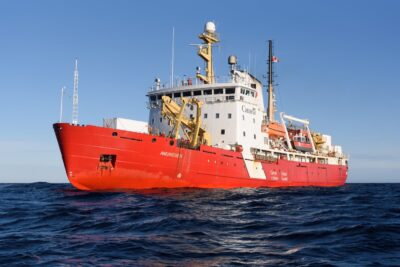
SYDNEY — Federal officials say Sydney, N.S., has the inside track on becoming the base for the Canadian Coast Guard’s upcoming polar icebreakers as the country continues the push to assert its sovereignty in the Arctic.
The government announced Tuesday that the Cape Breton port is the preferred location as the maintenance base for the two new vessels. Ottawa cited the deep, ice-free harbour, proximity to Sydney’s Canadian Coast Guard Academy and the fact the port has one of the shortest routes to the Arctic from Eastern Canada. It’s also near Halifax, headquarters of the Royal Canadian Navy’s Atlantic fleet.
Mike Kelloway, the local member of Parliament and parliamentary secretary to the minister of transport, said Sydney has access to specialized marine trades, year-round transportation links and a harbour that isn’t congested. “There’s the ability to build and build often in terms of warehouses and infrastructure that’s going to be needed,” Kelloway said in an interview Tuesday.
“My hope is that not only will we be home to two polar ice vessels — massive vessels — but this also becomes an opportunity for Sydney to become an ancillary port for other vessels that may not be able to be serviced in places like Halifax, which make no mistake about it, is the hub for the navy.”
If that happens, Kelloway says it would be the first time Sydney has any major military presence in its harbour since the Second World War.
Kelloway says land adjacent to the current Port of Sydney, belonging to the Membertou First Nation, is being considered for the base. The government says due diligence, planning, consultations with Indigenous groups and talks with local landowners are all needed before the project moves ahead.
The coast guard operates 18 icebreakers of various size, an icebreaking fleet the government says is the second largest in the world. As part of its fleet renewal program, the coast guard is buying two new polar icebreakers, which will be the largest in the fleet, to help bolster Canada’s Arctic presence. Able to operate in higher latitudes for longer than existing Canadian icebreakers, they’re expected to be “plug and play” so emerging technology and science equipment can easily be installed.
Seaspan’s Vancouver Shipyards are currently building the future CCGS Imnaryuaq with a budget of $3.15 billion. It’s expected in 2032. Quebec’s Davie shipyard is in charge of the future CCGS Arpatuug, expected in 2030 with a $3.25-billion budget. Construction of the hull is underway at the Davie-owned Helsinki Shipyard in Finland.
The new icebreakers are coming as the federal government pours more money and resources into developing the Arctic, where warming temperatures are creating opportunities for resource extraction and shipping. One of Prime Minister Mark Carney’s first announcements after taking office in March was $6.7 billion for Arctic military and infrastructure upgrades as the country puts a greater emphasis on protecting its sovereignty in the region. Several countries, including the U.S., claim the thawing Northwest Passage is an international waterway; Canada views it as internal waters. Flying the flag with coast guard vessels is one way to bolster Canada’s argument.
“Canada has beyond a deep commitment to the Arctic,” said Kelloway. “It’s Canadian waters. It’s a Canadian opportunity … Prime Minister Carney has talked about security and the economy, and economy and security being one, and I think this is evidence of it.”
In September, Ottawa folded the coast guard and its 126 vessels into the Department of National Defence, though the coast guard remains a civilian special operating agency and not an official part of the military. It has kept its roles in search and rescue, icebreaking, navigation and ocean science but the government has a bill before Parliament that would see it expand its mandates into maritime security. That could allow the government to include at least part of the coast guard budget in its NATO pledge to spend two per cent of GDP on defence.
In the Arctic, the coast guard is headquartered in Yellowknife, N.W.T., with an Arctic marine response station at Rankin Inlet, Nvt. Marine communications and traffic services are based out of Iqaluit, Nvt.
The coast guard is also acquiring two new Arctic and offshore patrol ships designed to support Arctic icebreaking in the summer and on the East Coast in the winter. Featuring large cranes, helicopter decks, medical and search and rescue facilities, the 103-metre long vessels can carry up to 57 personnel. Delivery of the first ship is scheduled for later this year. Halifax’s Irving Shipbuilding is building the future CCGS Donjek Glacier and CCGS Sermilik Glacier, with a project price of $2.1-billion.
This report by The Canadian Press was first published Jan. 13, 2026.
Devin Stevens, The Canadian Press
-17