


François Legault’s CAQ ended PQ/Liberal duopoly with back-to-back majorities
By Canadian Press on January 14, 2026.
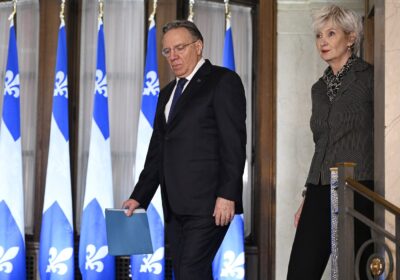
MONTREAL — From founding a successful airline to creating a political party that won back-to-back majority mandates, François Legault is stepping down as Quebec premier with a reputation as a builder and as someone who has had a profound influence on Quebec society.
Legault became a minister before he was even elected. It was Lucien Bouchard, premier between 1996-2001, who recruited the accountant and co-founder of Air Transat and appointed him minister of trade, science and technology in 1998. That was two months before Legault was elected for the first time as member of the legislature for the Rousseau riding, northeast of Montreal, in that year’s general election.
He went on to hold the two most important positions in cabinet — minister of education and then minister of health — in the successive governments of Bouchard and Bernard Landry, before joining the opposition in 2003. Legault stayed on the opposition side of the legislature for five years before he resigned.
In early 2011, he and businessman Charles Sirois published a manifesto entitled “Coalition pour l’avenir du Québec” — Coalition for Quebec’s future — that called for a political movement unburdened by the federalist-sovereigntist debate that its authors said had dragged the province down for generations. Later that year, both men founded the Coalition Avenir Québec as a middle ground between the two fighting sides — it would be federalist but nationalist, championing a strong autonomous Quebec within the Canadian federation.
Under the new CAQ banner, Legault was first elected in the riding of L’Assomption in 2012, with the Parti Québécois forming a minority government under Pauline Marois. The CAQ succeeded in electing 19 members.
The PQ was defeated two years later by Philippe Couillard’s Liberals, and the 2014 election saw 22 CAQ members take their seats in the national assembly.
In 2018, the CAQ succeeded in defeating the PQ/Liberal Party political duopoly for the first time since the 1960s, taking power with 74 seats out of 125, but with only 37 per cent of the popular vote.
Following the party’s handling of the COVID-19 pandemic, the CAQ won 90 seats and 41 per cent of the popular vote in the 2022 election, bringing Legault to the height of his popularity.
However, he and his party quickly fell out of favour with the francophone majority, following controversies including the CAQ’s reversal on a promise to build a third vehicle link across the St. Lawrence River in Quebec City, before flip-flopping again to champion the project when the party started slipping in the polls.
On Wednesday, before Legault announced his plans to resign, poll aggregator Qc125 noted the CAQ’s popular support was so low that it was poised to win only a handful of seats in a general election and possibly be wiped off Quebec’s political map.
The next provincial election is scheduled for Oct. 5.
This report by The Canadian Press was published Jan. 14, 2026.
Pierre Saint-Arnaud, The Canadian Press
16-15